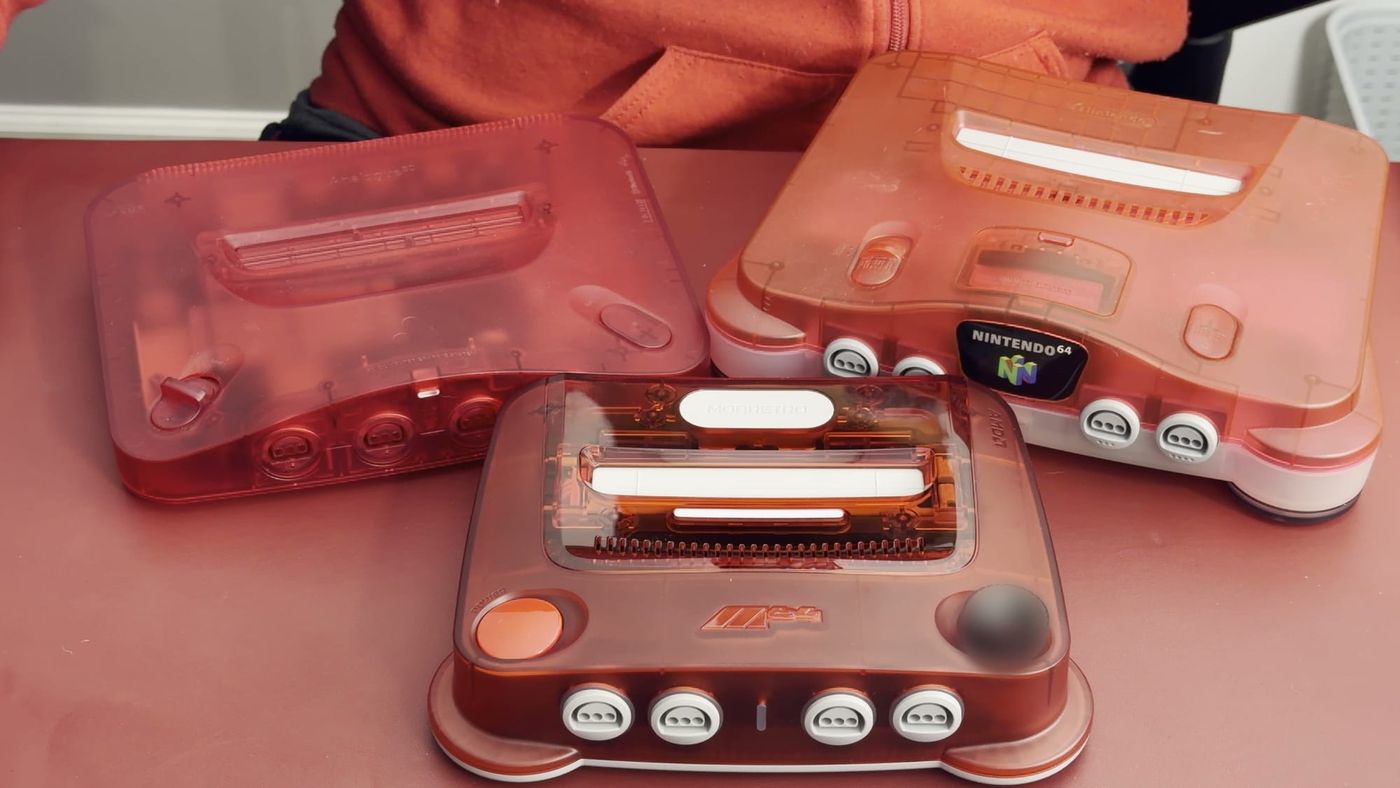
I own two Analogue 3Ds and a ModRetro M64. The black Analogue was a $249.99 preorder, the translucent red one is a Funtastic limited edition that sold for $299.99, and the M64 is transparent red too. Both consoles play original Nintendo 64 cartridges on a modern TV, both cost between $230 and $270, and both have changed a lot through firmware updates since launch. This comparison covers price, picture, compatibility, features, controllers and build, and ends with the one I would tell a friend to buy.
I lean toward the Analogue 3D only because it came out first and I got used to setting it up. That habit says nothing about which one is better. Most of what follows comes from Analogue’s and ModRetro’s own pages, with my own experience where I have it.
| Analogue 3D | ModRetro M64 | |
|---|---|---|
| Price | $269.99 ($299.99 limited editions) | $229.99 |
| In the box | Console, 16 GB SD card, HDMI cable, USB cable, 30 W power supply | Console, 16 GB microSD card, multi-region power adapter, power cable |
| Controller | Not included; 8BitDo 64 is $39.99 | Not included; M64 Pro is $89.99 |
| Video output | HDMI, 1080p or 4K | HDMI, 720p to 4K |
| CRT-style display modes | BVM, PVM, CRT, Scanlines, Clean; need a 4K TV | Scanline and CRT filters with a custom mode |
| Analog output for CRTs | None | AV adapter, $89.99 preorder |
| Save states | Yes, up to 20 per game | Not yet (on the roadmap) |
| Firmware updates | SD card (Wi-Fi “coming soon”) | Wi-Fi, USB or SD card |
| Cooling | User-cleanable dust filter | Fanless |
| Weight on my scale | 1 lb 14 oz | 1 lb 10 oz |
Price and what is in the box
The Analogue 3D opened for preorder at $249.99 in October 2024 and began shipping in November 2025. Analogue raised it to $269.99 for its November 24, 2025 restock, citing US tariffs it had been absorbing, according to Time Extension. Black and white are $269.99 on Analogue’s store today, and limited-edition colours cost $299.99. Several of those editions have sold out.
The M64 is $229.99 on ModRetro’s store, in clear, purple, green and red. ModRetro had promised $199 to early adopters on its waitlist, and I paid $199 for mine as a preorder. The M64 box includes the console, a 16 GB microSD card and a multi-region power adapter, with no HDMI cable. The Analogue 3D includes an HDMI cable, a USB cable and a 30 W power supply alongside its 16 GB card.
Neither console includes a controller, which changes the real comparison. Analogue pairs its console with the 8BitDo 64 at $39.99, and ModRetro sells its M64 Pro Controller at $89.99. With those controllers, the Analogue 3D comes to $309.98 and the M64 to $319.98 before tax and shipping. ModRetro lists the 8BitDo 64 as compatible with the M64, so the cheapest complete setup is an M64 with an 8BitDo 64, at $269.98 plus an HDMI cable.
Picture: closer than it was
Both consoles output over HDMI at up to 4K. Their headline feature is a set of display modes that imitate how N64 games looked on old televisions. The Analogue 3D calls them Original Display Modes and offers BVM, PVM, CRT, Scanlines and Clean, named after professional and consumer CRT monitors. According to Analogue, those modes need a 4K display. The M64 has its own scanline and CRT filters, with a custom mode for strength, sharpness, bloom and gamma.
Both companies have kept improving the picture since launch. Analogue added progressive output in 3DOS 1.2.0 in January and a horizontal upscaling mode in 1.5.0 in July, according to its firmware notes. ModRetro added low-latency video output and display settings that persist between sessions in firmware 1.25.0 on September 9, according to its changelog. Lon.tv’s review found that the M64’s CRT filters darken the image noticeably, an example of the differences close tuning turns up.
For my own use, the two now look about the same. In the beginning, the Analogue was edging out the M64, and the updates have brought them roughly level. A very discerning player who works through every setting may still prefer one picture. I just want to play, and from that perspective both do the same thing.
Compatibility and accessories
Analogue says the 3D is compatible with every original N64 game, across all regions. That claim has been questioned: in December 2025, N64 developer Kaze Emanuar found that the console is not cycle-accurate, meaning its timing differs slightly from real hardware, according to Time Extension. He also said the differences are imperceptible in play. I very much agree with that. ModRetro publishes no percentage and instead keeps a compatibility list that marks games “No Issues” or “In Progress”.
The M64’s list is worth checking. Retro Dodo’s pre-launch review counted 16 of 292 games still in progress, including Donkey Kong 64, according to its review. Firmware 1.25.0 later improved Donkey Kong 64 and Banjo-Tooie with overclocking on. Anyone with a specific favourite game should look it up before buying.
Accessories are where the Analogue 3D is clearly ahead today. Analogue lists support for the Rumble Pak, Controller Pak and Transfer Pak, plus rarer add-ons such as the Bio Sensor and the voice recognition unit, in its compatibility guide. It also emulates a Controller Pak and Rumble Pak for wireless controllers. ModRetro lists a built-in Controller Pak, but its own roadmap still lists Controller Pak features as coming, and Transfer Pak support is planned through its Chromatic handheld in a future update. Neither console can connect the 64DD, the disk drive add-on Nintendo released only in Japan.
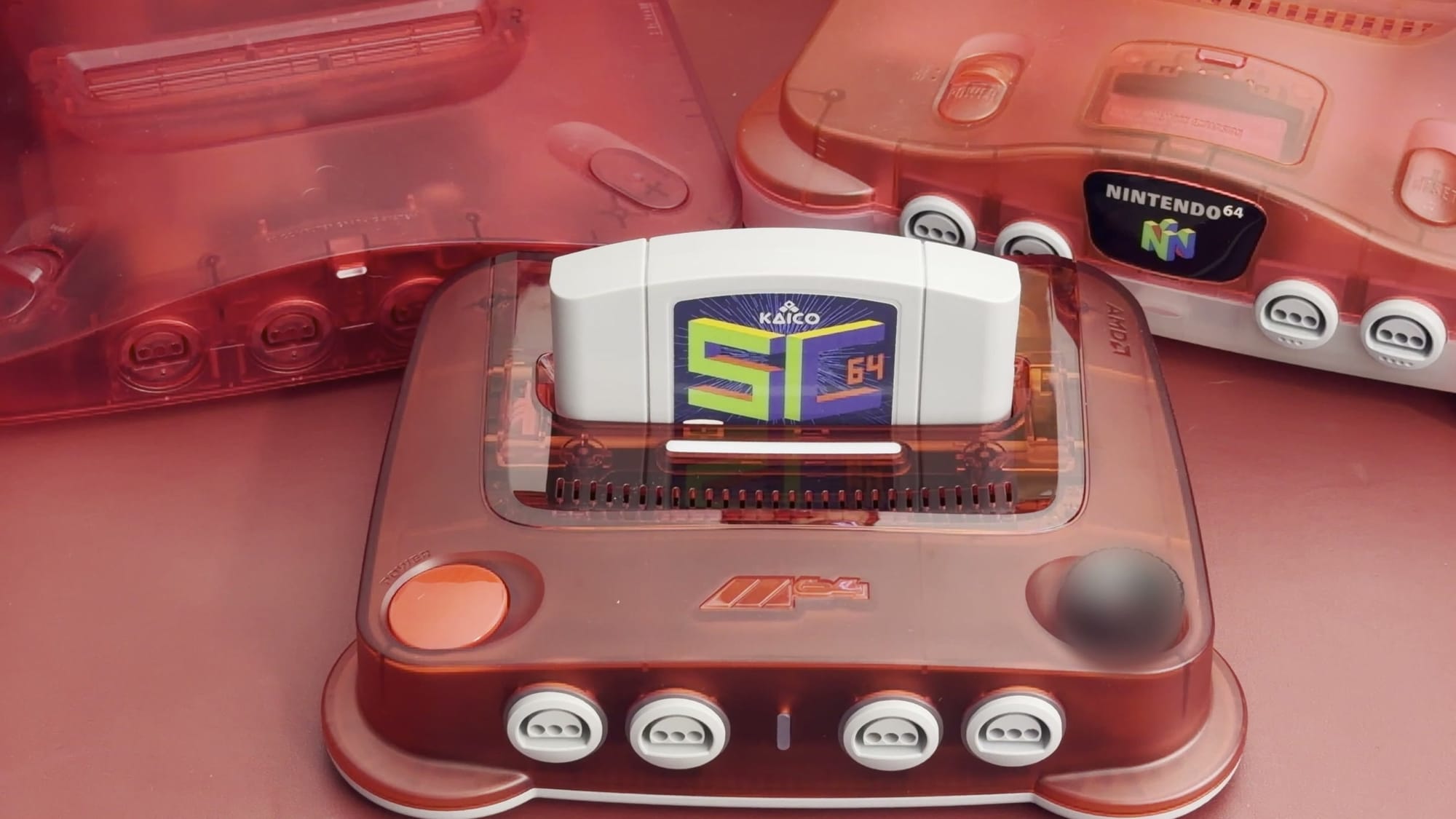
Both consoles have the Expansion Pak, the N64’s memory upgrade, built in. Both also work with my SummerCart64, a flash cartridge that loads game backups from a microSD card. EverDrive 64 X5 and X7 carts failed on the Analogue 3D at launch until their maker released a fix, according to Time Extension, and ModRetro fixed EverDrive save corruption in some circumstances in firmware 1.25.0.
Features and updates
Save states are the biggest feature gap. A save state stores the exact moment of a game so it can be resumed later, even in games that only save at checkpoints. The Analogue 3D added them in 3DOS 1.3.0 in May, with up to 20 per game, and added screenshots in 1.4.0 in June. The M64 has neither yet, and save states sit in the last phase of ModRetro’s update roadmap, which gives no dates.
Both consoles can overclock, running the N64’s chips faster than the original hardware to smooth out games that struggled with their frame rate. The Analogue 3D offers several levels, and since 3DOS 1.5.1 in September they can be changed during play. ModRetro ships a standard overclocking mode, with an advanced mode in development, according to its product page. Analogue warns that overclocking can cause faster demos, audio desync or instability in some games, and ModRetro notes that its compatibility list does not reflect games played with overclocking on.
Updates are easier on the M64. It updates over Wi-Fi, by USB or from its SD card, according to ModRetro. The Analogue 3D still updates from an SD card, and its product page marks Wi-Fi updates as coming soon. Both companies have released firmware steadily, with Analogue at 3DOS 1.5.1 and ModRetro at 1.25.0 as of early October.
Controllers
Both consoles have four original controller ports, so original N64 controllers plug straight in. For wireless play, the Analogue 3D supports the 8BitDo 64, 8BitDo’s mod kit for original controllers and the Nintendo Switch Online N64 controller. The M64 works with its own Pro Controller, the 8BitDo 64, original controllers and others, and firmware 1.25.0 added rumble for the 8BitDo 64.
My own setup is simple. I mostly use red and blue 8BitDo 64 controllers, which work on both consoles. Sometimes I use an original N64 controller with an extension cable that gives me about 10 feet, so I can sit back from the TV. That covers both consoles without buying a controller for each.
Build and handling
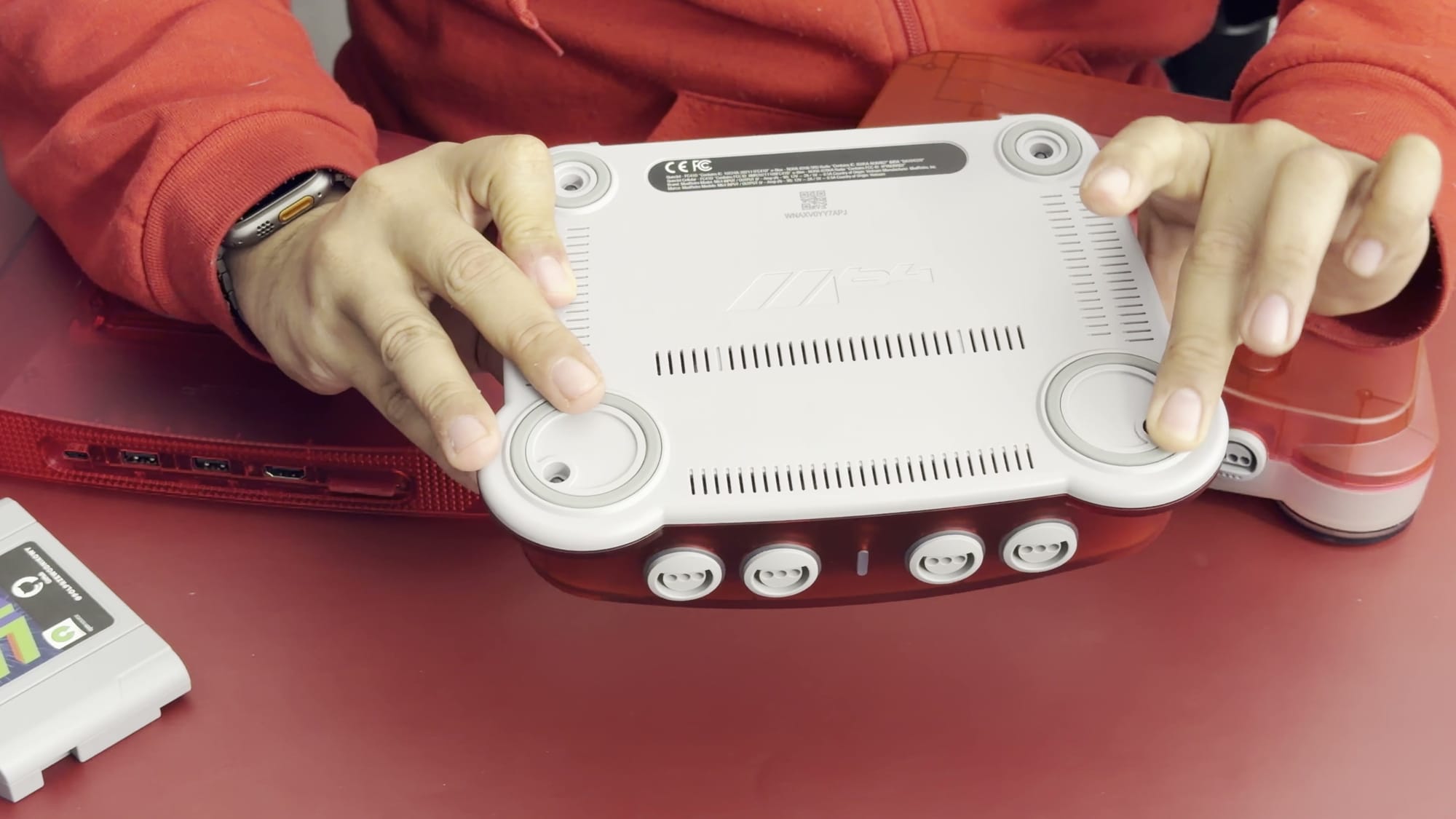
The two feel different in the hand. On my scale, the Analogue 3D weighs 1 pound 14 ounces and the M64 weighs 1 pound 10 ounces. The Analogue 3D has a full rubber base, while my M64 has small rubber rings with more bare plastic underneath, as I noted in my M64 unboxing. The M64 also has an eject button that lifts the cartridge out, and on my unit it is still stiff, though I have not used it much.
Cooling differs as well. ModRetro describes the M64 as fanless, and Analogue’s guide covers cleaning the 3D’s dust filter. I have not had any problems with either console in my use.
For CRT owners
Players who still use a CRT television have one option on the way. Analogue states that the 3D does not work with CRTs or with its own DAC adapter, so it is HDMI only. ModRetro sells an M64 AV Adapter with composite, component, S-Video and RGB output, priced at $89.99 as a preorder that ModRetro says ships by Christmas. Until it ships, both consoles are HDMI only in practice.
Which one I would tell a friend to buy
If a friend asked me today, I would tell them to get the cheaper one. Failing that, get the one that looks best to you, and if either is on sale, get that one. Both are almost equal in quality and performance now. Brand loyalty and ecosystems should not decide it, because buying one of these is about gaming.
For me, it is about having fun and reliving gaming memories. Either console does that well. Go for the one that gets you gaming at the best price.