News / News · News · Controllers & Accessories
8BitDo Arcade Controller Pro: Price, Release Date, Specs
8BitDo's leverless Arcade Controller Pro is up for pre-order at $119.99, shipping November 30. What's new, what it works with, and how it compares.
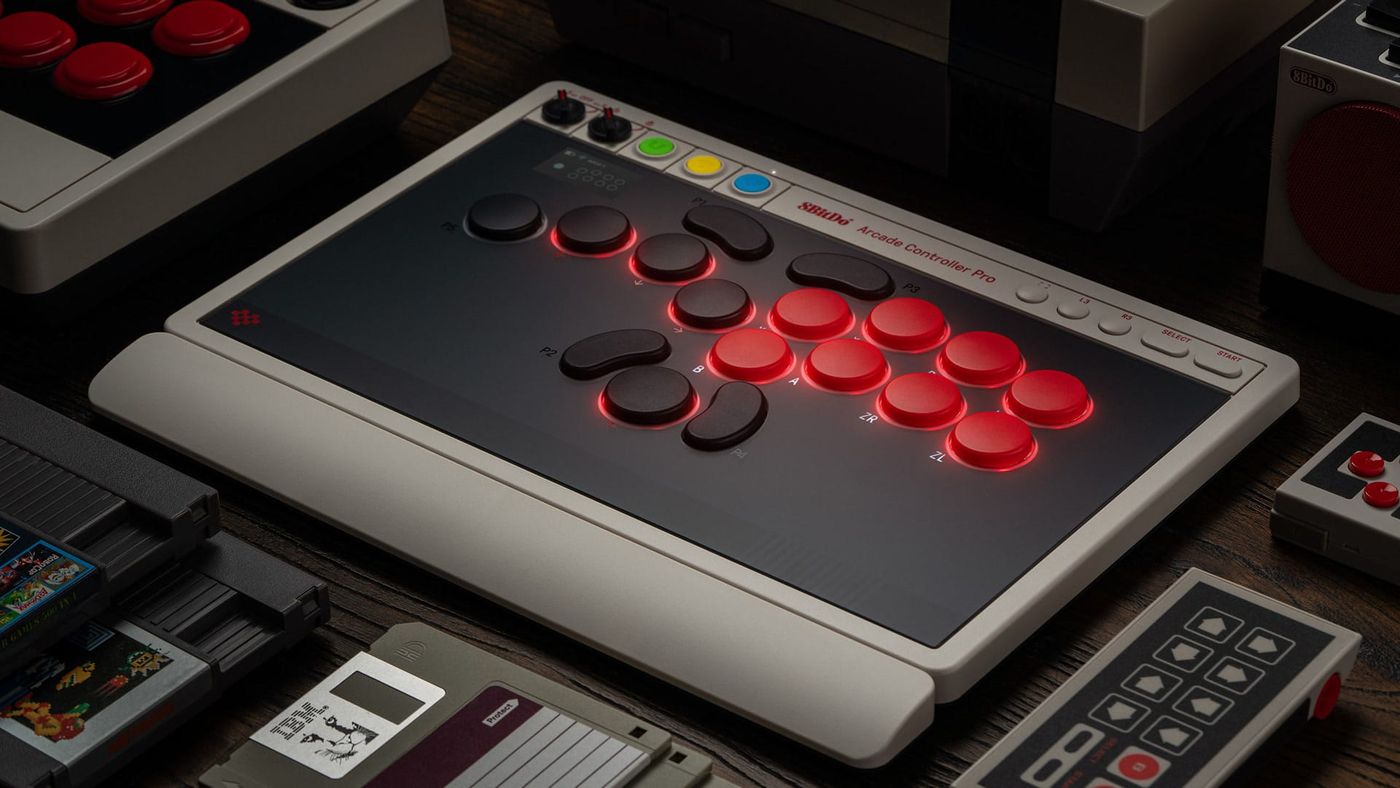
Here is the thing about 8BitDo’s original leverless controller: you can change a fair amount on the controller itself, with a turn-and-click panel, but you are doing it blind, by dial, and the deeper settings still mean a Windows app. The Arcade Controller Pro’s answer is to put a screen on the controller and move the mapping, the SOCD choice and the lighting onto a menu you can read. That is the headline. Around it sit a fifth programmable button, a new set of switches with spares tucked under the glass, a wrist rest that finally comes in the box, and a price of $119.99, thirty dollars over the original it is sold next to. Pre-orders went up on October 22, after the start date slipped once, with a ship date at the end of November on 8BitDo’s own listing. With the fancy end of this category sitting at three hundred dollars, the question you are really asking is whether the Pro earns its thirty over the original, or over a Snack Box. Here is what 8BitDo has put in writing, what actually changed, and how it lines up.
How much is the 8BitDo Arcade Controller Pro, and when does it ship?
Same price either way you want it, and the date comes straight from the title 8BitDo gave its own store listing when it went live on October 22. The N Edition is the grey with red accents that winks at the NES; the White Edition is a first for this controller. 8BitDo’s product page sends you to one of two places: Amazon if you’re in the US, or 8BitDo’s own store, which ships anywhere, the US included. Amazon is taking pre-orders but keeps the price hidden until the thing is in your cart, so the number on this page is 8BitDo’s. Order direct and it comes from China, and the shipping policy talks in weeks, with a DHL option if you’d rather pay to hurry it; the details are in At a glance.
It took a while to get here. The June announcement said pre-orders in September. By late August the page said October. October is when they opened, so the second date stuck, but if you’re planning around a late-November delivery, remember this schedule has already moved once. What hasn’t moved, at all, is the spec sheet. Put the June page next to today’s and the specifications match line for line. The only new things are the order buttons and a sponsorship block.
What’s different from the original Arcade Controller?
More than the identical footprint suggests. The original, out since the middle of 2025 and still on sale, is a straightforward leverless board: Kailh Wizard switches, four programmable buttons, a set of lock caps, a smaller battery that lasts longer, and no screen. You change connection mode, volume and mapping with a turn-and-click panel on the controller, use fast mapping for the programmable buttons, and do the rest in 8BitDo’s Ultimate Software V2 on a Windows machine.
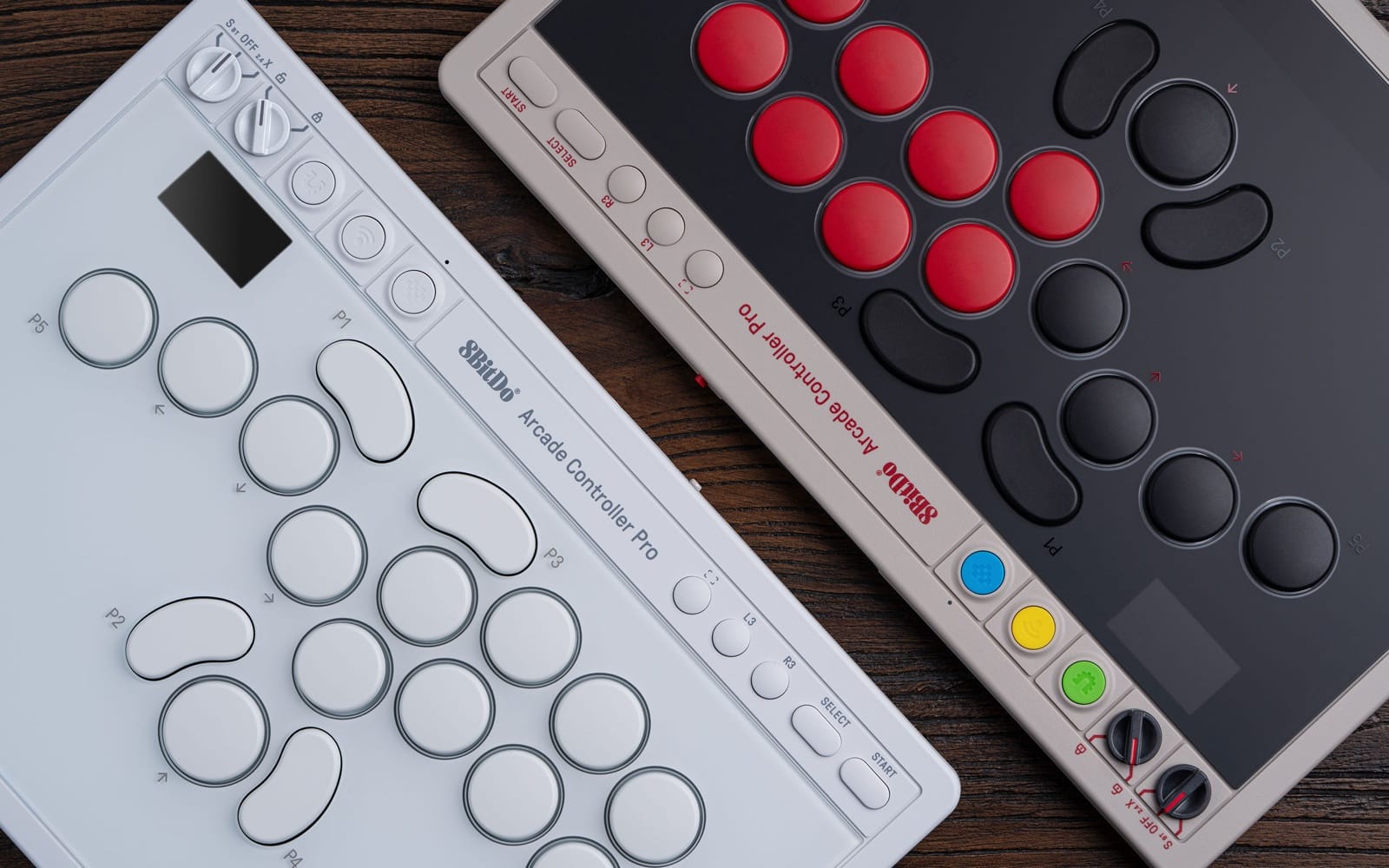
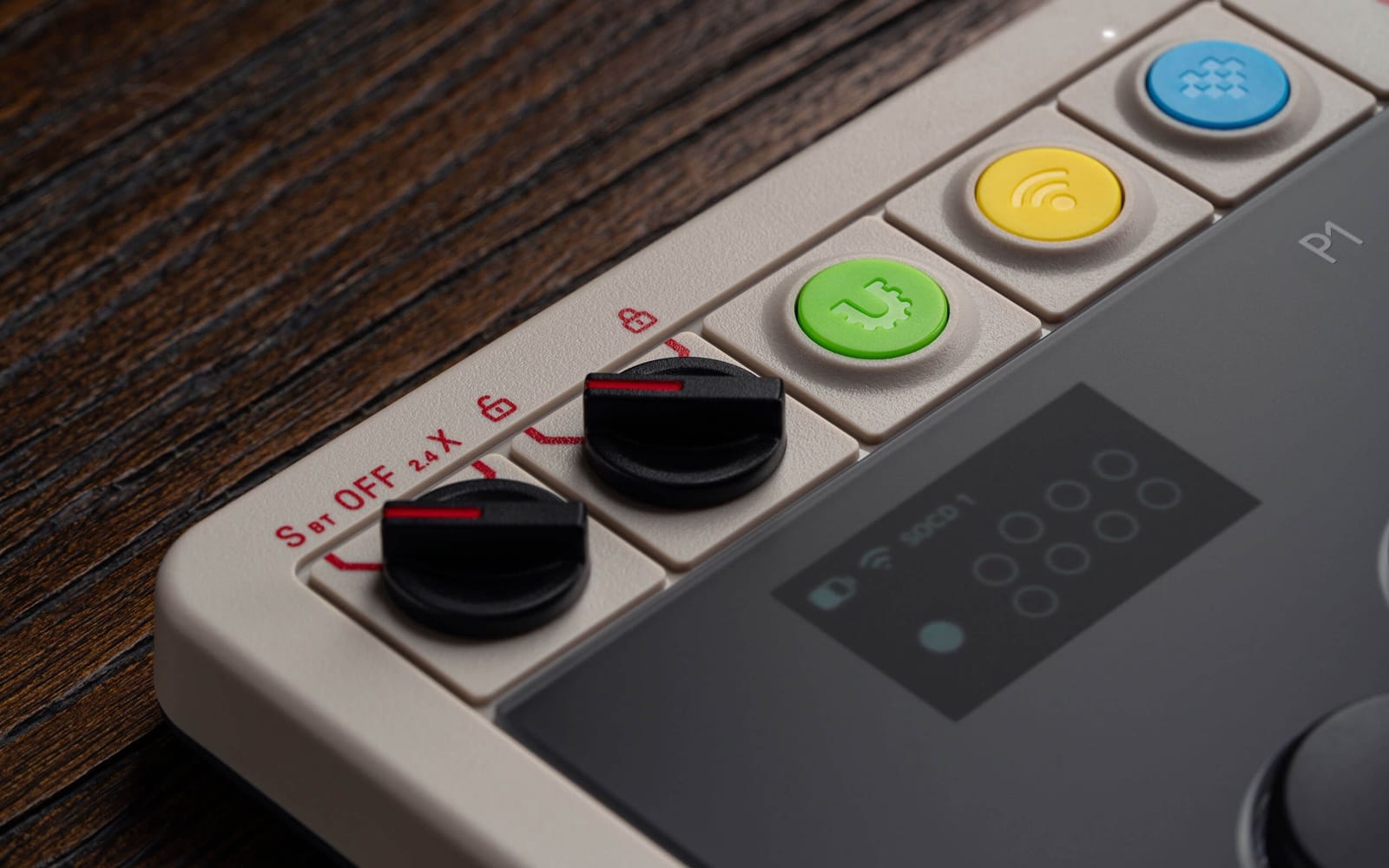
The Pro keeps all of that and piles convenience on top. The display is the big one. A small screen up in the corner runs what 8BitDo calls its built-in Ultimate Software, so remapping, SOCD and RGB are handled in a menu you can actually read instead of a dial and a desktop app. It shows your inputs as you press them, shows the battery, and can be switched off so it stays dark until you hit the Ultimate button. The turn-and-click panel is still there, two dials in the photos, and on the Pro it also handles the display settings and the tournament lock.
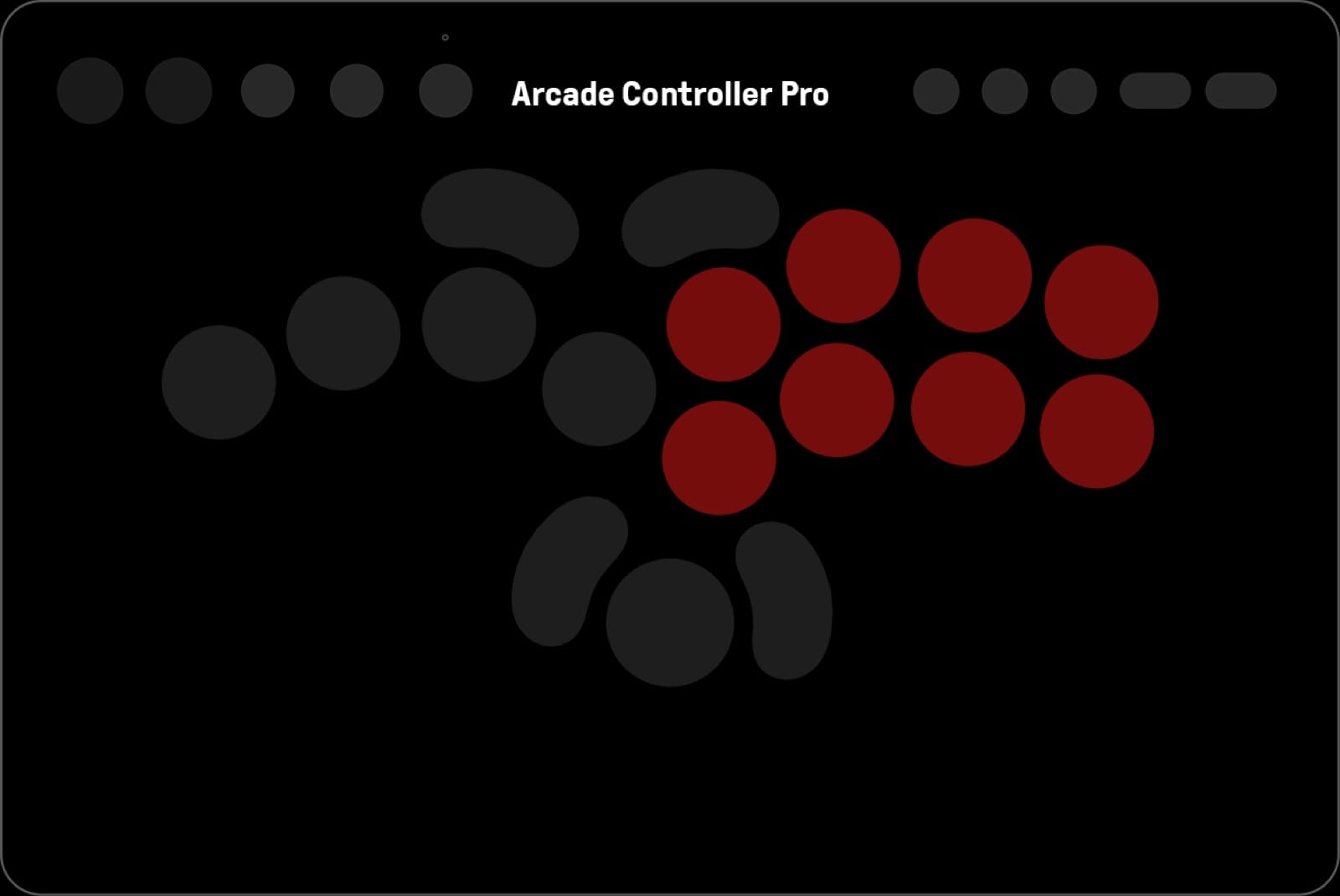
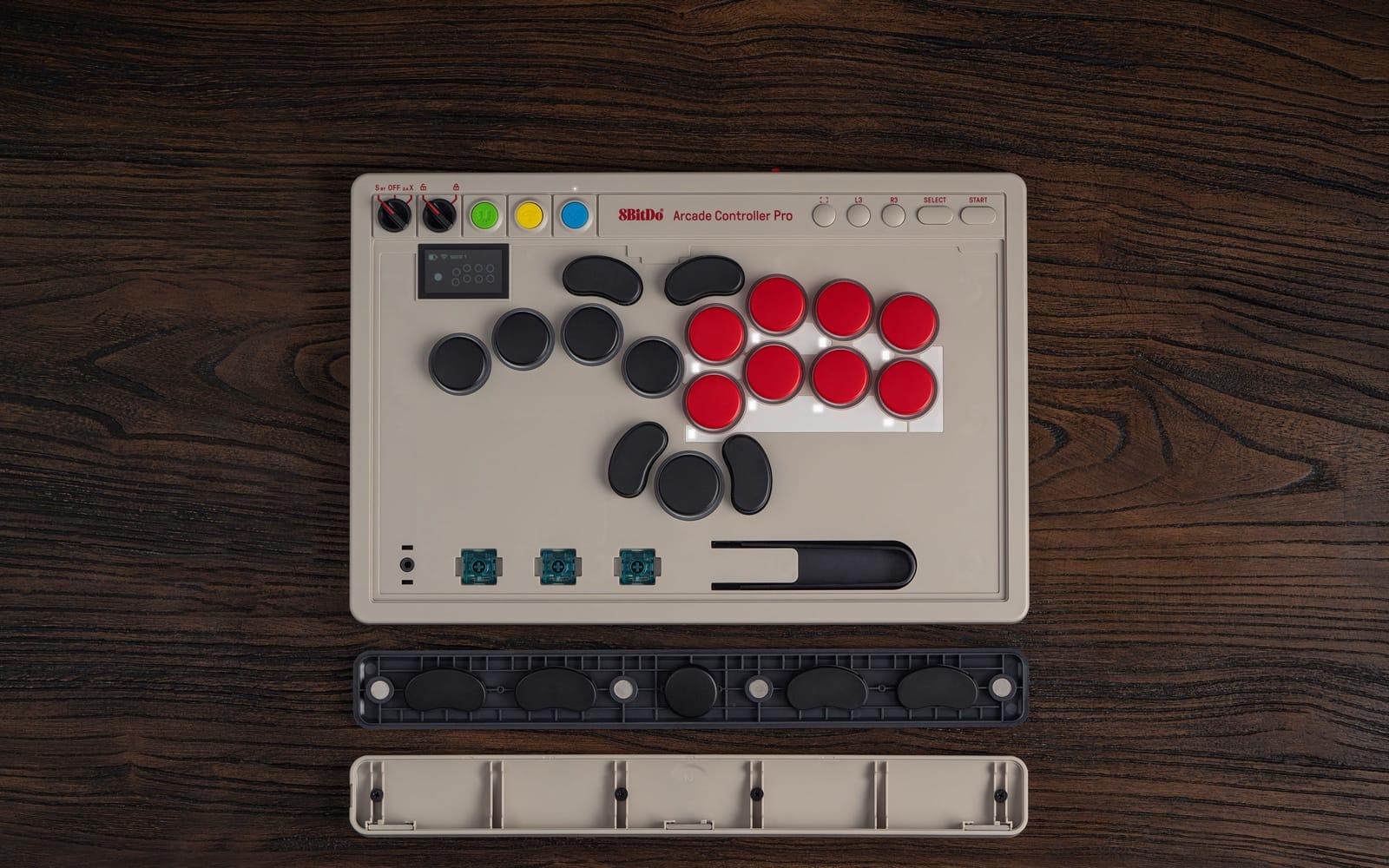
Then the buttons. There’s one more on the face, a fifth programmable button sitting out on the far left, and all of them are smaller and packed closer, which 8BitDo sells as a more compact layout. The round caps go in any orientation, and like the original, the lit labels flip between the Switch and PC layouts when you change input mode. Underneath are new switches, 8BitDo’s Core Green low-profile linears made with Kailh, and the tempered glass faceplate pops off to reveal three spares and a puller. The wrist rest is the last piece: on the original it’s a separate purchase in an upgrade kit, on the Pro it’s magnetic, it’s in the box, and it doubles as a holder for the five lock caps.
The battery is the odd one out, because it gets bigger and worse at the same time. Three times the capacity of the original’s cell, yet 8BitDo rates it for five fewer hours of wireless play with the lights off, and charging takes an hour longer. No reason is given, and because the rating is taken with RGB off, you can’t blame the lights. On paper the Pro is thinner and a few grams lighter, with the caveat that 8BitDo’s own copy for the original calls it “as thin as 1.6 cm”, so don’t bank on the thickness gap, and nobody says whether the weight includes the wrist rest. All the figures are in At a glance.
One mix-up to clear before you order. Hypebeast wrote that the five spare caps change how the buttons feel. They don’t. 8BitDo calls them lock caps, and they are flat caps you put on P1 to P5 so those buttons can’t be hit by accident in a match. Feel comes from the switch, and the switch is what you swap if you want it different.
Does it work on PS5, Xbox or Steam Deck?
No on PS5 and no on Xbox. 8BitDo’s compatibility list for the Pro reads Switch, Switch 2 and Windows, exactly what the original’s reads, and there’s no explanation for leaving the others out. Xbox players aren’t totally stranded, because 8BitDo sells a separate, officially licensed Arcade Controller for Xbox built on the original design, for $99.99, covering Xbox Series X|S, Xbox One and Windows. It just isn’t this one. There’s no sign of a PlayStation model anywhere on 8BitDo’s site.
Steam Deck and phones are a different kind of missing. They’re absent from the Pro’s list, and 8BitDo’s Steam compatibility page doesn’t mention either arcade controller. Since the Pro talks to Windows through a 2.4 GHz adapter and to the Switch over Bluetooth, I’m not going to guess what else it might pair with. The line 8BitDo has drawn is Switch, Switch 2 and Windows, and its guarantees end there. One small FAQ note for Switch owners: it won’t wake the console.
What does the screen do?
The settings work, on a screen you can read instead of a dial or a PC. 8BitDo’s FAQ says the on-device Ultimate Software covers button mapping, SOCD and RGB from the display, and that the “fast mapping” the original used for its programmable buttons has been dropped because of it. The screen also shows your inputs live, which is a nice way to check a mapping or an SOCD mode without loading a game, and your battery level.
8BitDo’s own documents don’t quite agree with each other here. The product page still says you can “fast-map P1-P5 directly on the controller” and lists fast-mapping as a feature of the five programmable buttons, while the FAQ says that’s gone and mapping goes through the display. Both pages are 8BitDo’s and both were live on October 26. What’s true under either version is that P1 to P5 get remapped on the controller, through the screen’s menu, with no computer in the loop. Whether a fast-mapping shortcut also survives is for 8BitDo to sort out, and this page will note it when the two pages agree.
Which SOCD modes does it have, and can you use it in tournaments?
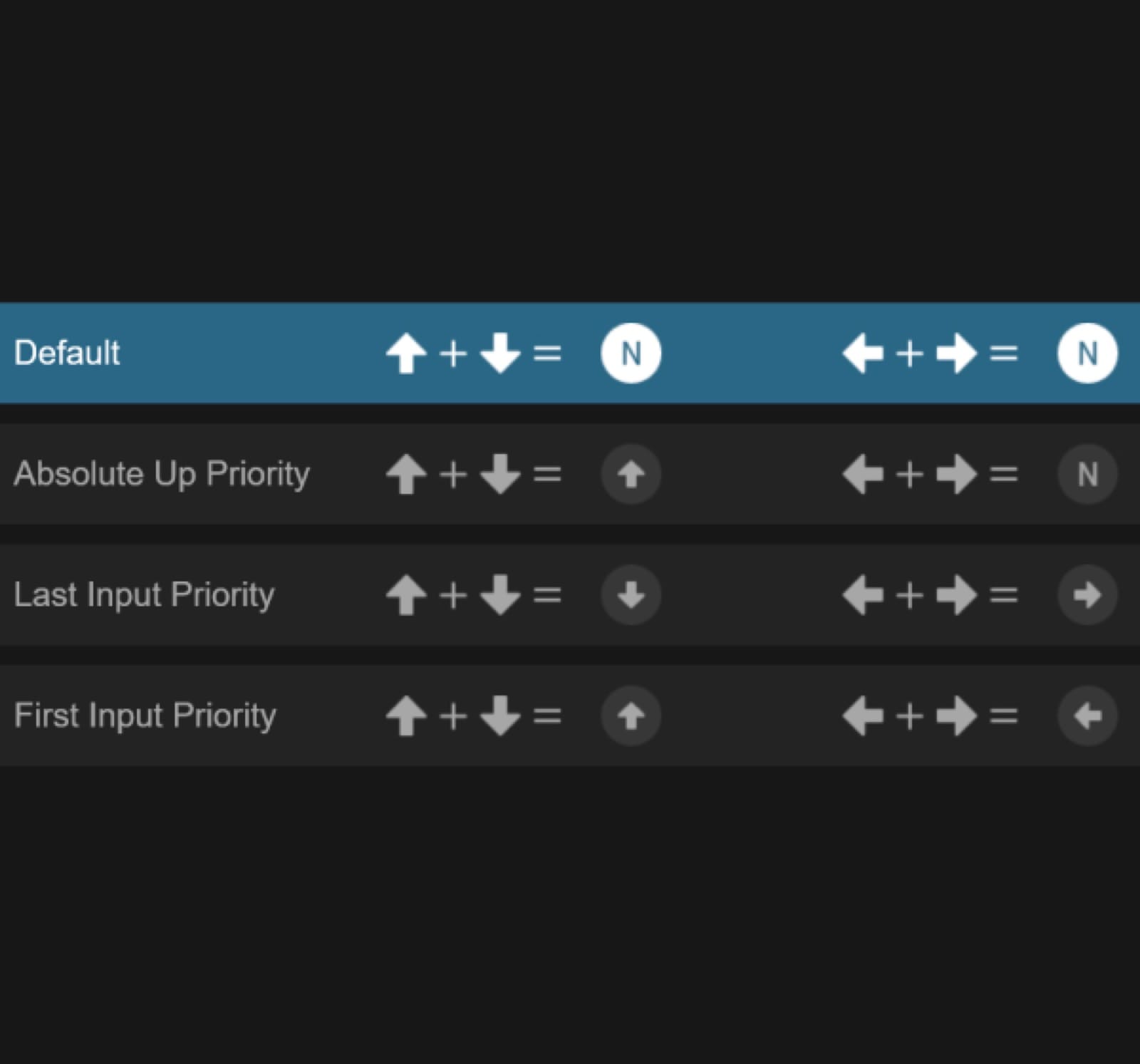
Four, and the one it ships in is the one that passed the single rule set this site looked at. SOCD is simultaneous opposite cardinal directions: on a leverless controller nothing stops you pressing left and right together, or up and down, so the controller has to pick what to send. Out of the box the Pro is in Neutral, where left plus right cancels out and so does up plus down. You can change that on the controller or in Ultimate Software V2 to one of three others, per 8BitDo’s own graphic: Absolute Up Priority, where up beats down and left plus right still cancels; Last Input Priority, where the newest press wins; and First Input Priority, where the first press holds.
On tournament legality 8BitDo promises nothing. It brands the Pro “Built for the Fight” and calls itself the presenting sponsor of Street Fighter League Americas and EMEAA for 2026, and it stops there; nowhere does it say the controller is legal under any particular rules. So what follows is this site reading one rule book, the Street Fighter League Americas official rules, and nothing more. Those rules say opposite directions pressed together must either both register or both be thrown out, which Neutral does and the three priority modes don’t. They ban macros and turbo, so anything you set up in Ultimate Software’s macro feature stays off. And they limit a controller to 11 attack inputs and 4 movement inputs with no duplicates, which is worth counting against however you map the five P buttons. Other events write their own rules, and nothing here was checked against EVO or Capcom Pro Tour.
The tournament lock is the one piece 8BitDo does describe. It kills the Ultimate, Pair, Home and capture buttons, L3, R3 and all five P buttons. You set it with the dial, and the movement and action buttons keep working, as do Select and Start, which aren’t on 8BitDo’s disabled list. The other match-day feature is the cable lock, a metal clasp over the top USB-C port, because a cable yanked mid-match is a match lost; the FAQ confirms the locked top port wins if both ports are plugged in.
Can you swap the switches?
Yes, and 8BitDo leads with it. The Core Green switches are hot-swappable, meaning they pull out and press in with no soldering, and the FAQ says Kailh switches of the same height are supported. The puller and three spares sit under the faceplate, which releases with a button on the back and lifts off as one glass panel. The original’s board is hot-swappable as well, but it ships with no spares and no puller; those are in its upgrade kit. So on the Pro a tired or annoying switch is a swap instead of a warranty email, and the parts are already in the case. It also makes the division of labour clear: lock caps decide which buttons can be pressed, switches decide how pressing feels.
How does it compare with the Razer Kitsune and Snack Box MICRO?
Put it between a cheap all-button controller and an expensive one and the Pro’s argument is wireless, a screen, and nothing left to buy, at the middle price. Junk Food Arcades’ Snack Box MICRO is the budget pick: wired only, half an inch thick, licensed with Hit Box, with its own hot-swappable switches and four SOCD modes; it lists Switch, Switch 2, PC and Steam Deck, and a paid upgrade adds PS5 and Xbox. Razer’s Kitsune is the splurge: wired only, PS5 and PC, low-profile linear optical switches, four SOCD modes plus a no-cleaning option on PC, a tournament lock and a cable clasp; Razer’s page is silent on whether its switches come out. The prices in the table are from each maker’s own store on October 26, 2026.
| Arcade Controller Pro | Arcade Controller (original) | Snack Box MICRO | Razer Kitsune | |
|---|---|---|---|---|
| Price | $119.99 (pre-order) | $89.99 | $89 | $299.99 |
| Status | Ships November 30, 2026 | On sale since July 2025 | On sale | On sale |
| Platforms (official) | Switch, Switch 2, Windows | Switch, Switch 2, Windows | Switch, Switch 2, PC, Steam Deck; PS5 and Xbox with a $76 upgrade | PS5, PC |
| Wireless | Yes | Yes | No | No |
| Screen | Yes, 1.47 inches | No | No | No |
| Hot-swappable switches | Yes | Yes | Yes | Not listed by Razer |
| Switch type | Core Green low-profile linear, with Kailh | Kailh Wizard low-profile | Amber low-profile | Razer low-profile linear optical |
| SOCD modes | Yes, 4 | Yes | Yes, 4 | Yes, 4 plus none on PC |
| Tournament lock | Yes | Yes | No | Yes |
| Wrist rest included | Yes | No | No | No |
| Battery | 3,000 mAh, 15 hours with RGB off | 1,000 mAh, 20 hours | Wired only | Wired only |
| Size and weight | 301 x 201 x 16 mm, 1,090 g | 301 x 201 x 22 mm, 1,097 g | Half an inch thick; other figures not recorded | Not published on Razer’s page |
Start with your platform and the field thins out fast. On PS5 it’s the Kitsune or an upgraded Snack Box, because the Pro doesn’t play there. On Switch 2 it’s the reverse, because the Kitsune doesn’t. If you’re on Windows or Switch 2 and you want to lose the cable, only the Pro and the original in this group can do that, and the thirty dollars between them buys you the screen, the fifth button, the wrist rest and the new switches, and costs you five rated hours of battery.
I don’t own either Arcade Controller, so you’re getting the paperwork here and no hands-on, and 8BitDo hasn’t published a latency number to lean on either. What I can tell you is where I’m coming from: fighting games were part of my Genesis and Dreamcast years, from TMNT: Tournament Fighters, the most fun I had on the Genesis, through Marvel vs. Capcom and Power Stone 2 on the Dreamcast, and I’ve pre-ordered from 8BitDo before, the Ultimate 3C+ and the Gears of War: E-Day keyboard and mouse. In 8BitDo’s leverless line the Pro is the first you can set up on its own screen. Whether that’s worth thirty dollars over the original is a call for someone who has actually had it in their hands.
Nerd Alert
Your Turn
What are YOUR thoughts
What have your experiences been? Let us know.