News / News · News · Handheld Gaming
PS6 Handheld and RDNA 5: What Sony Has Actually Said
Digital Foundry heard Sony has an exclusive of sorts on AMD RDNA 5 for a handheld. Sony has never announced one. Here is what is on the record.
A PS6 handheld with an exclusive lock on AMD’s next graphics architecture is the kind of sentence that travels fast, and this week it did. By Monday it had become a headline about Sony securing “a major RDNA 5 advantage” for its “upcoming” portable. Follow the thread back, though, and it gets thinner at every step: a hedged remark on a paywalled podcast, transcribed by a Reddit user, about a handheld Sony has never announced, built on a chip AMD has never named. None of that makes it wrong. It just makes it a rumour, and rumours deserve to be read as what they are. So here’s the whole chain, from the words that were actually spoken to what Sony and AMD have put on the record, and where that leaves the rest of the handheld market.
What is the RDNA 5 “exclusive” Sony supposedly has?
A sentence spoken behind a paywall. On a recent Patreon-only episode of DF Direct Weekly, Digital Foundry’s Richard Leadbetter said, as transcribed by a listener on Reddit: “There has been some behind the scene discussions that Sony has an exclusive of sorts on RDNA5 for handheld with it’s mobile device that’s coming.” That transcription is where the public story begins. Twisted Voxel quoted it, Notebookcheck paraphrased it, and both drew from the same chain, so for all the coverage, this is one source saying one hedged thing.
Notebookcheck’s own write-up adds that this “isn’t the result of a conventional exclusivity agreement”, and frames it instead as AMD becoming choosy about which semi-custom handheld chips it builds, favouring partners who commit to big volumes. That framing can’t be checked against the episode, since the episode can’t be heard without a subscription, and the theory behind it has its own problems, which the next section gets into.
Credit where it’s due: Digital Foundry is a serious outlet with a track record on exactly this subject. In December 2024, as VGC reported, DF’s John Linneman said the team had heard about a Sony handheld “some months ago from a couple of sources”, which lined up with Bloomberg’s reporting. So when Leadbetter says there have been discussions, it’s worth listening. It’s also worth noticing how carefully he said it. “Behind the scene discussions” and “an exclusive of sorts” are the words of someone passing along what he’s heard, with the uncertainty left in. The headlines took the uncertainty out.
Is Sony actually making a PlayStation handheld?
Sony hasn’t said so, and that’s the honest answer to the question people type into Google. There is no announcement, no name, no date and no price. What exists is a well-sourced report and a couple of suggestive sentences from the top of the company.
The report is Bloomberg’s, from November 2024: Sony Interactive Entertainment was in the early stages of a portable that would play PS5 games natively, the project was likely years away and could still be cancelled, and the PS Portal had originally been meant to work as a standalone device before it shipped as a streamer. Sony declined to comment, and has kept declining since.
The sentences are more recent. In June 2026, at a Sony investor meeting, SIE President and CEO Hideaki Nishino described the next-generation platform’s goal as “an expansion of usage styles, enabling a seamless experience that can be enjoyed naturally beyond the living room”, per Sony’s own transcript. In the same breath he named the PS Portal as the hardware Sony already offers for play outside the living room. He told Famitsu much the same: new console experiences using technology “in various forms, in various places”. You can read a handheld into that if you want to. You can also read a better Portal into it. Nishino didn’t say which.
And on timing, Sony Group CEO Hiroki Totoki told analysts in May 2026 that the company hadn’t decided when the next console would launch or what it would cost, as VGC reported. Bloomberg had reported in February that Sony was weighing a push to 2028 or 2029 over memory prices. If the handheld is tied to the next generation, its calendar is just as unsettled.
For what it’s worth, Victor’s own read, from a reply he posted under one of his videos in early October, is that “leaks like these are usually grounded in real project plans, so I do think something’s coming.” That’s a take on the device existing. On the chip deal, he’s said nothing, and neither has anyone who’d know.
Isn’t the PS Portal already a PlayStation handheld?
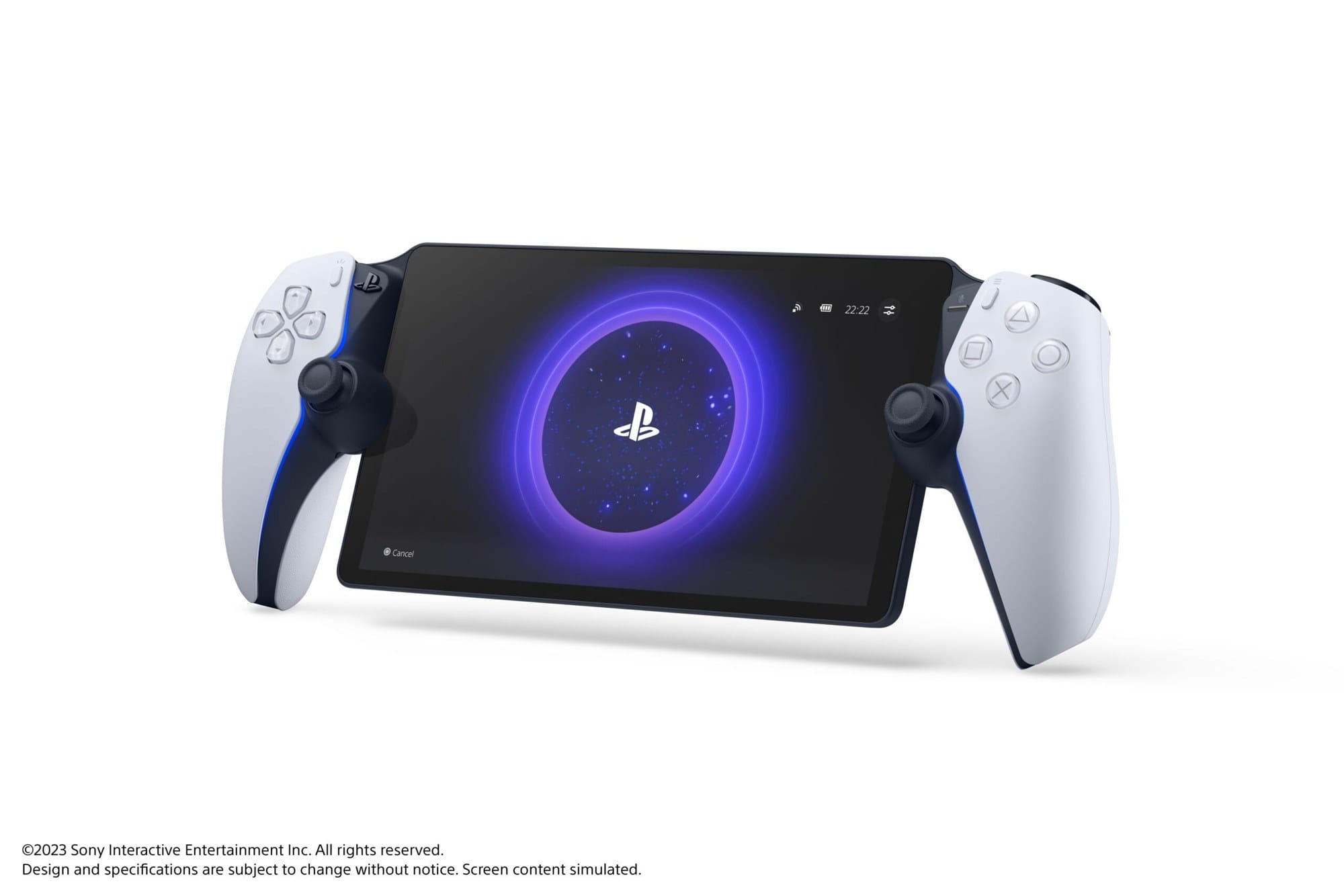
It looks like one, and that’s where the confusion starts. The PlayStation Portal launched in November 2023 at $199.99 as a Remote Play device: a screen with DualSense halves on either side that streams whatever your PS5 is running. In November 2025 Sony added official cloud streaming for PlayStation Plus Premium members, so it can now play digital PS5 games from your library without a console switched on at home. Since April 2, 2026 it costs $249.99 in the US.
What it has never done is run a game on its own silicon. Every frame comes over Wi-Fi from a PS5 or a Sony server. That’s the whole distinction behind the rumour mill: Bloomberg’s reported portable would play PS5 games natively, which means a real processor inside, which means a chip deal with somebody, which is how a conversation about RDNA 5 starts in the first place. The Portal is the device Sony has. The handheld is the device people are guessing about.
What is RDNA 5, and when is it coming?
Right now, RDNA 5 is a name the community uses for a product AMD hasn’t named. At its Financial Analyst Day in November 2025, AMD’s GPU roadmap showed one next generation after RDNA 4, promising new ray tracing hardware and “next-generation AI”, and left the box unlabelled, as HWCooling noted at the time. Some leakers call it RDNA 5, others UDNA. AMD has committed to neither in public, and it has published no date and no specifications. The best current reporting, from igor’sLAB, has board partners expecting the next desktop Radeons at the end of 2027 or the start of 2028.
Two more pieces of context make the “exclusive” harder to picture. First, every handheld chip you can buy today is a generation or two behind the desktop cards: the Ryzen Z2 Extreme in machines like the ROG Xbox Ally X20 and Victor’s own Legion Go 2 uses RDNA 3.5 graphics, and the Steam Deck and the base Xbox Ally sit on RDNA 2, as this site’s FSR 4 on Steam Deck piece lays out. There was never an RDNA 4 handheld chip at all. Second, the leaker Kepler_L2, who has a decent record on AMD’s plans, posted in January that AMD’s roadmap splits in two: low-end laptop chips stay on RDNA 3.5 until 2029, while the “premium” integrated graphics move to RDNA 5. That’s a rumour too, but if it’s right, RDNA 5 reaches ordinary AMD chips that any handheld maker could buy, and a Sony exclusive would cover only a custom part built to Sony’s order.
Does that leave Xbox and Steam Deck without RDNA 5?
Nobody has shown that it does, and the theory holding the idea up has already been challenged once. The argument goes like this: AMD will only design a semi-custom handheld chip for a partner who promises enormous volume, Sony can promise it, and the Windows handheld makers can’t. That reasoning first appeared in October 2025, when Kepler_L2 claimed AMD had wanted a commitment of more than ten million units before it would build a dedicated chip for Microsoft’s since-cancelled in-house Xbox handheld, as Insider Gaming relayed. Windows Central’s Jez Corden, who covers Xbox hardware closely, answered in six words: “this isn’t even slightly true btw.”
The Valve side doesn’t fit the theory either. The codename “Gainsborough” turned up in a real AMD driver this autumn, leakers have tied it to a Steam Deck 2, and the same leakers describe it as a semi-custom AMD chip, as this site’s Steam Deck 2 specs piece covers. If Valve is getting a custom AMD handheld chip of its own, “only Sony gets one” is already in trouble, and that’s before anyone asks which graphics generation Gainsborough uses, which hasn’t been confirmed.
Then there’s Microsoft, which has a custom AMD chip of its own on the way for the next Xbox console, codenamed Project Helix, and, per Fortune’s October reporting, a next-generation Xbox handheld pencilled in for holiday 2027. Microsoft hasn’t confirmed the handheld. The point isn’t that any of these devices is certain. It’s that three companies are reported or rumoured to be working with AMD on portable silicon at the same time, and the only evidence that one of them has locked the others out is a sentence that begins “there has been some behind the scene discussions”.
What is Project Amethyst, and is it Sony-only?
Project Amethyst is the public Sony and AMD partnership, and it’s the one piece of this story with a paper trail. Mark Cerny announced it at the end of the PS5 Pro Technical Seminar in December 2024 as “a deeper collaboration with a focus on Machine Learning-based technology for graphics and gameplay”. AMD’s Jack Huynh spelled out the goals the following summer: a hardware architecture tuned for machine learning in games, and the neural networks to run on it. The results are already shipping. PSSR on the PS5 Pro came out of it, and so did FSR 4; in March 2026 Cerny confirmed that FSR Upscaling 4.1 uses the same neural network as the upgraded PSSR, which this site covered in its FSR 4.1 piece.
Here’s the part that matters for the exclusivity question. Both companies have gone out of their way to say Amethyst is open. Cerny told Tom’s Guide: “This is not for proprietary technology... these technologies are available to any of AMD’s customers freely.” When the two companies showed off their future hardware ideas in October 2025, Neural Arrays, Radiance Cores and Universal Compression, Huynh said they were “so excited to bring these innovations to developers across every gaming platform”, as Pure Xbox reported, and Cerny said those features exist only in simulation so far, aimed at “a future console in a few years’ time”.
So the one Sony and AMD deal anyone can actually read about is explicitly a shared one. That doesn’t rule out a separate, private arrangement on handheld silicon. It does mean that if such an arrangement exists, it runs against the grain of everything the two companies have said in public about how they work together.
When could a PS6 handheld come out, and what would it cost?
Sony has given no date and no price, for the handheld or for the next console it would presumably sit beside. Everything beyond that is rumour, and the rumours don’t agree with each other. On one side, Kepler_L2 said in March that the PS6 and the handheld were “still on track” for holiday 2027. On the other, Bloomberg reported in February that Sony was considering holding the next generation until 2028 or 2029 because of memory costs, and Sony’s own CEO said in May that nothing had been decided. One of those pictures has to give.
The spec sheet floating around is rumour as well, and it comes mostly from the YouTube channel Moore’s Law Is Dead, which named the project “Canis” in August 2025 and described a chip with 16 graphics compute units, a mix of Zen 6 cores, up to 48 GB of memory and backward compatibility with PS4 and PS5 games, with a price estimate between $549 and $699 built from a parts-cost guess. Kepler_L2 later added a figure of around 15 watts. Treat all of it as a sketch by people who’ve been right before and wrong before. Sony’s one on-record comment about hardware economics, from that same June investor meeting, is that it doesn’t intend to sell hardware at significant losses, and that it can’t absorb every component price increase. That line is worth more than any leaked number.
If you’re waiting on a PlayStation handheld, here’s the honest state of play. Something is probably in development, because Bloomberg and Digital Foundry both say so and Sony’s CEO keeps circling the idea. The chip inside it is unknown, the “exclusive” on that chip is a single hedged remark, and the date is anybody’s guess. The Portal is the only PlayStation you can hold in your hands today, and it needs a Wi-Fi connection to do anything at all.
Nerd Alert
Your Turn
What are YOUR thoughts
What have your experiences been? Let us know.