Atari Lynx (1989)
The first colour handheld games console: sketched over lunch by two of the Amiga's engineers, demoed from behind a wall, sold by Atari at twice the Game Boy's price, and fed six AA batteries.
https://averagetechnerds.com/atari-lynx/
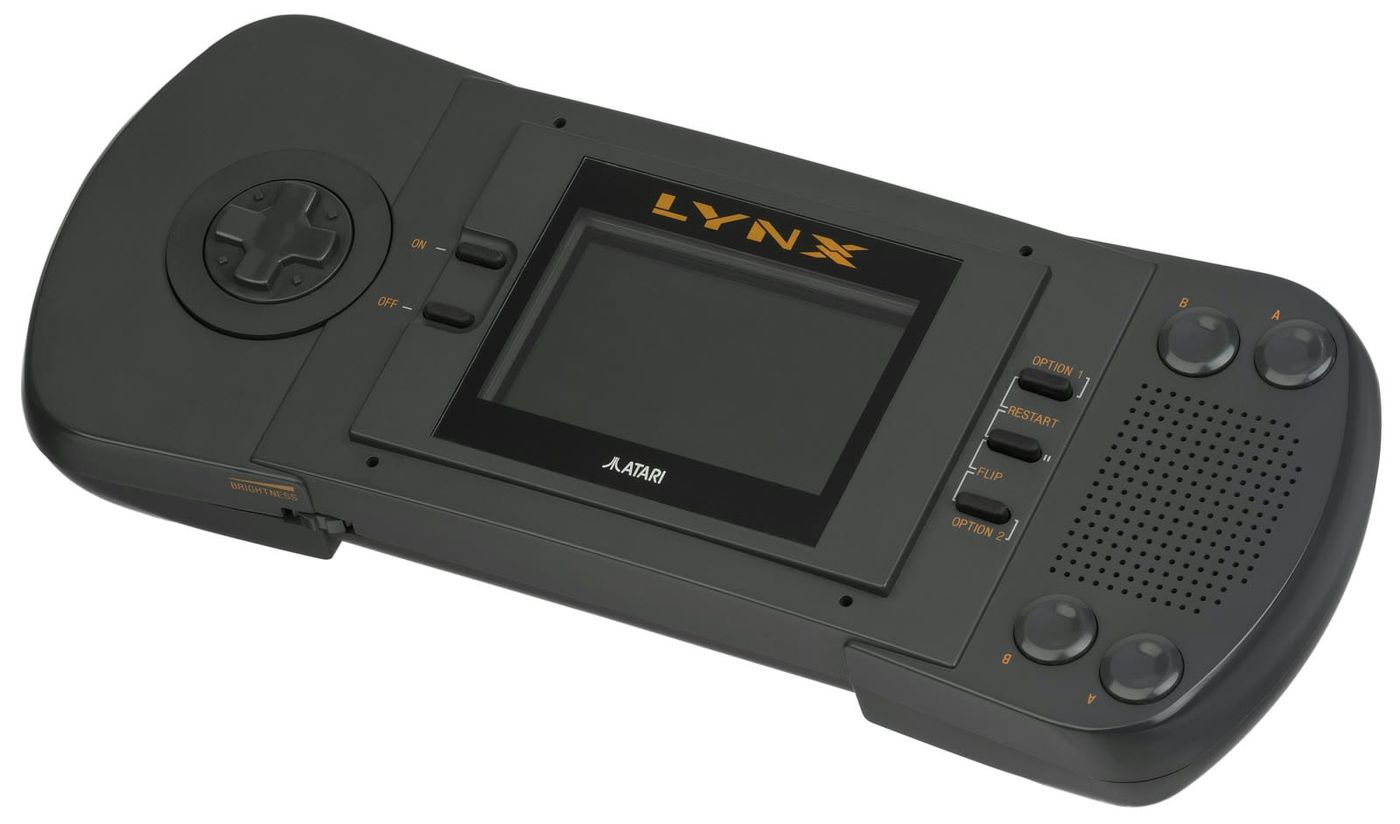
At the Consumer Electronics Show in Las Vegas, in January 1989, a small group of visitors got a private look at a colour handheld game machine. It looked finished. It wasn’t. The real electronics were spread across breadboards in a hidden room, wired to the handheld through a hole in the wall, and its two designers sat in there out of sight. The marketing staff had a secret button that lit a light on the other side when it was time for the next game. One visitor found it and kept pressing it until the designers came out to see what was going on.
That handheld became the Atari Lynx, in Guinness’s words the first colour handheld games console. It had a backlit colour screen in 1989. It also cost about twice as much as a Game Boy, came out in tiny numbers, and ate six AA batteries in an afternoon.
Designed over lunch
The two men behind the wall were R.J. Mical and Dave Needle, both from the team that built the Amiga computer. Dave Morse, who had been president of Amiga, was by then running the game company Epyx, and in 1987 he took them to lunch. As Mical told it, Morse offered to “pick up the tab if you design ’Handy’ for me”. They took the deal. Wired’s version has them sketching the whole thing out in an hour and a half.
Handy was the codename, and Epyx’s own hardware specification from 1987 still survives. It calls the machine “a portable hand held programmable video game”, and it’s a fun read. The two option buttons are called “flablode” buttons, which the spec explains is “a Jovian word” for a function they knew was needed but didn’t have a definition for yet.
Epyx runs out of money
Building a handheld costs a fortune, and Epyx was running out of money. Nintendo was reportedly offered the Handy. It passed. Just before the summer CES in June 1989, Jack Tramiel’s Atari bought the hardware. Atari would build it and sell it, and Epyx would make the games. At that show it went by the “Portable Color Entertainment System”, a name you’d have a hard time asking for at a toy shop counter. By the time it reached the shelves, it was the Lynx.
Epyx didn’t get out of 1989 in one piece. By the autumn it was bankrupt, after a row with Atari over money, and people still argue about whose fault that was. Mical and Needle had already left in September. The very next day they sat down at the same restaurant as that 1987 lunch and sketched their next machine, which became the 3DO. The Amiga, the Lynx and the 3DO, with the same two people in every one.
Christmas 1989
The Game Boy beat it to the shops, in Japan in April 1989 and in America that July. The Lynx turned up late in the year, and only in stores around New York. So picture Christmas 1989 as two stacks of boxes. On one side, fewer than 70,000 Lynxes. On the other, the 1.1 million Game Boys Nintendo planned to ship, and Nintendo saying even that wouldn’t cover half the demand. If you lived anywhere else in America, you couldn’t walk into a shop and buy a Lynx that year.
Then there was the price. About $180 for a Lynx, roughly double the Game Boy’s $90. If you were the kid asking your parents, that’s a much harder sell, and the games cost more too, closer to $40 against about $25. You did at least get a game in the box, California Games, and a cable to link up with a friend’s Lynx.
Atari took the Lynx to Japan that November too, and that started a fight. Back home at the American launch, with toy shop buyers in the room, Atari said Nintendo was leaning on the Japanese distributors, threatening to cut off any that started carrying the Lynx. Then Atari’s Sam Tramiel delivered his line: “We are the only U.S. company left in the game business.” That’s big talk from the smaller company.
A good machine that lost
By the end of 1990, it wasn’t close. About half a million Lynxes sold that year, against roughly 5 million Game Boys in the US alone, going by each company’s own estimate. Ten Game Boys for every Lynx. If you had one in 1990, you were in a very small club. And that was before Sega’s Game Gear arrived in America in 1991.
Why did it lose? Mostly for the reasons you’d guess. The price. The size. The batteries. Too few big games, about 70 in its whole commercial life. Mical added one more, and it points at the company that sold his machine: Atari didn’t know how to market it, he told Wired years later. As for how many sold in the end, guesses run from about 1 million to 3 million. That’s a wide range, and none of those numbers comes from Atari’s own books.
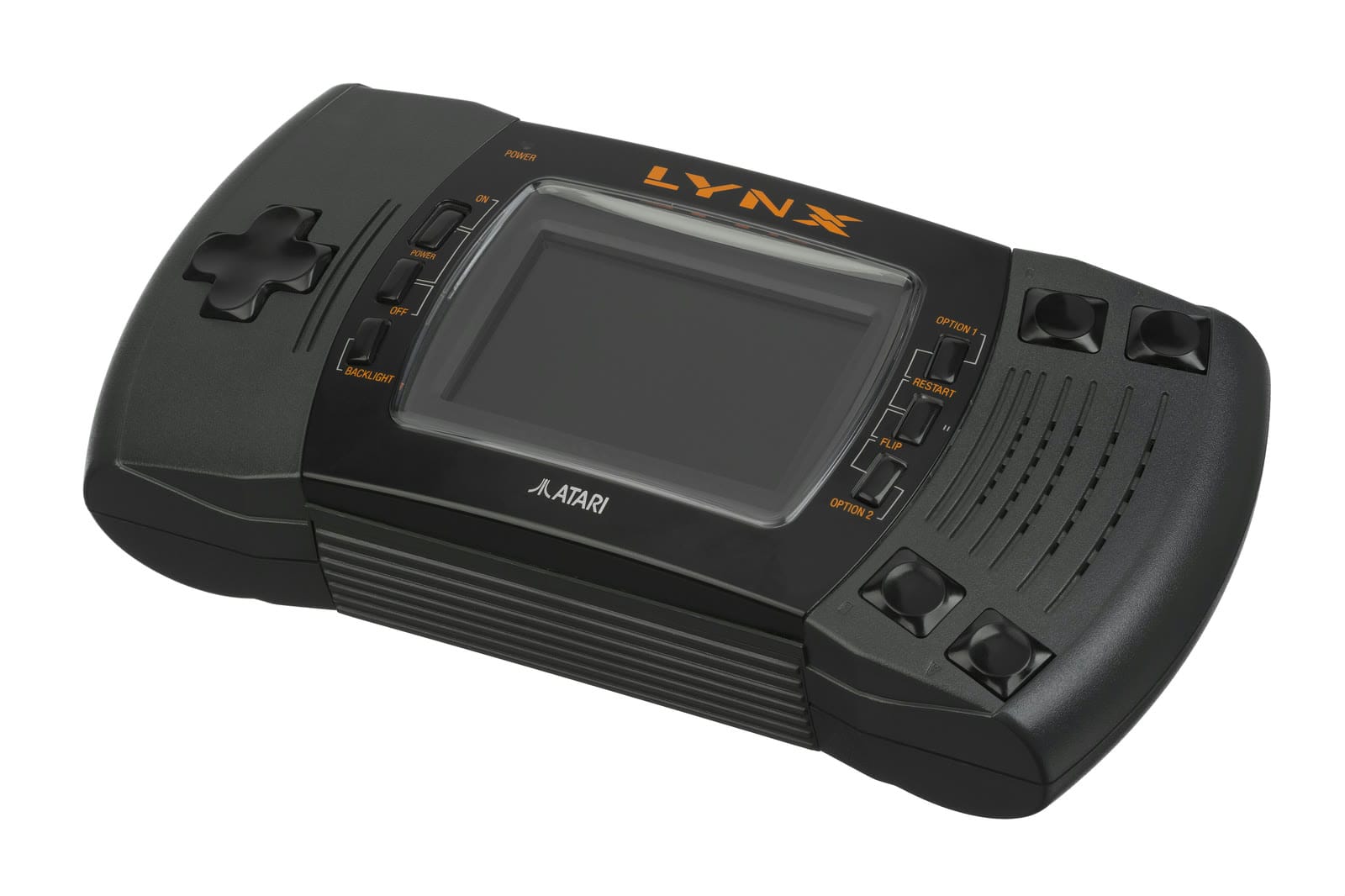
Atari had one more go in 1991 with the Lynx II. Smaller, lighter, with rubber grips, stereo in your headphones at last, and a backlight you could switch off while a game was paused. A couple of years later you could find one in shops for about $80, less than half what the first Lynx cost. But by then Atari’s attention had moved to its new home console, the Jaguar. The ads stopped, and in 1995 the support did too, the same year as Super Asteroids and Missile Command, usually named as its last Atari game. Before the ads stopped, though, one of the early ones put a schoolboy in the school toilets, sneaking a game on his Lynx, and fans identify the kid as a young Tobey Maguire. If they’re right, that’s a future Spider-Man, sneaking off with a Lynx.
What it cost, then and later:
| Model | When | Price | What it was |
|---|---|---|---|
| Lynx | Late 1989, US | Around $179 | California Games, a link cable and a carrying case in the box |
| Lynx | November 1989, Japan | - | Atari’s push into Nintendo’s home market |
| Lynx II | Mid-1991 | - | Smaller, lighter, rubber grips, a backlight you could switch off |
| Lynx II | About 1993, US | $99.99 alone, $129.99 in a bundle | Often down to $79.99 in shops |
How it was made
The hardware is the part people still talk about, and the original spec explains it better than most histories.
In numbers:
| Part | Atari Lynx |
|---|---|
| Processor | A 65C02 built into a custom chip called Mikey, at about 4 MHz |
| Graphics | Suzy, a 16-bit chip that scales and stretches sprites in hardware |
| Memory | 64 KB, shared by the screen and the game |
| Screen | About 3.5-inch backlit colour LCD, 160 x 102 |
| Colours | 16 on screen, out of 4,096 |
| Sound | Four channels; mono on the first model, stereo on the Lynx II |
| Power | Six AA batteries |
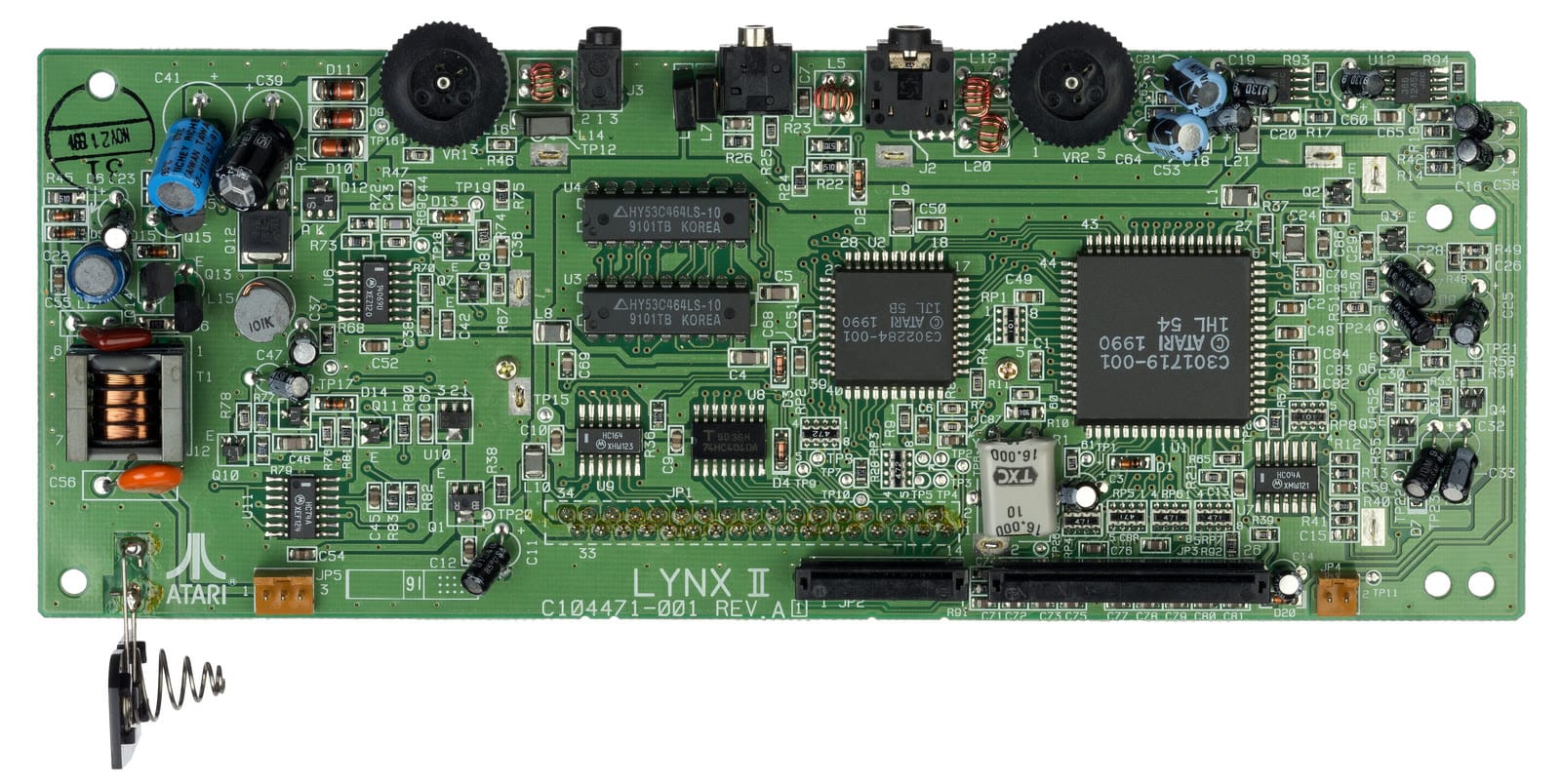
Two custom chips. Epyx named them Mikey and Suzy. Mikey holds the processor, the sound, the timers and the screen driver. Suzy does all the drawing and the fast maths.
The brain. The processor is a 65C02, a faster relative of the chip in the Commodore 64 and the Apple II, built right inside Mikey. It runs at about 4 MHz, which Mical put at four times a Commodore 64. The designers could have used the Amiga’s chip, the 68000, and didn’t, because of price, and because a 65C02 could be built into their own custom chip. It’s an 8-bit processor. Suzy is a 16-bit chip, and Atari sold the Lynx as “16-bit”. Half of it was.
The screen. About 3.5 inches corner to corner, a bit smaller than a credit card. A tiny fluorescent tube lights it from behind, the same kind of light as the long tubes in a school hallway, shrunk to fit in your hands. That’s what let you keep playing in the back seat after dark. It shows 16 colours at a time out of 4,096, which is like owning a box of 4,096 crayons and being allowed 16 of them for each picture. On a handheld game console in 1989, a lit colour screen was brand new.
Suzy’s trick. A sprite is a moving picture in a game, like a character or a car. Suzy resizes every sprite as it draws it, so things can zoom toward you smoothly. It can also change a sprite’s width and position on every single line it draws, which the spec calls stretch and tilt, and that lets it fake 3D roads, floors and walls. There’s no fixed limit on how many sprites it can draw, and it has hardware to multiply and divide numbers fast. For a handheld in 1989, that was a lot.
The memory. The Lynx had 64 KB of working memory, the space where a game keeps everything it’s doing right now, and the picture on the screen had to live in there too. One photo on your phone today takes up dozens of times more room than that.
The sound. Plug headphones into the first model and you still got mono, the same sound in both ears. The Lynx II fixed that. The chip itself could play four sounds at once, like a little band of four, all squeezed through one small speaker.
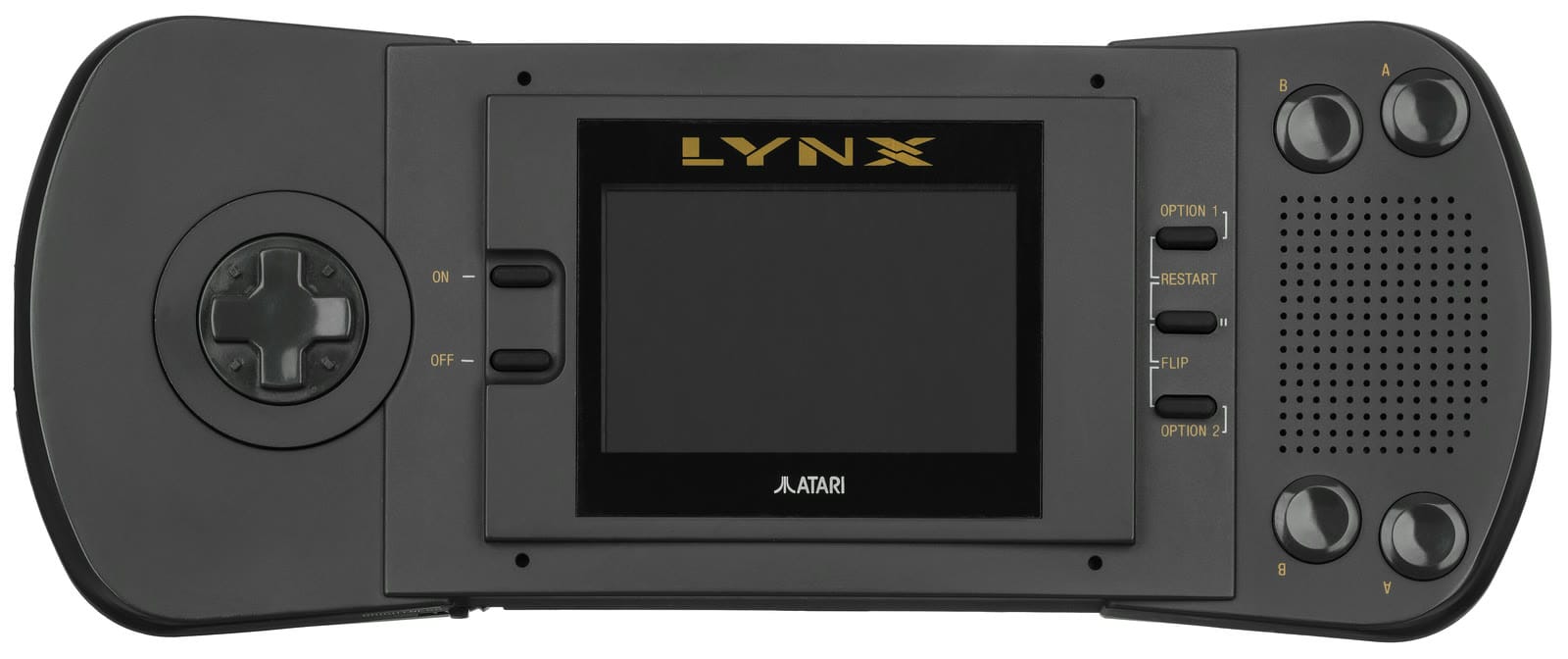
Flip it over. There are two pairs of A and B buttons, one on each side, and the game can turn the picture upside down. Hold it the other way round and a left-handed player has the controls on the side that suits them. Atari patented it. The spec also allows for games played with the console held upright.
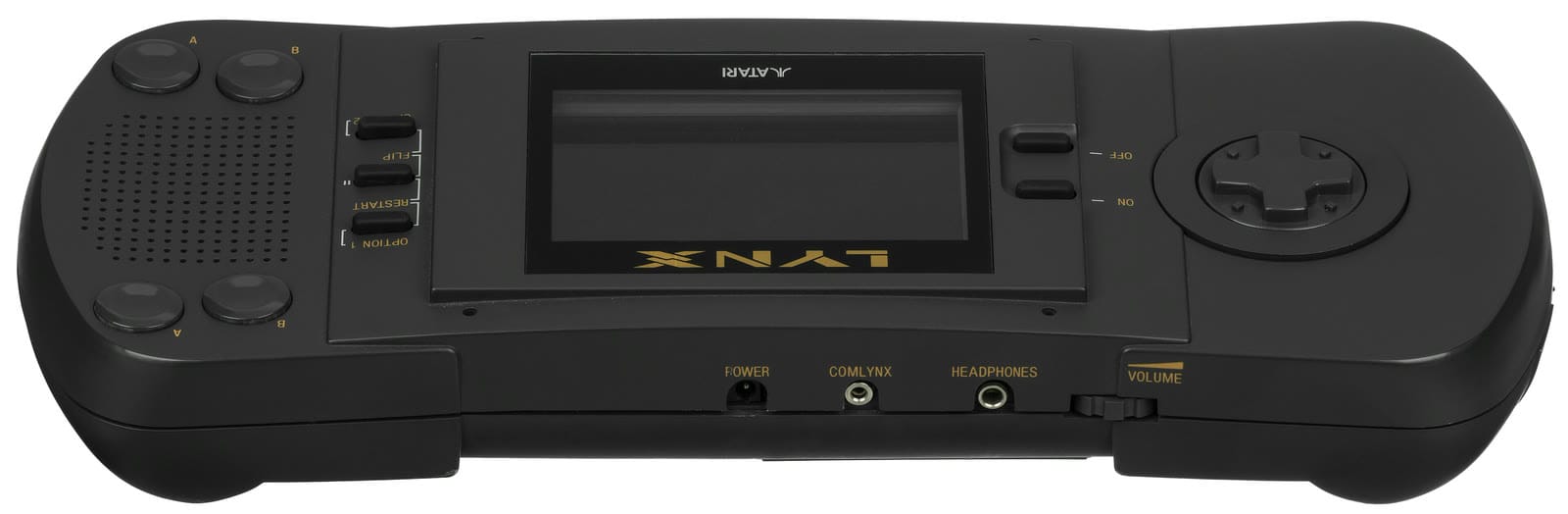
Six AA batteries, and the light behind that screen drank most of their power, going by fan measurements. Picture a long drive to your grandparents’ house. About four or five hours in, the Lynx goes dark, and all six are spent. The first model even switched itself off after five minutes of nobody touching it, just to make them last.
ComLynx. A cable from one Lynx to the next, and on to the next, like a string of fairy lights. The designers said that wire could carry 16 players. The most any real game ever managed was eight, in Todd’s Adventures in Slime World, and each of those eight players needed their own copy of the game. Eight friends, eight Lynxes, eight cartridges and 48 AA batteries, for one match. The early plans were wilder still. The spec first pictured an infrared link, an invisible beam like the one from a TV remote, and it designed in a cassette tape reader as another way to load games. A handheld that played tapes, like a Walkman with a screen. That one died for a simple reason: 64 KB of memory couldn’t hold a whole game.
The cards. Lynx games came on small, flat cards, and the first ones were hard to get your fingers on to pull out, so later ones got a curved lip to grab. Most held 256 KB, four times the console’s own memory. The kits developers used to make those games were built around Amiga computers, the machine Atari’s own ST was fighting in the shops. Atari’s handheld, made on its rival’s computer.
No TV out. On purpose. Needle pictured it on long car trips, on planes and on beaches. Atari reportedly built just two or three TV adaptors, for magazine screenshots.
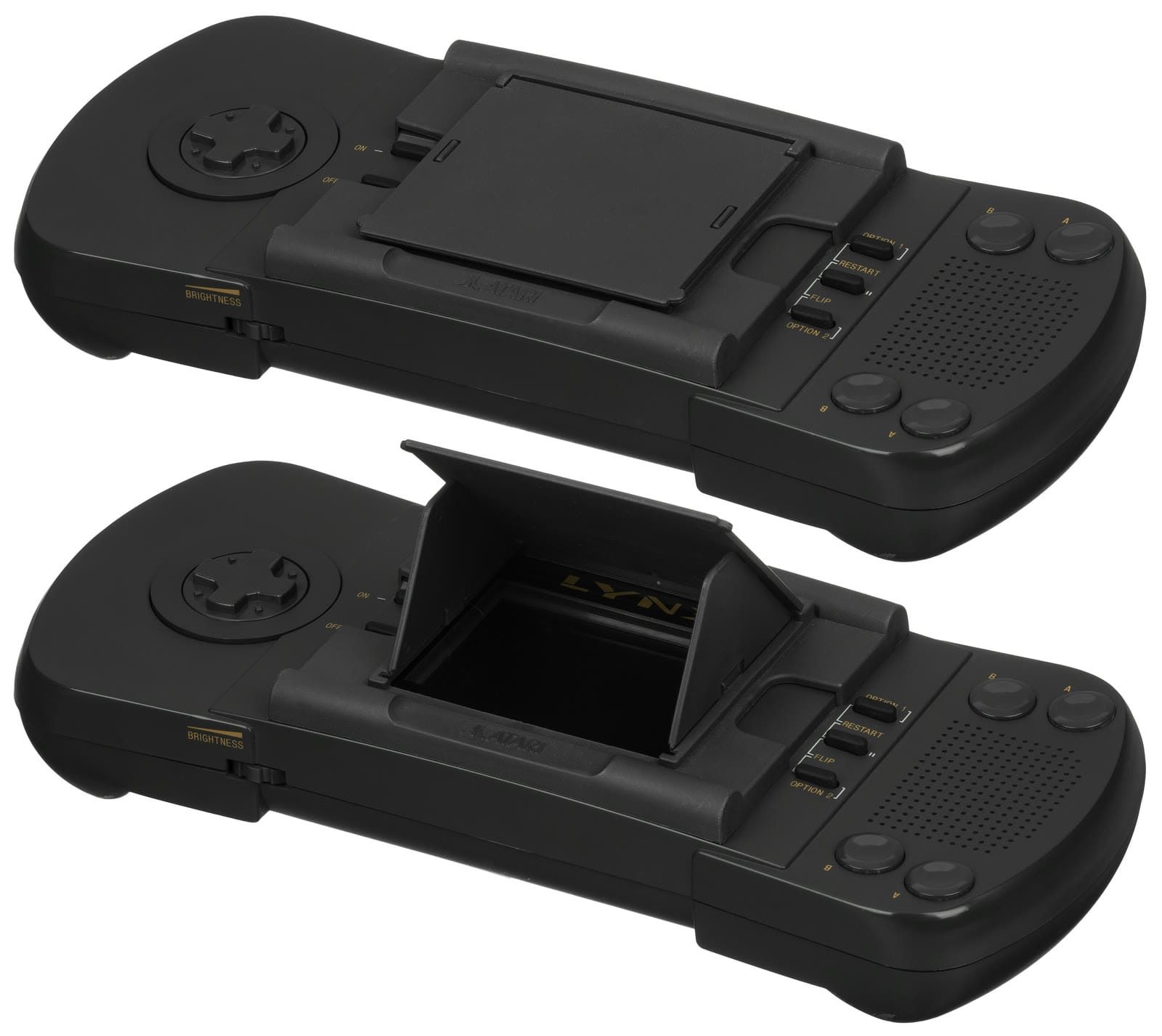
In 2008, nearly 20 years later, the Lynx won an Emmy. You read that right. The TV award, from its technology and engineering side, and this one was for innovation in handheld game screens. It shared the honour with the Nintendo DS and Mattel’s old Football and Auto Race handhelds.
Still getting new games
The Lynx left the shops in the mid-90s, and the games kept coming. Songbird Productions has been making new Lynx cartridges for more than 20 years, and in April 2026 it shipped a brand new one, Wee Ninja. A new cartridge, for a handheld from 1989, in 2026. If you’d rather play the old favourites, the easiest way is a console you already own: the Atari 50 collection has six Lynx games in it, and more are on Steam. And for the cartridge crowd, Atari and Songbird even made a fresh Super Asteroids and Missile Command card in 2024, curved lip and all.
In June 2026, a fan got Wolfenstein 3D running on the Lynx, drawing its walls with the same stretch and tilt that were written into the 1987 spec. A trick meant for fake roads and walls, used almost 40 years later for a shooter. If you still have your old cards, an Analogue Pocket with an adapter will play them. And a brand new Lynx? Atari clearly likes the idea. In May 2026 its director of sales and marketing called the Lynx “one of the Holy Grails” for a hardware revival, but the money doesn’t work, and nothing is coming soon.
Based on Epyx’s 1987 Handy hardware specification, Atari’s flip-screen patent (US 4,969,647), the designers’ 1989 interview in Electronic Gaming Monthly, Wired (1994), the Akron Beacon-Journal (1989), the Associated Press (1991), the Seattle Times (1995), Guinness World Records, GameSpot on the 2008 Emmy, Famitsu, the alt.games.lynx FAQ, a 1993 Cleveland Free-Net Lynx guide, AtariAge, Evercade, Steam, Songbird Productions, Time Extension and Maximum Utmost, as of November 16, 2026. Where the sources disagree, the page says so.
Nerd Alert
Your Turn
What are YOUR thoughts
What have your experiences been? Let us know.