Game Boy Advance SP (2003)
The Game Boy Advance folded shut, with a light and a battery you charge: an idea nearly shot down, no headphone jack, the special editions, and a 2005 backlight you can only spot on the label.
https://averagetechnerds.com/game-boy-advance-sp/
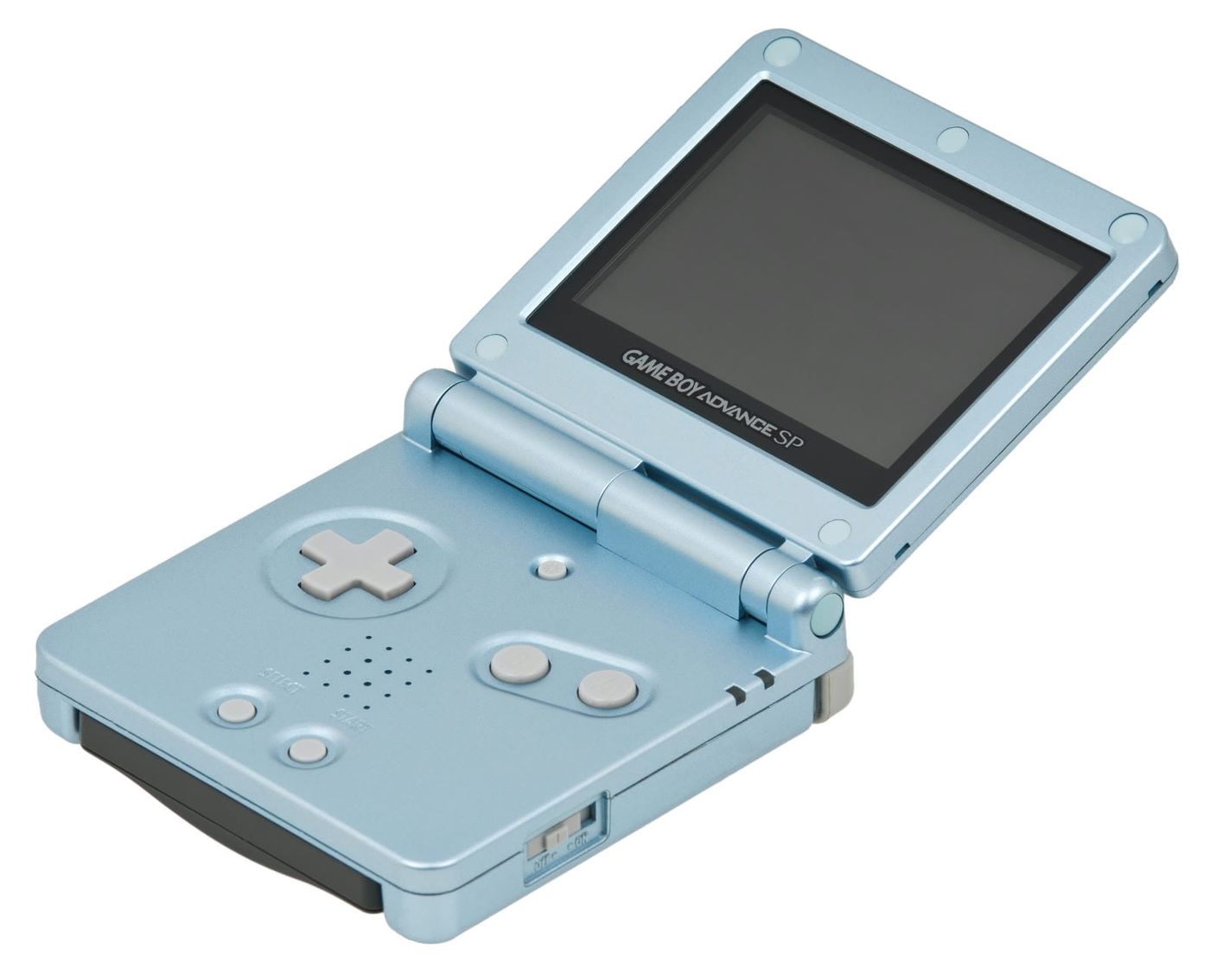
Turn off the bedroom light, flip the lid open, press the little button between the screen and the controls, and there’s your game, glowing in the dark. After two years of tilting a Game Boy Advance under a lamp, that one button was the whole reason to want an SP.
There’s a detail that’s easy to miss, though. There are two Game Boy Advance SPs that look almost exactly the same. The first one lights its screen from the front. The second, which Nintendo slipped into stores in 2005 with barely a word, lights it from behind and is far brighter. The surest way to know which one you had is still to flip it over and read the label.
That’s the SP. Nintendo took the Game Boy Advance’s two big complaints, a screen you couldn’t see without a lamp and a hunger for AA batteries, and fixed both in a folding shell, with the same chips inside. It lost the headphone jack along the way, sold 43.57 million, and got its proper backlight late in life, quietly.
An idea almost nobody liked
It nearly didn’t happen. At Nintendo, Satoru Okada pitched a small, thin Game Boy Advance with a rechargeable battery to about ten people, and the feedback was almost all negative. The battery would be too expensive. It would be too fragile.
So he had an engineer build a concept model as small as possible, without worrying about whether it could actually be manufactured. He showed that to the same group, and in his words they “completely changed their tune”. Sometimes you have to put the thing in someone’s hand.
Valentine’s Day, 2003
It went on sale in Japan on Valentine’s Day, February 14, 2003, for 12,500 yen with the charger in the box. The original Game Boy Advance was 8,800 yen by then, so this was the premium model, and Nintendo pitched it that way: its release said the folding design gave it a look adults wouldn’t hesitate to slip into a shirt pocket. That’s a nice moment. Nintendo saying, in writing, that a Game Boy wasn’t only for kids anymore.
North America got it about five weeks later, on March 23, and Europe five days after that. If the price in your head is $99.99, you’re remembering the number most people quote, but Nintendo of America’s own release says $99.95. Call it a hundred dollars either way.
And the name? “SP” stands for special. Nintendo of America’s own FAQ explained it with a car: same performance as the Game Boy Advance, with a flashier design and a built-in light, “like adding in leather seats and a sun roof when you buy a car”. The “Small Pockets” and “Super Portable” guesses are jokes.
It sold fast. Six weeks after that Valentine’s Day launch, Nintendo had already shipped more than two million SPs around the world, by its own count. Averaged out, that’s about one leaving the warehouse every two seconds, around the clock.
Same insides, new everything else
Nintendo of America said it plainly: “Internally, the two systems are essentially the same.” Nothing got faster. Every game ran exactly as it did on the original. Everything around the chips changed.
It folds. The screen lives in the top half and shuts over the buttons, so the screen is protected in a bag or a pocket. Closed, it’s a little square about the size of a drink coaster, close to half as wide as the original GBA. To get there, the L and R buttons shrank and moved, and the cartridge slot went underneath. And one small surprise: shutting the lid doesn’t turn it off. Nintendo’s manual says so, which is why the game kept running in the dark and, now and then, the next morning brought a flat battery.
It has a battery you charge. No more hunting through the kitchen drawer for two fresh AAs: the SP had its own rechargeable pack built in. With the light on, a full charge lasted about 10 hours, a five-hour car ride there and back. And when it did run flat, you could plug it in and keep playing.
And it has no headphone jack. To use headphones you needed Nintendo’s Headphone Adapter, sold separately for about four dollars, and it plugged into the same socket as the charger. So you could charge, or you could listen with headphones, but not both at once. That was 2003, years before phones started doing the same thing. The tiny Game Boy Micro brought the jack back in 2005.
How it was made
To see why the SP’s light was such a clever patch, start with the screen. It’s the same 2.9-inch, 240 by 160 color screen as the Game Boy Advance, with 32,768 colors, and it’s a reflective screen. That means it has a mirror-like layer behind the pixels and shows you a picture by bouncing light from the room back at you. Plenty of light in the room, good picture. No light, no picture.
In numbers:
| Part | Game Boy Advance SP |
|---|---|
| Inside | The same as the Game Boy Advance: a 32-bit ARM chip with the old Game Boy processor built in |
| Screen | 2.9-inch, 240 x 160, front-lit (backlit on the 2005 AGS-101) |
| Battery | Built-in rechargeable lithium-ion: about 10 hours with the light on, 18 off, 3 hours to charge |
| Size | 84.6 x 82 x 24.3 mm folded, about 143 g |
| Headphones | No jack; an adapter shared the charging socket |
| Old games | Plays Game Boy, Game Boy Color and Game Boy Advance cartridges |
The front light (model AGS-001, 2003). Instead of rebuilding the screen, Nintendo laid a light on top of it. Picture a thin, clear sheet over the screen with tiny lights along one edge, according to a modder’s teardown. The sheet spreads that light across and down onto the pixels, and the mirror layer bounces it back up to your eyes. It works, and it’s cheap and easy on the battery. But the light passes through the pixels twice and the sheet sits in front of them, so the picture looks a bit washed out next to a backlit screen. Nintendo called it the first front light on a handheld game console. The button between the halves just switches it on and off, and Nintendo’s own tip was to leave it off in bright places, for the best colors and a longer battery.
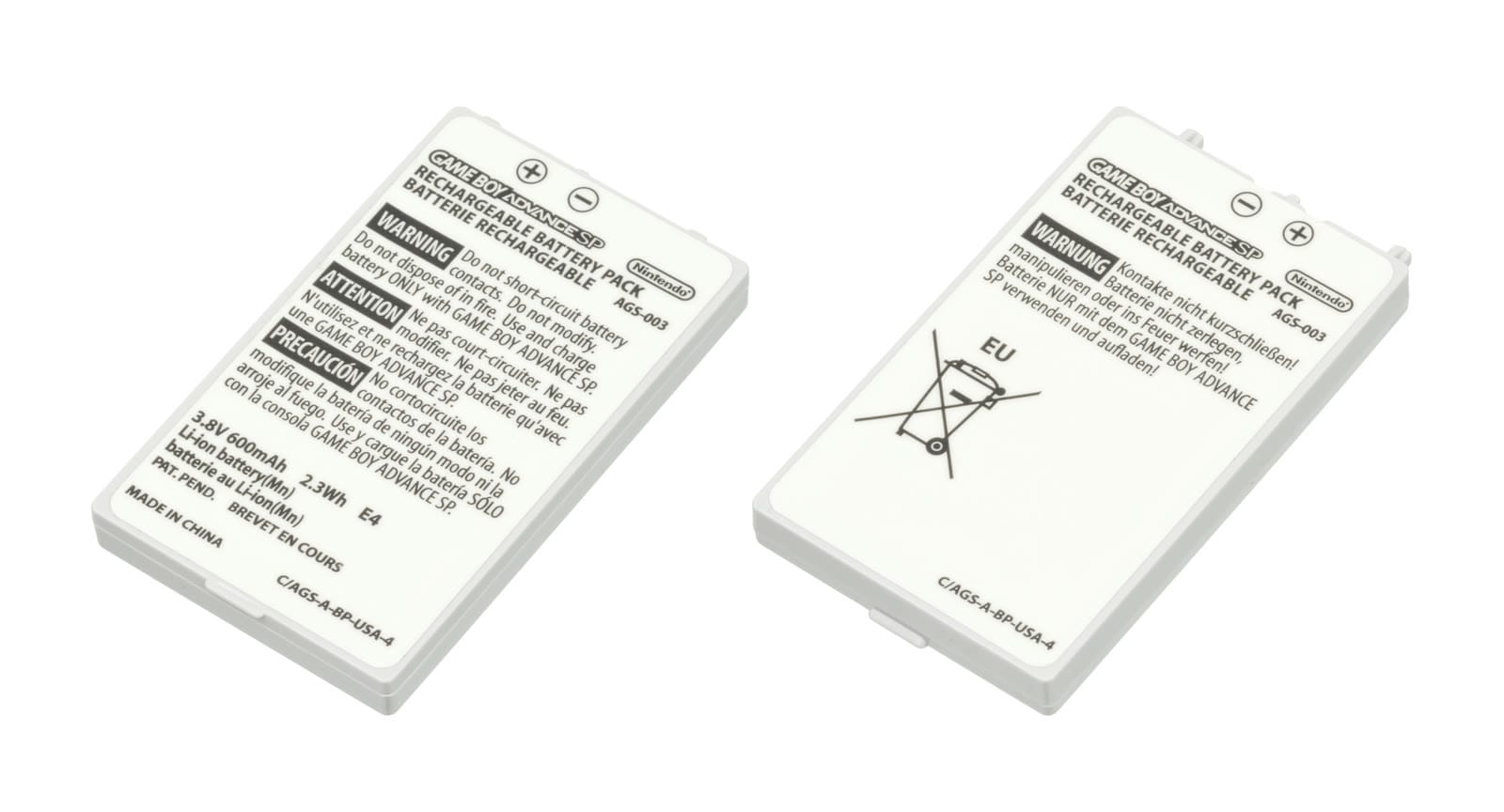
The battery. It sits behind a small cover on the back, like the battery door on a TV remote, so when it wore out you didn’t need a new Game Boy, just a new pack, and Nintendo sold them. And it does wear out. Nintendo’s manual says that after about 500 charges it holds roughly 70 percent of what it did new. Charge it every other day and that’s close to three years of play.
The sockets. Up top there are just two. One is for when you wanted company: a link cable to your friend’s Game Boy, or the cable to the GameCube. The other does double duty, charger or that headphone adapter, so with your headphones on, a low battery meant you had to pick one. The charger only fit the SP, none of the older Game Boys, but it got a second life when the original DS used the same one.
What it plays. Game Boy, Game Boy Color and Game Boy Advance cartridges, so the games from your old Game Boy still had a home: three generations in one pocket. Nearly all the old ones work, and L and R stretch them out to fill the wider screen. It talks to other machines, too. Plug it into a GameCube with a cable and Metroid Fusion unlocks extras in Metroid Prime, a little handshake between Samus on the TV and Samus in your hands.
A secret in the manual. Hold a direction and a button while the Game Boy logo is on screen, and an original black-and-white Game Boy game boots in one of 12 color palettes. Left and B gives you gray. It sounds like a playground rumor. It’s printed in the SP’s own 2003 manual, and it’s really the color boot code shared by the Game Boy Color and the whole GBA family, so it works on the original GBA and on every SP, front-lit or backlit. It does nothing for Game Boy Color or GBA games.
Folding wasn’t even new for Nintendo. Back in 1982, the two-screen Game & Watch games, starting with Oil Panic, already snapped shut. The man working out that hinge went shopping for makeup compacts to see how theirs opened. He told that story in Iwata Asks, where it leads to the DS. So when the SP clicked shut like a compact in a handbag, two decades later, it was a trick a Game & Watch had pulled first.
Special editions
Over the next couple of years the SP put on a lot of outfits, and one of them was a birthday present. For the Famicom’s 20th anniversary, Nintendo Japan dressed an SP in Famicom colors and released it on February 14, 2004, the same day as its Famicom Mini line of classic games, and one year to the day after the SP itself came out. North America and Europe got their own version that summer, the Classic NES Edition, with old NES games re-released to play on it. Europe also got a gold Zelda SP with the Triforce on the lid, and in Japan the Pokemon ones mostly lived at Pokemon Centers.
The main versions, start to finish:
| Model | When | Price | What it was |
|---|---|---|---|
| Game Boy Advance SP | February 2003, Japan | ¥12,500, charger included | The fold-up, front-lit original |
| Game Boy Advance SP | March 2003, US | $99.95 | Cobalt and Platinum at launch |
| Famicom edition | February 2004, Japan | ¥12,500 | Dressed for the Famicom’s 20th birthday |
| Classic NES Edition | June 2004, US | About $100 | The same idea for America |
| Price cut | September 2004, US | About $80, as reported | - |
| AGS-101 | September 2005, US | $79.99 | The backlit one, sold with almost no fanfare |
Then it got cheaper. From September 1, 2004, the US price dropped by twenty dollars, to about $80, the AP reported at the time. Remember that $80. It comes back.
A backlight, without a word
A year after that price cut, a new SP slipped onto North American shelves, and from the outside you could hardly tell. Same fold, same shape, same $79.99 as the one already in stores. The sure giveaway was the label underneath: AGS-101. It arrived on September 19, 2005, the same week as the tiny Game Boy Micro, in Graphite or Pearl Blue, plus a SpongeBob edition at Toys “R” Us.
The difference was the light. The AGS-101 has a real backlight, sitting behind the screen and shining straight through the pixels toward you, like a phone. A Nintendo spokesperson explained the switch simply: “the technology has come down in price enough for backlights to be affordable”, and “All GBA SPs manufactured in the future will feature backlights.”
Nintendo hardly told anyone. The only marketing was one line on the box: “Now with a BRIGHTER backlit screen!” The little button between the halves changed jobs, too. On the backlit model it flips between two brightness levels, and there’s no off at all. IGN got its hands on one that week and found the screen far brighter, with colors punchier than the games were drawn for, and pixels a touch slower to change, so scrolling left a faint blur.
And the label is still the only sure test. Color doesn’t settle it, because Japan had a Pearl Blue front-lit model back in 2003, and some European colors came in both versions. Flip it over: AGS-001 is front-lit, AGS-101 is backlit. Outside North America it’s a murkier story. A limited European release reportedly followed in 2006, and it reportedly never came out in Japan at all.
One more correction while the light’s on: the SP wasn’t the first Game Boy with a light. That was the Japan-only Game Boy Light from 1998, which had a backlight. Nintendo’s own claim was narrower, the first front light on a handheld, and by IGN’s count it was the first lit Game Boy sold in the US.
More than half of them
So which Game Boy Advance did people actually buy? Mostly this one. Nintendo’s sales page today lumps the original, the SP and the Micro together at about 81.5 million, but its older tables split the SP out: 43.57 million, more than half the family on its own. Line up every Game Boy Advance Nintendo ever sold, and more than half of them fold shut. And more than half of those SPs went to the Americas.
Nintendo never announced an end date. Its shipment tables show the Americas finishing around 2008, and the last few trickling out elsewhere until about 2011 or 2012. The Game Boy Micro that came after it played only GBA cartridges, which makes the SP and the original Game Boy Advance the last Nintendo handhelds that played your old Game Boy games.
And today? Some of its games live on Switch Online, in the Expansion Pack tier at $49.99 a year. And if you kept your cartridges, the Analogue Pocket plays them, front light not needed.
Based on Nintendo’s 2003 releases in Japan, North America and Europe, Nintendo of America’s SP FAQ and the 2003 instruction booklet, Nintendo’s historical sales tables, Nintendo UK’s history pages, Satoru Okada’s 2022 interview, Eurogamer and IGN on the 2005 backlit model, Nintendo World Report, Game Developer, AP, Iwata Asks, Pan Docs, the maru-chang model reference, and Nintendo’s Switch Online and Analogue’s Pocket pages, as of November 16, 2026. Where the sources disagree, the page says so.
Nerd Alert
Your Turn
What are YOUR thoughts
What have your experiences been? Let us know.