TurboGrafx-16 (1989)
A tiny Japanese hit that played games on credit-card HuCards, gave consoles their first CD-ROM drive, then came to America in a bigger box with one controller port.
https://averagetechnerds.com/turbografx-16/
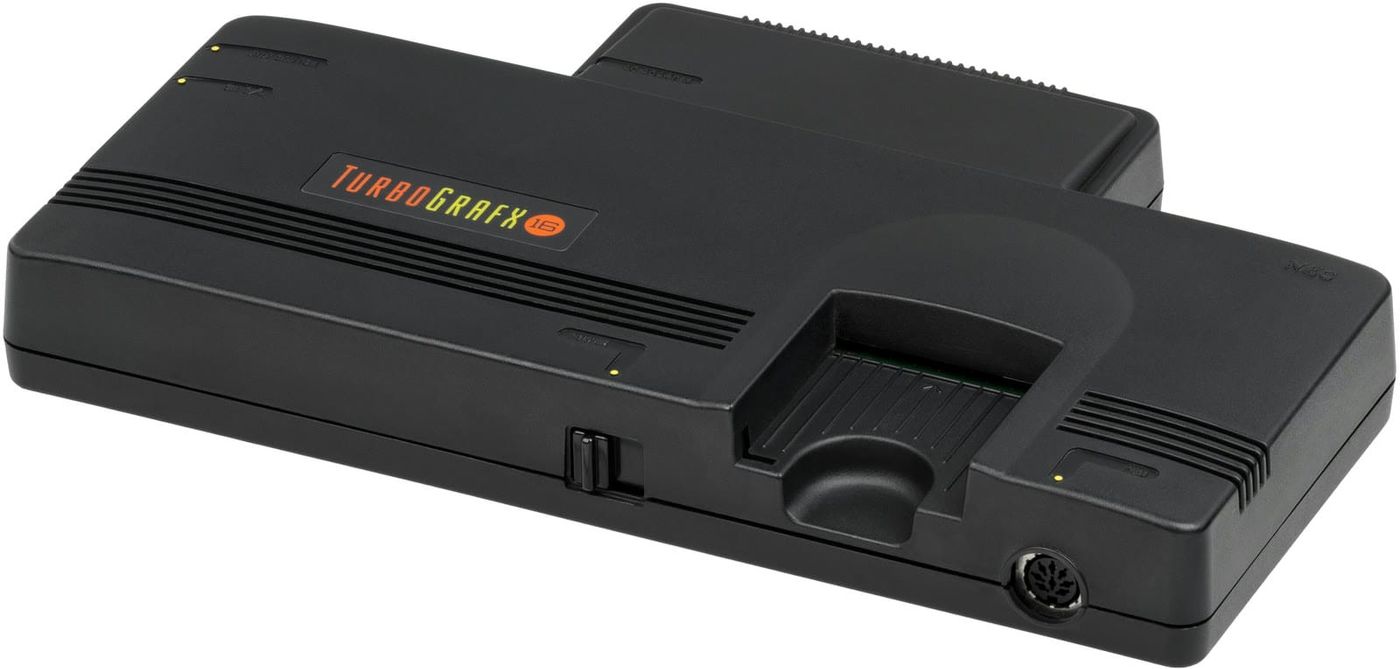
In 2020, Konami brought out an official TurboGrafx-16 mini, a little plug-in-and-play tribute to a console from 1989. Put Konami’s measurements next to the original Japanese console’s, and the mini is the bigger of the two.
Rewind to 1987, in Japan. The machine started there as the PC Engine, a tiny white box about 14 centimetres square that played games on cards the size of a credit card. Japan liked it, and it was the first home console to get a CD drive. Then it crossed the Pacific in a much bigger black case, picked up a new name with a “16” in it that only half explained itself, and ran straight into the Genesis.
A game company builds a chip
The PC Engine started with game makers who wanted a better machine to make their games on. Hudson Soft was a studio in Sapporo, way up on Japan’s northern island of Hokkaido, started by two brothers, Yuji and Hiroshi Kudo. If you’ve played Bomberman, you’ve played their work. Their engineers wanted more than Nintendo’s Famicom could give them. So before there was any console, they designed the chips.
Getting those chips made was the hard part. The big chipmakers wouldn’t take the job, so Seiko Epson built them, and the chip cost about ¥200 million to make, by the Japanese histories. The design was Hudson’s own. One engineer, Kimio Yamamura, is named on its 1987 patents for how the chips move characters around the screen, make colour and make sound. The people behind Bomberman had drawn up the insides of a console.
Hudson had the chip. NEC had the factories. The electronics giant had wanted a CD-ROM game machine since about 1985, and what it lacked was a cheap chip to build one on. So when Hudson shopped its design around, NEC said yes. Hudson got a royalty on every console made and every game card, according to its first American employee. Even the ones that never sold.
The PC Engine
The name was the plan. NEC reportedly pitched it as the “heart of the computer”, an engine you’d keep bolting new parts onto as the years went by. Think of the first piece of a stereo stack, with room on your shelf for the rest. It went on sale in Japan on October 30, 1987, for just under ¥25,000.
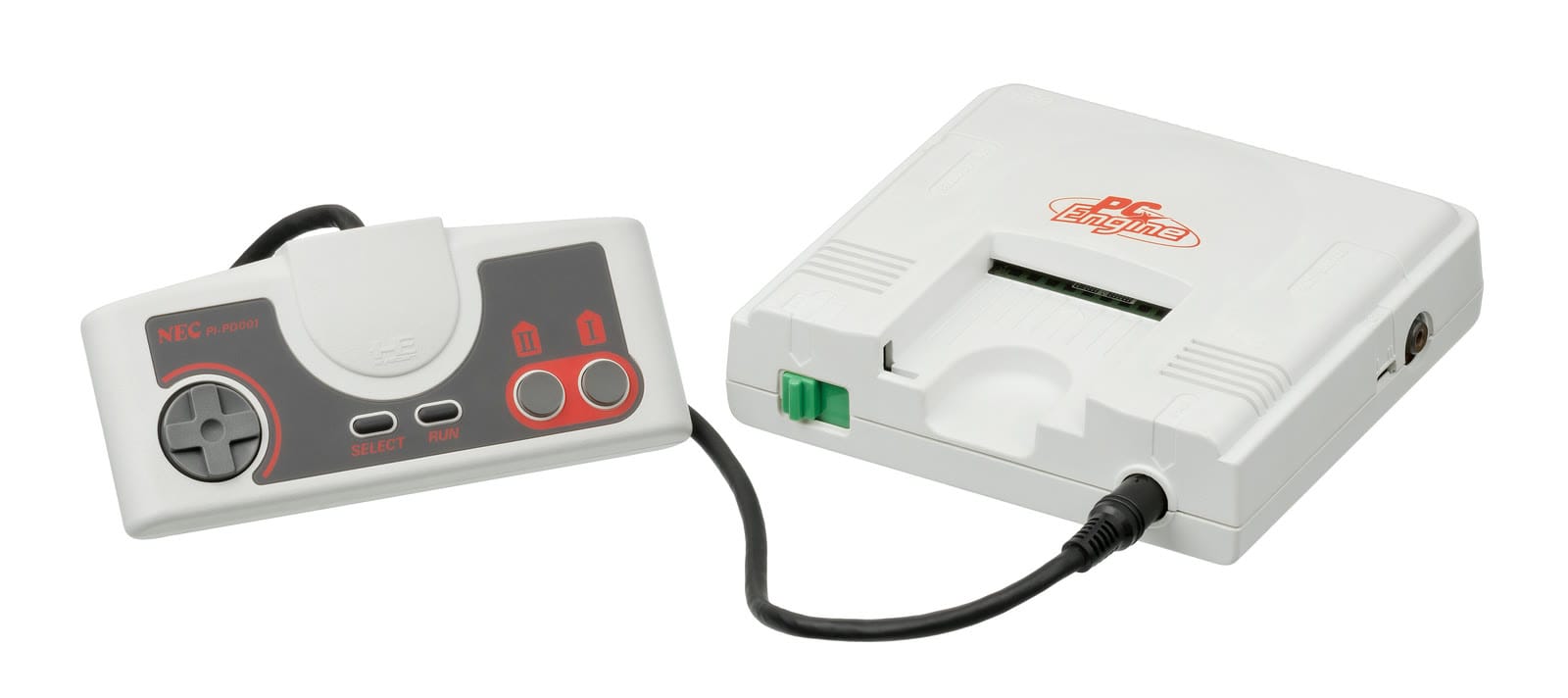
It was small. Roughly 14 by 14 centimetres and 3.5 tall, which makes it one of the smallest home consoles ever made. The games came on HuCards, thin cards about the size of a credit card, that slid into the front.
It also sold. About 600,000 went out in the first year, and it settled in as Nintendo’s main rival in Japan, with Sega’s Mega Drive left as a niche machine there. You might read that the PC Engine beat Nintendo outright. Nobody has turned up the sales figures to back that up. Second to Nintendo, with Sega well behind, is what the numbers actually show.
The games helped, and some of them came from a strange place. NEC’s own games arm ported Sega’s arcade hits, Space Harrier, Fantasy Zone, After Burner II and Out Run, onto a console fighting Sega’s for the spot under the TV. Picture finding Mario on a PlayStation and you’re close. Japanese publishers like Namco, Konami, Irem and Human signed up too.
A CD drive, in 1988
A CD drive. On a game console. In 1988. NEC’s CD-ROM2 docked to the PC Engine and went on sale on December 4, 1988, and as far as anyone has found, no other home console had one for several years. If the PlayStation is where disc games start for you, this one got there first.
To put that in perspective, a CD-ROM drive for a computer in Japan back then cost about ¥250,000. NEC’s console drive came in at nearly ¥60,000, more than twice the price of the console itself, which was a lot of money and still a fraction of the alternative. It wasn’t the first CD games device of any kind, since computers already had drives. It was the first one you plugged into the console under your TV.
A disc meant room. Room for real recorded music, for voices, for animated scenes, where a card had only the console’s own sound chip to make its music. One of the early discs, Fighting Street, was reportedly the first home version of Capcom’s Street Fighter. Yes, that Street Fighter.
America gets a bigger box
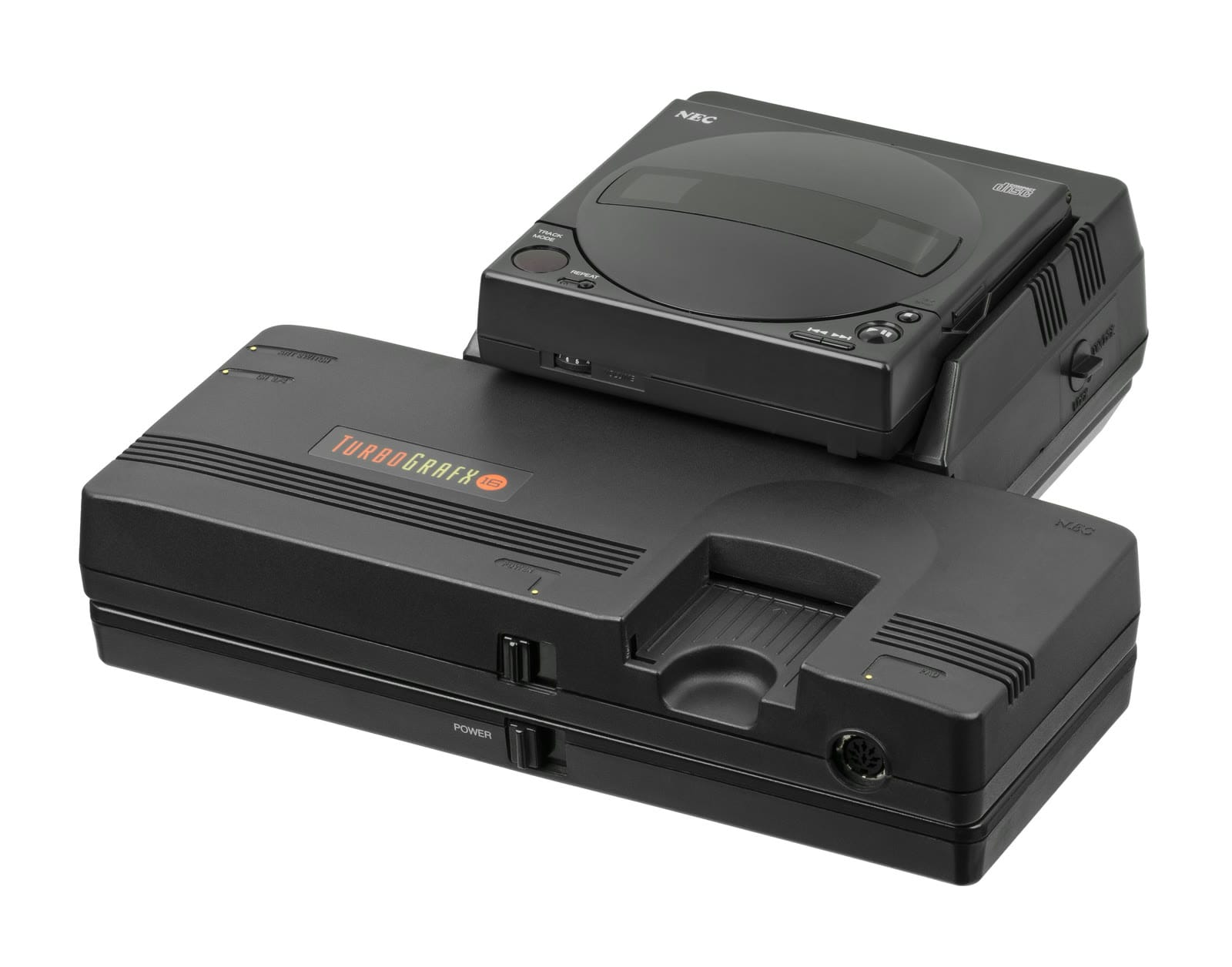
The little white box didn’t survive the trip. NEC’s American team ran focus groups, the name “PC Engine” got a lukewarm reaction, and the team came away feeling that Americans wanted something bigger and more futuristic. Hudson would have kept the little one. America got the big black one, unveiled in May 1989.
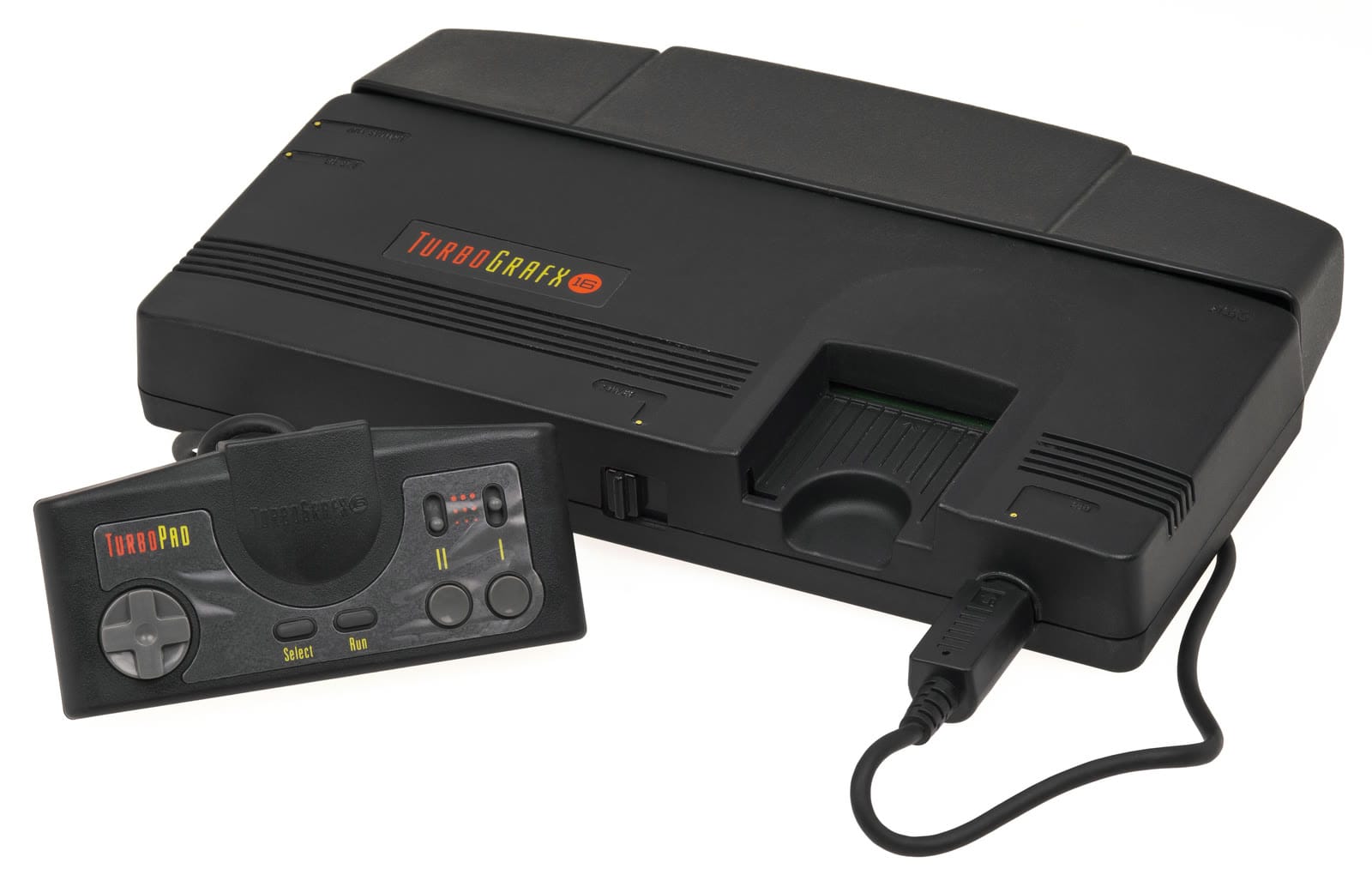
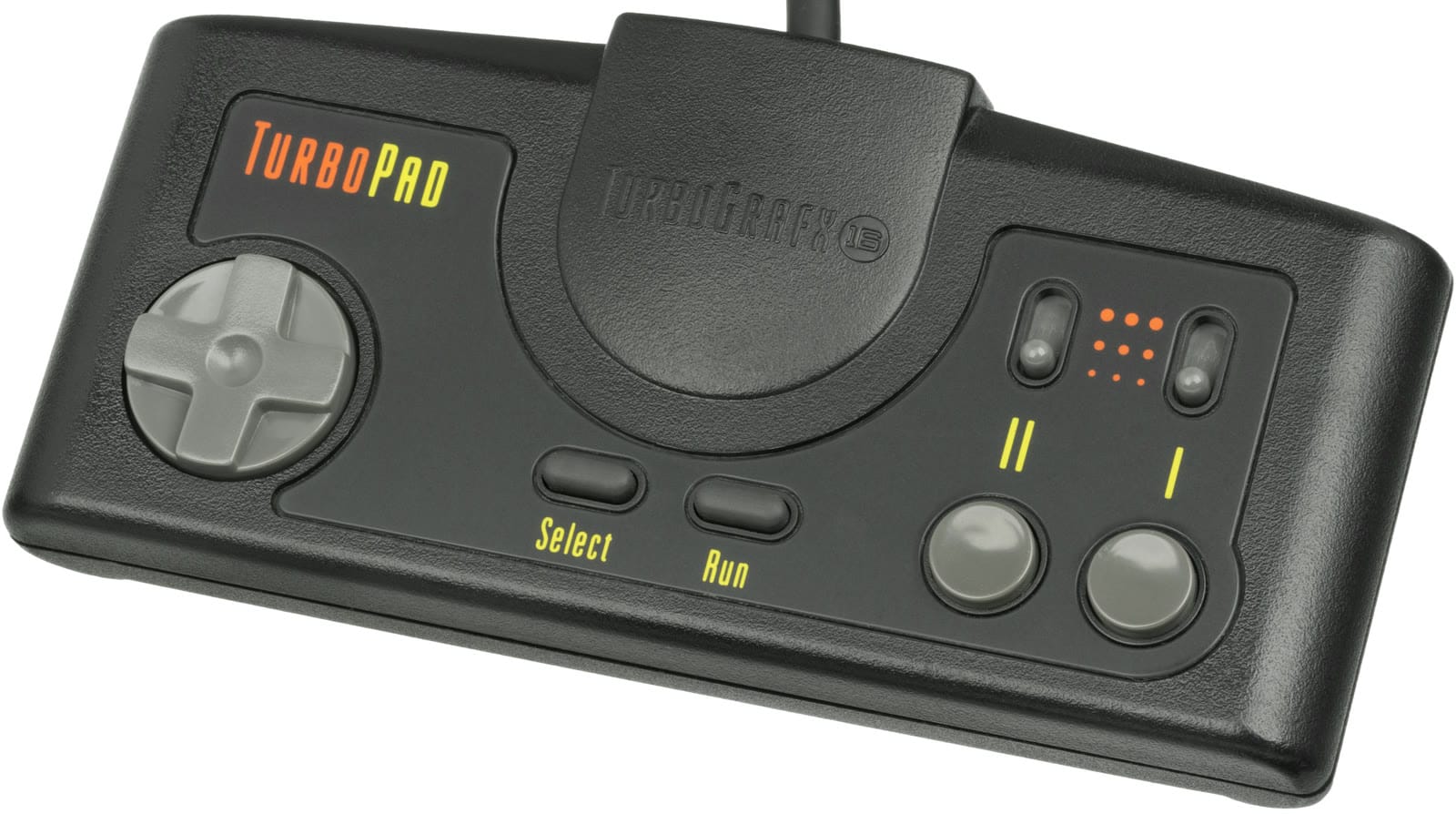
The new name came with it. “TurboGrafx” was for speed and graphics. The “16” was for the console’s 16-bit video chip, and NEC said exactly that at the announcement, while the processor running the games was an 8-bit chip. That’s where the long argument over whether it was “really” 16-bit comes from. The honest answer is half of it was. Everything got the Turbo treatment: the controller became the TurboPad, the multiplayer adapter the TurboTap, and HuCards became TurboChips.
It reached shops in New York and Los Angeles at the end of August 1989, for about $200, two weeks behind the Sega Genesis. In the box was Keith Courage in Alpha Zones, a Hudson game reworked from a Japanese one. And the hero’s name? Keith. He was reportedly named after NEC’s American boss, Keith Schaefer. If you ever wondered why a game hero is called Keith, there’s your answer.
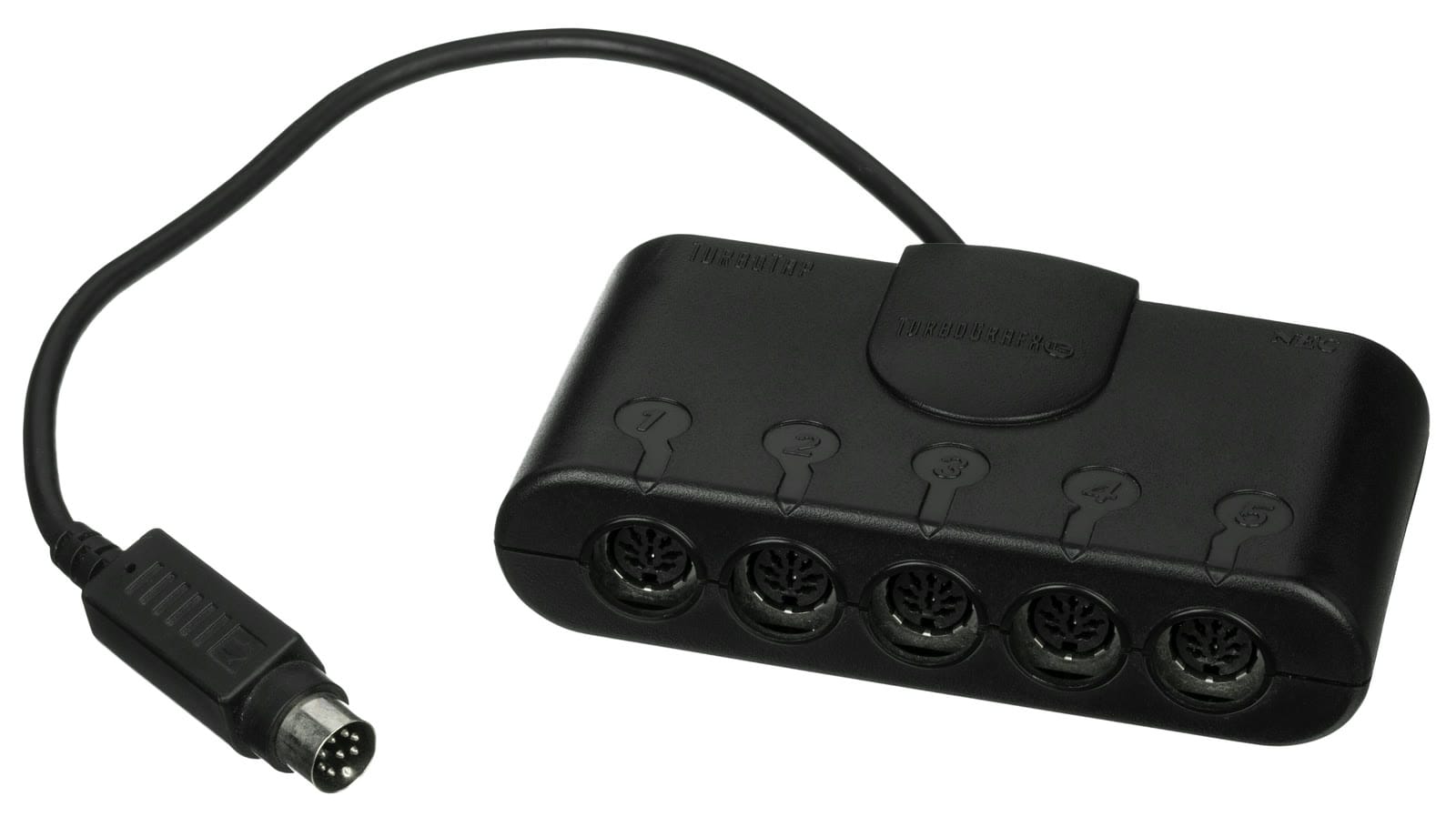
Two things in that box caught people out. It had one controller port. Every model did, so a second player meant buying the TurboTap, which took five. And the only video output on the original American console was RF, the antenna-style connection to channel 3 or 4, in mono, even though the sound chip inside was stereo. Composite video and stereo sound needed an add-on, the TurboBooster or the CD unit.
Losing to the Genesis
Sega simply outspent NEC. Probably four times as much on marketing, maybe ten, by the estimate of Ken Wirt, NEC’s American general manager. And Sega’s famous “Genesis does what Nintendon’t” was aimed at Nintendo. NEC wasn’t even in the fight Sega was picking. The games were the other problem. Nintendo’s exclusivity terms scared some American publishers off, and others would only let NEC publish their games for them. By the end, just five outside companies had signed up to make games for it.
NEC had also built for a hit. It made about 750,000 consoles for the American launch, far more than it ever sold. The leftovers had to go somewhere. The last 100,000 to 200,000 of them went to Brazil, by the accounts of people who worked there. Picture a warehouse full of consoles, shipped to another continent.
The CD drive came to America in late 1989 at $399, twice the price of the console, with no game in the box. It did bring a hard carrying case for the whole system. It played your music CDs too, and it put the graphics from CD+G karaoke discs up on your TV. About 20,000 sold in America, by one estimate. Twice the price, and nothing to play when you opened it. You can see why.
In 1992 Hudson took the wheel. A Hudson-led company in Los Angeles took over the American side and put the console and the CD drive in one box, the TurboDuo, for about $300. Then it went after Sega in the ads, with comic strips starring Johnny Turbo, a hero modelled on the company’s own brand manager, fighting a villain called “FEKA”. You don’t need help spotting who that was aimed at. By that brand manager’s account, the company even had a verbal deal for Mortal Kombat, until Japan said no. Johnny Turbo very nearly had Mortal Kombat. Instead, it was all over by 1994.
Bonk, Bomberman and the cards people kept
Sonic was still a year and a half away when this console got its mascot: Bonk, a caveman with a huge head, in Japan in December 1989. Even his names were jokes about the machine he lived on, PC Genjin, “PC caveman”, in Japan and PC Kid in Europe. The launch hero was reportedly named after a boss. The mascot was named after the console.
The one-port problem had an upside. Hudson’s first five-player Bomberman was a PC Engine game, built around that multitap, and the TurboTap made it possible here.
The family
The PC Engine kept growing sideways. The SuperGrafx, in Japan in December 1989, added a second video chip and four times the memory, and only five games were made for it.
The TurboExpress, the PC Engine GT in Japan, was the whole console shrunk down to fit in your hands at the end of 1990. It played the very same cards on a colour screen lit from behind, like a phone screen, so a dark room was no problem, and you could even add a TV tuner. It was hungry, though. Six AA batteries, gone in about three hours.
The Duo followed in 1991, console and CD drive in one body, and it won a Good Design Award. The last trick was the Arcade Card in 1994. It was a Japan-only card packed with extra memory, made so Neo Geo arcade fighters like Fatal Fury 2 and Art of Fighting could come home on CD. Arcade fighters in your living room, on a console from 1987. The idea reportedly came from the Los Angeles office.
The main models and add-ons, from the first to the last:
| Model | When | Price | What it was |
|---|---|---|---|
| PC Engine | October 1987, Japan | ¥24,800 | The original, a small white box |
| CD-ROM2 | December 1988, Japan | Nearly ¥60,000 | The first CD drive for a home game console |
| TurboGrafx-16 | August 1989, US | About $200 | The bigger American version |
| SuperGrafx | December 1989, Japan | - | A second video chip and four times the memory; five games of its own |
| TurboGrafx-CD | Late 1989, US | $399 | The CD drive for America, with no game in the box |
| TurboExpress (PC Engine GT) | December 1990, Japan and US | ¥44,800; $249.99 | The whole console in your hands |
| PC Engine Duo | September 1991, Japan | ¥59,800 | Console and CD drive in one body |
| TurboDuo | October 1992, US | $299.99 | The Duo for America |
| PC Engine mini / TurboGrafx-16 mini | 2020 | - | Konami’s minis, close to sixty games each |
How it was made
All of that runs on three Hudson chips, and they’re cleverer than the “16-bit” argument suggests.
In numbers:
| Part | TurboGrafx-16 |
|---|---|
| Processor | Hudson HuC6280, an 8-bit chip built on the 65C02, at 7.16 MHz |
| Graphics | Hudson’s 16-bit HuC6270 video chip |
| Memory | 8 KB, plus 64 KB for the picture |
| Colours | Picked from 512 |
| Sprites | 64 on screen, up to 16 on one line |
| Games | HuCards, credit-card-sized cartridges, and CDs with the add-on drive |
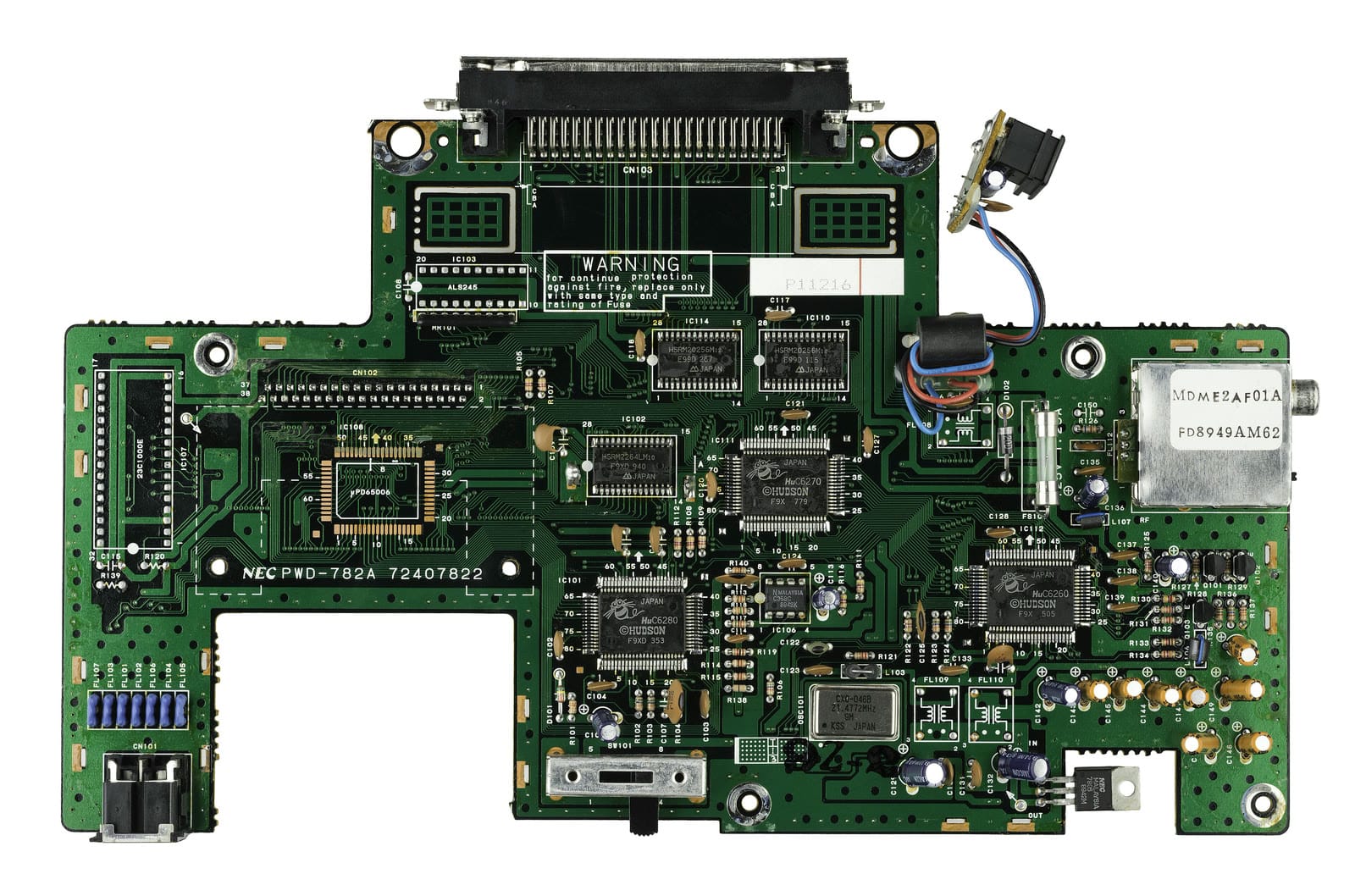
The brain. The HuC6280 is an 8-bit chip, which means it works on numbers in small bites, nothing bigger than 255 in one go. It comes from the same family as the processor in the NES, with extra instructions Hudson added. Some of them move whole blocks of memory in half the time or less. Its speed, 7.16 MHz, means it ticks about seven million times a second. It also has a slow gear, 1.79 MHz, and it always wakes up in that one. So a game starts by shifting it up, the way you’d shift a bike out of its lowest gear.
The memory. The game gets 8 KB to work in. A kilobyte holds about a thousand letters of text, so picture a few typed pages. The picture gets eight times that, 64 KB. A game can still reach up to 2 MB, because the processor flips through it 8 KB at a time, like reading a thick binder on a tiny desk by swapping pages in and out. And there’s no start-up program in the console. You switch it on and it goes straight to whatever is on the card.
The picture. The HuC6270 is the 16-bit video chip, and it draws the background and the sprites, the moving objects like characters and bullets. The HuC6260 turns them into colours and a TV signal. It has 512 colours to pick from and can put up to about 480 of them on screen at once, so nearly the whole box of crayons is out on the table at the same time. You’ll see the console described as having “dual 16-bit graphics processors”. It has one video chip and one colour chip; the SuperGrafx is the model with two video chips.
The sprites. On weaker machines, too many moving things on screen made them flicker, blinking in and out as the game took turns drawing them. This chip can juggle 64 at once. NEC’s own service manual shows it off with R-Type, which runs without that flicker, and it names Pac-Man on the Atari as the one to compare against. If you played that Pac-Man, you know exactly what they mean.
The sound. It lives inside the processor. Six channels each play a short, custom-drawn waveform, two of them can make noise for drums and explosions, one can bend another for wobbly effects, and there’s a mode for playing recorded samples like voices. All in stereo, which the American console then sent out in mono.
The cards. A whole game lived on that credit-card-sized HuCard. The biggest one ever made is Street Fighter II’ Champion Edition, at 2.5 MB, more than 300 times the memory the console gives a game to work in. American TurboChips have some of the wires that carry the game’s data swapped around compared with Japanese HuCards, like a plug with its wires crossed. That’s the region lock, by the technical write-ups. A card from the other side of the Pacific won’t talk to your console.
The CD unit. It came in three parts: the drive, a box that joined it to the console, and a System Card, a HuCard you slotted in so the console knew how to talk to the drive. The base unit brought extra room, too. It added eight times the console’s working memory, the same again for recorded sounds, and a tiny 2 KB patch kept alive by a battery so your saves survived switching off. Later System Cards pushed the memory to 256 KB. The drive was slow to find things. Jumping to another spot on the disc took about three seconds, so developers kept everything a scene needed side by side, the way you’d keep a recipe’s ingredients on one shelf.
How many, and what came after
Nobody agrees on how many were sold, and some counts even add the CD drives in as if they were extra consoles. Estimates run as high as 10 million worldwide. Hudson’s president, Hiroshi Kudo, later put it at about 4.5 million, and called it a success for Hudson, maybe a failure for NEC. After that royalty deal back at the start, you can see how both could be true.
The games kept coming long after America gave up. In Japan, the last licensed PC Engine game, Dead of the Brain 1 & 2, came out in 1999, almost twelve years after the console. Kids who unwrapped one at launch were grown up by the time the last new game arrived. And when Konami took in Hudson in 2012, the PC Engine came along with it, which is how Konami ended up making the minis.
It never really went away
If you missed it the first time, you’ve had chances since. The games came to the Wii’s Virtual Console, then to PlayStation in Japan, and then Konami made the minis: a little PC Engine for Japan and Europe and a TurboGrafx-16 for America, each with close to sixty games inside. The Japanese one even hid a special version of Soldier Blade that Hudson once handed out at its tournament events. The American one had to wait about two months longer, stuck when factories in China were paused over COVID.
The Japanese and European minis measure 120 by 115 millimetres. The American one is 240 by 156. So the American mini is bigger than the original full-size PC Engine, which is the “make it bigger” story told one more time, in 2020.
For the real cards, there’s the Analogue Duo, a modern console that recreates the hardware in a reprogrammable chip instead of emulating it. It plays original HuCards, TurboChips and CD games, region-free, over HDMI. The shoebox of cards still has somewhere to go.
Based on NEC’s TurboGrafx-16 service manual, the NEC and Hudson chip manuals, Hudson Soft’s 1987 patents, the Christian Science Monitor (1989), Computer Entertainer (1989), Gamasutra’s 2014 history with interviews with the people who ran it, Nintendo Life’s making-of feature, Sony’s 2009 and Konami’s 2020 announcements, Famitsu, Rodrigo Copetti’s and Charles MacDonald’s hardware write-ups, Gematsu, Eurogamer, Destructoid and Analogue, as of November 16, 2026. Where the sources disagree, the page says so.
Nerd Alert
Your Turn
What are YOUR thoughts
What have your experiences been? Let us know.