Virtual Boy (1995)
No screen inside, just a line of red LEDs and a mirror swinging 50 times a second: the Massachusetts lab, why it's red, why there's no strap, and its 2026 comeback.
https://averagetechnerds.com/virtual-boy/
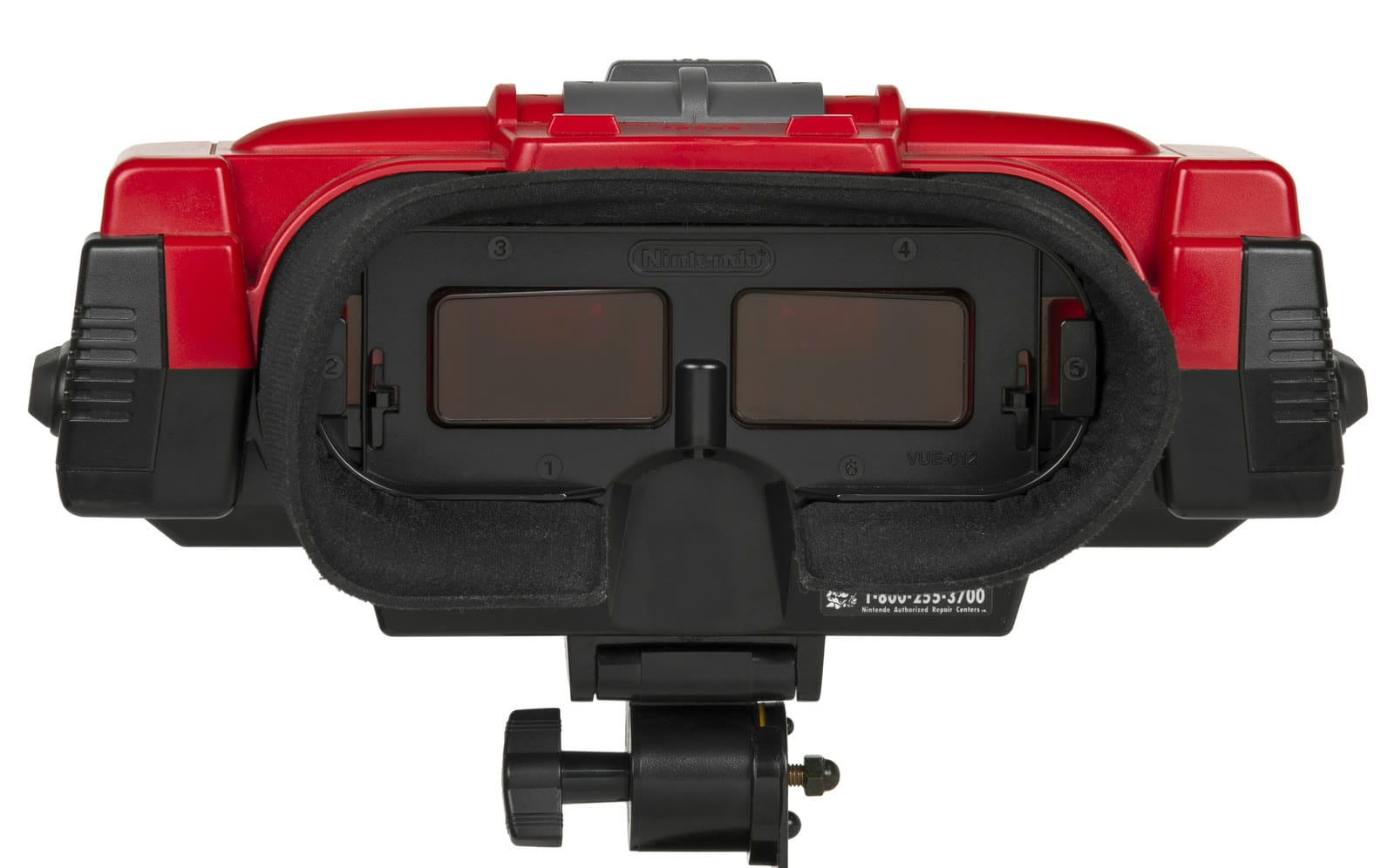
A Virtual Boy has no screen in it. Look in through the eyepiece and what you’re seeing is a single upright line of red lights for each eye, and a mirror swinging back and forth 50 times a second. The lights flash in time with the mirror, and your eye stitches the sweeps together into a whole picture. In 3D.
Nintendo sold that idea in 1995. In Japan it lasted about five months. Thirty years later, Nintendo brought it back.
A lab in Waltham
The display didn’t come from Kyoto. It came from Waltham, Massachusetts, where a team of MIT scientists had started a small company called Reflection Technology. The story goes that their first office was a bakery basement, so you’d walk into work every day to the smell of bread. Their president, Allen Becker, patented the trick, and they gave it a proper engineer’s name: the Scanned Linear Array. Say it slowly and you’ve got it. A line of lights, and a mirror that scans it across your eye.
Their first product was the Private Eye, a display about an inch across that you wore up by your eye, where it looked like a 12-inch screen sitting a foot and a half away. It went out as a pricey kit for developers, and only a small crowd ever bought one. Then, around 1990, the team had a bigger idea. They took two of them, one for each eye, bolted them onto a welder’s mask, added head tracking, and plugged the whole thing into a PC running a tank game seen from the driver’s seat. Turn your head, and the battlefield turned with you.
They shopped it around. Mattel and Hasbro both said no. So did Sega, and its American boss Tom Kalinske has said why on record: kids “got sick, threw up, or fell over,” and “it was just one color,” at a time Sega was selling the colour Game Gear.
Gunpei Yokoi falls for it
In 1991, Reflection took it to Nintendo. There it met Gunpei Yokoi, head of Nintendo’s R&D1 team and the man behind the Game & Watch and the Game Boy. Reflection’s Ben Wells says Yokoi “fell in love with the technology.” When the team pitched Nintendo’s board, president Hiroshi Yamauchi reportedly fell asleep, and Reflection’s man in Japan took that as the go-ahead.
Nintendo didn’t just borrow the display. It bought a share of Reflection, the first time it had ever bought into an American company, and took the video game rights for the whole world. If you wanted to make a game with that red display, you went through Nintendo. Back in Kyoto, about 60 people on Yokoi’s team got to work.
Why it’s red
Every Virtual Boy picture is red on black, and the reason starts with printers. The only LED strips Becker could get were made for the printer industry, and printers used red light. Wells put it simply: “If the world had invented blue LEDs before red, then it would have been blue instead.”
You’ll hear that red was the only colour of LED that existed. Red and green had been around for a long time. Bright, efficient blue LEDs only arrived in the early 1990s, and the scientists who made them won the 2014 Nobel Prize in Physics. Nintendo had its own reasons to like red, too: the LEDs were cheap and easy on batteries, and an unlit LED is perfectly black. That black is what Yokoi loved. With no frame and no glow around the picture, the image seemed to float in a space with no edges, a kind of infinite depth.
Announced, launched, rented
Nintendo unveiled it in November 1994 with big words. Virtual reality for the mass market, it promised, and “their own private universe” for every player. That’s a lot to put on a red visor. The hopes were just as big: 3 million sold in Japan alone in the first year.
It showed up late. Japan got it in July 1995, three months behind plan, and North America that August for about $180, with Mario’s Tennis reportedly packed in. Nintendo of America planned to spend more than $25 million telling you about it and expected 1.5 million sold by the end of the year. Hold that number.
There was a very 1995 way to try it, too. Through Blockbuster, you could rent a Virtual Boy and two games for three evenings for $9.99, or try one at 3,000 Blockbuster stores. Nintendo said it shipped more than 100,000 in the first week.
On a stand
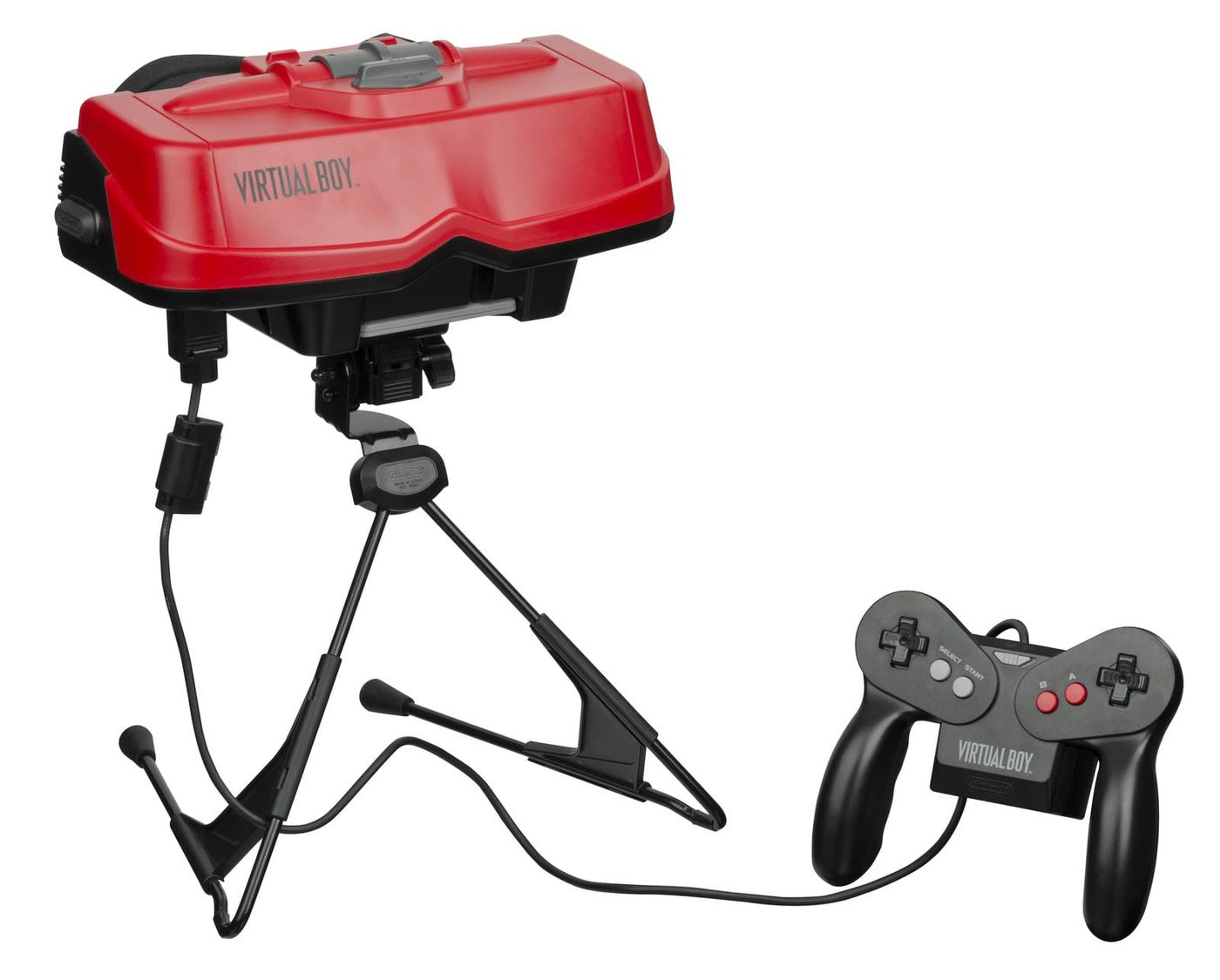
The Virtual Boy was meant to be worn. That’s why it had a low-power chip and ran on batteries. What shipped was a visor on a two-legged stand that you set on a table and leaned into.
Yokoi’s reasons at the time were simple. The picture didn’t move when your head did, so there was no real point strapping it on, and Nintendo was nervous about head-mounted displays in general. Then there was the next player, who might not love pressing their face into someone else’s make-up. A shoulder mount was supposed to follow, sold separately. It never did.
The box and the manual both said it plainly: nobody under seven was supposed to play, and the manual put that part in capital letters. Games could also stop on their own, about every half hour by the US manual, and tell you to rest your eyes, so even a long Saturday session came with breaks built in. Behind those warnings was an eye specialist, Dr. Eli Peli, whom Nintendo brought in to look the thing over. The display itself reportedly came back as generally harmless. The real danger was smaller and stranger: in a very young child, two pictures sitting even slightly out of line could nudge the eyes toward lazy eye. So Nintendo locked both displays into a rigid case on a steel frame, where they couldn’t drift apart.
The jokes about it ruining people’s eyesight are just that. Headaches and eye strain were real and widely reported at the time. No evidence of lasting damage has turned up.
How it was made
Inside, the Virtual Boy is two tiny displays and a brain that has to do everything twice.
In numbers:
| Part | Virtual Boy |
|---|---|
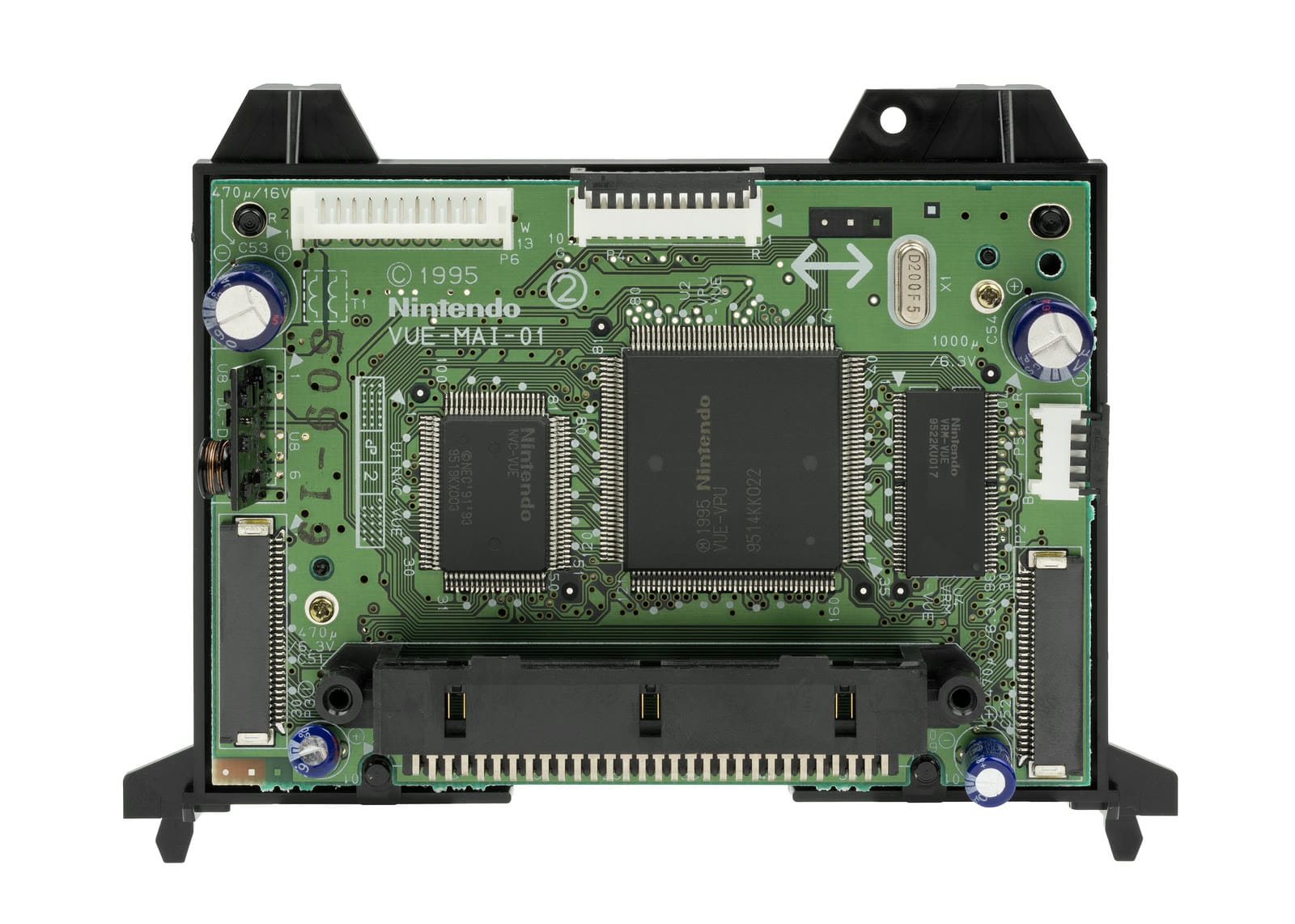
| Processor | A 32-bit RISC chip at 20 MHz, reportedly an NEC V810 |
| Displays | Two, one per eye, each a column of red LEDs and a vibrating mirror |
| Picture | 384 x 224, red on black |
| TV output | None |
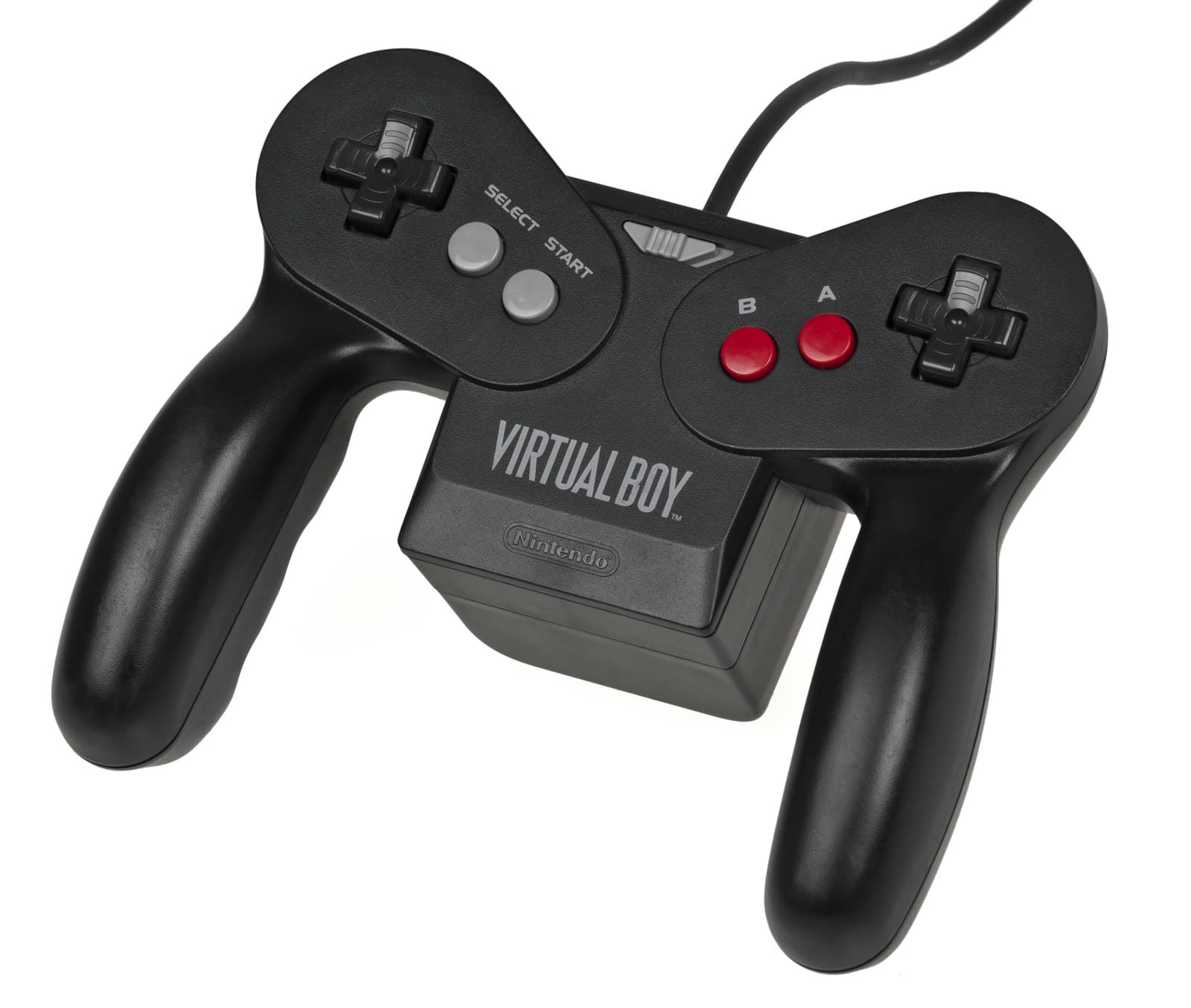
| Controller | Two D-pads and six buttons |
| Power | Six AA batteries in a pack on the controller, about 7 hours a set |
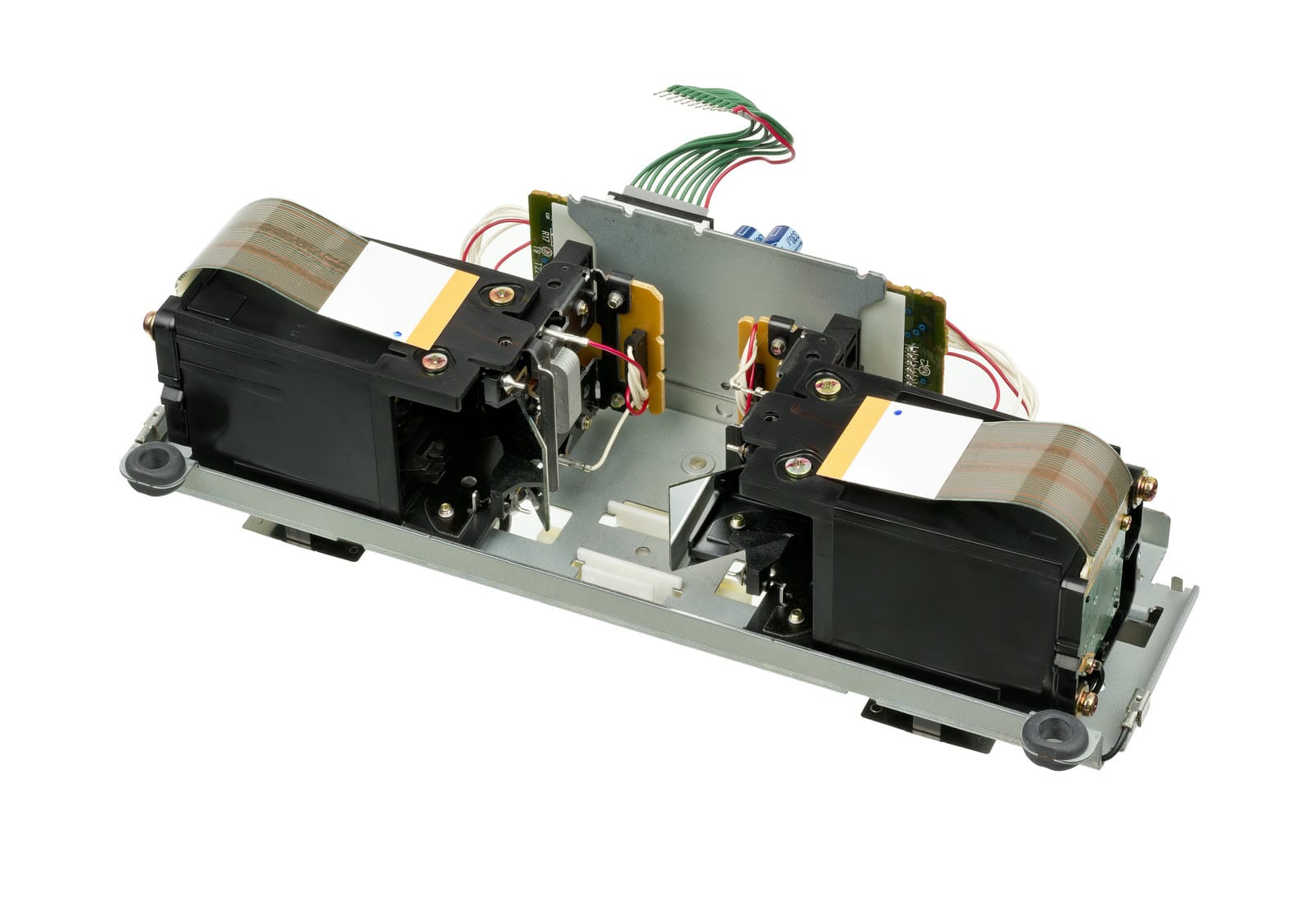
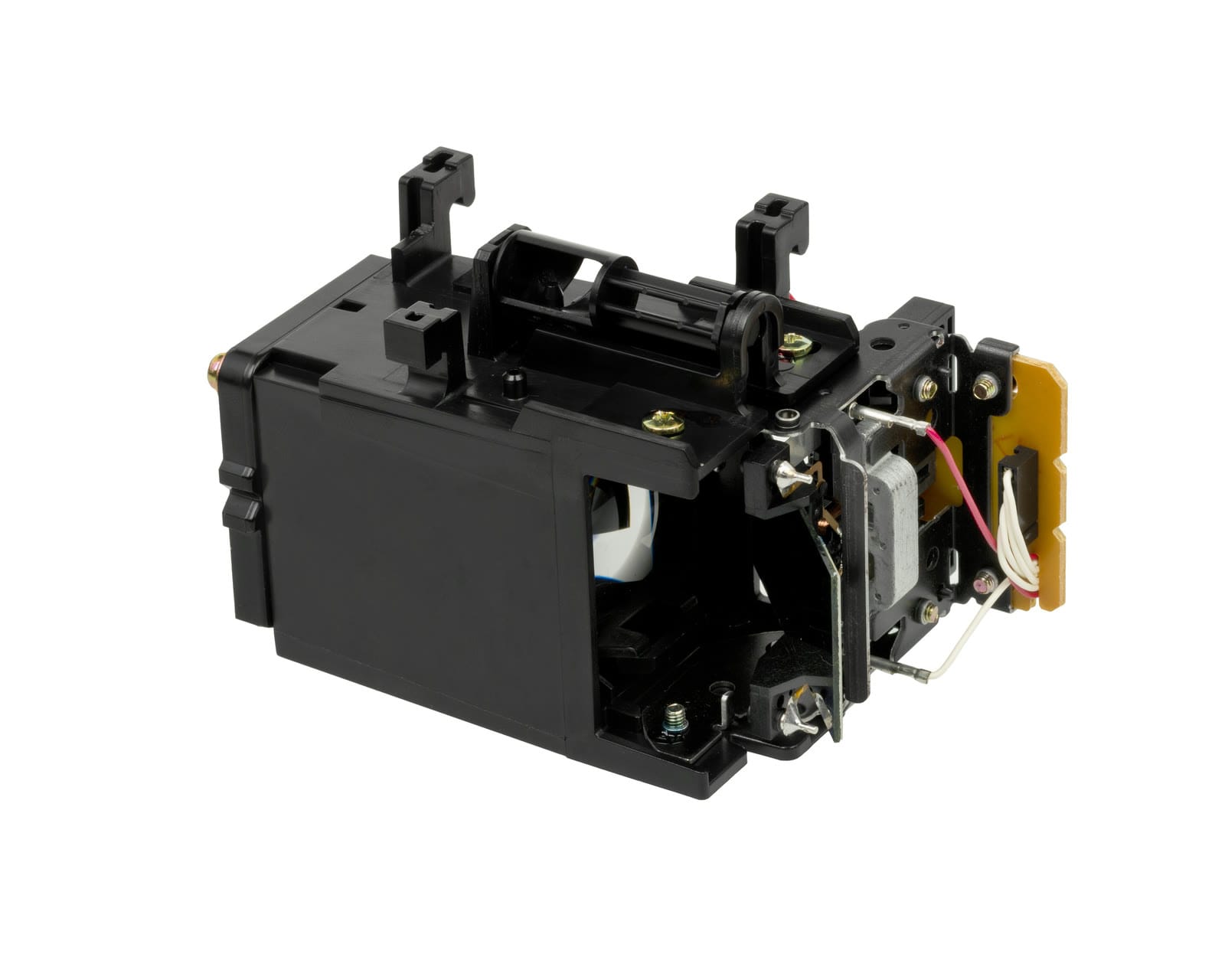
The display. Each eye gets its own Reflection Technology unit. Each is a single column of 224 red LEDs, one for every line of the picture, facing a mirror that swings back and forth 50 times a second. As the mirror sweeps, the LEDs flash 384 times, one column at a time, and you see a 384 by 224 picture. The two mirrors swing in opposite directions, which keeps the unit from shaking and saves power, and they reportedly hum while they work. Each dot can show black or one of three shades of red.
The 3D. The depth works like a View-Master. Each eye sees a slightly different image, and your brain does the rest. Sliders on the unit set the distance between your eyes and the focus, so the next player has to adjust them again, and the manual admits “a small percentage of people may not experience the full 3-D image.”
The brain. It had double duty: for every frame of a game, it drew two separate pictures, one for each eye, and kept them in step, “effectively doing twice as much work,” as Yokoi put it. It also had to go easy on power, because when Nintendo picked it, the plan was still a headset running on batteries. What went in was a 32-bit processor, which means it chewed through numbers in bigger bites than the 16-bit Super Nintendo did.
The controller. Two D-pads, one on each grip, plus six buttons, so a game could use one pad to move and the other to aim or turn. The batteries live in the controller too: six AA in a box that slides onto its back, good for about seven hours. An AC adapter was sold separately.
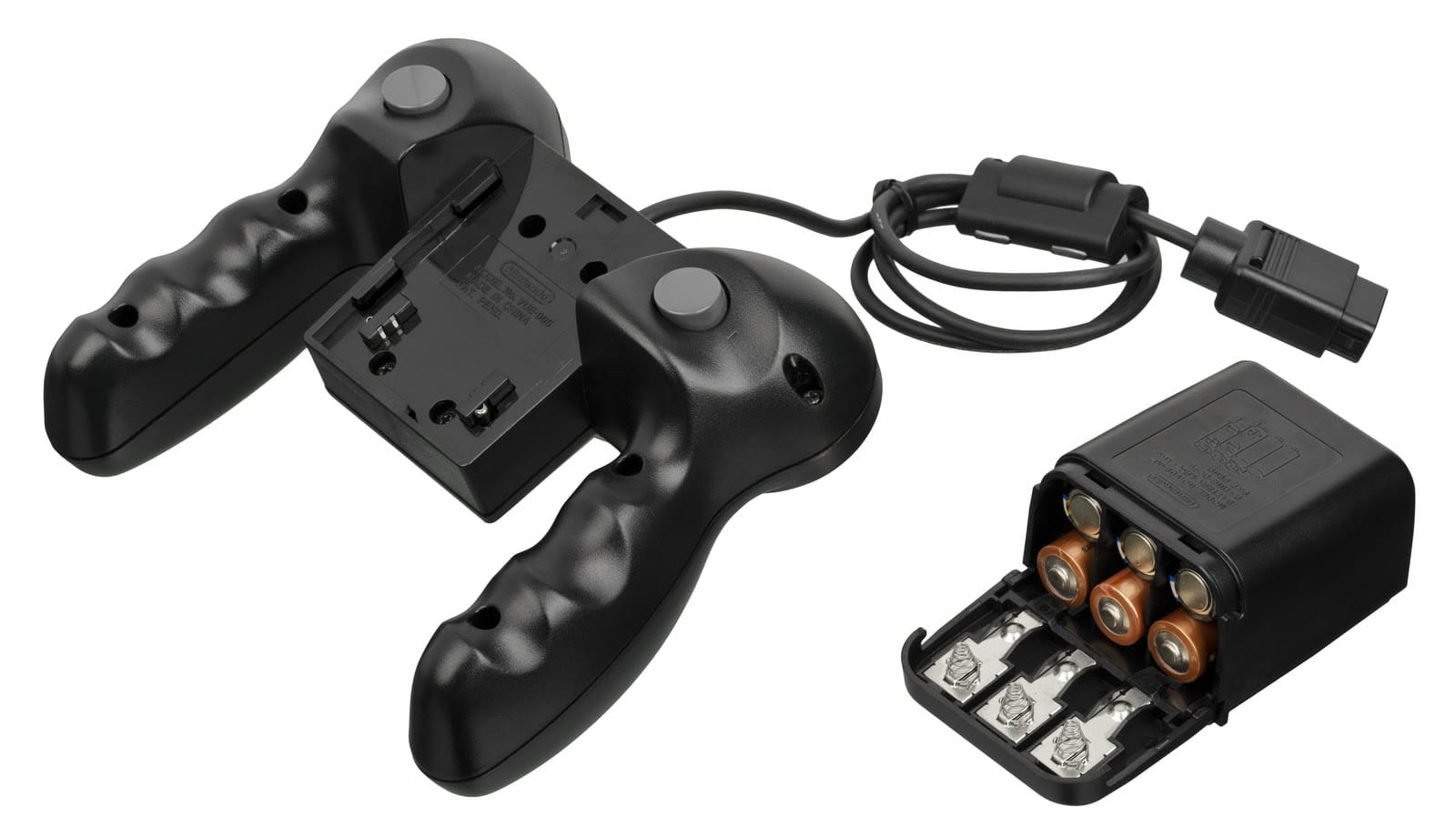
Everything else. There’s a link port for playing against a friend, and not one released game ever used it. And there’s no way to plug it into a TV, so whoever was waiting for their turn just watched you lean into a red visor, with no idea what you were looking at.
Twenty-two games
Only 22 games ever came out, Japan and North America together. Some of that was on purpose: Yamauchi kept outside publishers on a short leash early on, so weak games wouldn’t pile up on it. The bigger surprise is who got held back. Here was a brand-new Nintendo console built around 3D, and Yokoi was reportedly told to go easy on Mario, because Mario’s real jump into 3D was being saved for the Nintendo 64.
The list is short and strange. The big Nintendo platformer didn’t star Mario at all. It starred Wario: Virtual Boy Wario Land. Of all the movies Hollywood had going, the one that got a Virtual Boy game was Waterworld, and it’s the only movie game on the system. And Japan got The Mansion of Innsmouth, a first-person horror game built on H.P. Lovecraft, played on a red and black screen you pressed your face into. That’s one way to make horror feel close.
Gone in a year
It fell fast. Two months after launch, Nintendo knocked $20 off the American price and blamed the exchange rate. By the next spring it had reportedly dropped to $99, and by late 1996 you could find one in a clearance bin for $30 or less. If a Virtual Boy turned up under your tree back then, that bin may be where it came from. Japan gave up first, about five months in, right before Christmas 1995. North America held on until around August 1996.
What it cost, then and now:
| What | When | Price |
|---|---|---|
| Virtual Boy | July 1995, Japan | ¥15,000 |
| Virtual Boy | August 1995, US | $179.95 |
| First US cut | October 1995 | $159.95 |
| Next cut, reportedly | Spring 1996 | $99 |
| Virtual Boy replica for Switch | February 2026 | $99.99 |
| Cardboard viewer for Switch | February 2026 | $24.99 |
Now for that 1.5 million. Nintendo of America hoped to sell that many by the end of 1995. The number people quote for the whole world is 770,000, but it counts consoles shipped to stores by the spring of 1996, which isn’t the same as consoles people took home. It’s the lowest-selling console Nintendo has made since the NES. The next lowest, the Wii U, sold more than 13 million.
Gunpei Yokoi
That same summer, Gunpei Yokoi left Nintendo. He’d been there about 31 years, since long before the Game Boy. He didn’t slow down. About a month later he had his own company, Koto, and it went on to design another handheld, Bandai’s WonderSwan.
Did the Virtual Boy cost him his job? That’s how the story usually gets told, and nobody has ever proved it either way. His biographer, Takefumi Makino, tells a gentler version: Yamauchi didn’t try to pin the failure on him, Yokoi had long planned to leave at 50 and stayed on to see the Virtual Boy through, and he made the Game Boy Pocket to make up for it. Yokoi himself blamed the way it was sold in Japan, and he wasn’t shy about it: “Give me one billion yen to market it, and I will launch the Virtual Boy into the stratosphere.”
He only got about a year with Koto. In October 1997, after a minor crash on a highway, Yokoi got out to check the damage and was hit by a passing car. He was 56. Because the flop, his exit and his death all landed within two years, people started joining the dots, and the stories got darker with each telling: that Nintendo had fired and humiliated him, that the yakuza had something to do with his death. None of it has ever been backed up. He resigned, and the crash was just that, an accident.
Koto is still around. Today it makes Occlu-pad, a tool that makes eye training more fun for children with amblyopia, or lazy eye, and the company says it grew from Yokoi’s wish to make rehab fun. It’s the same condition the Virtual Boy’s warning label was written around. That part is a coincidence, and a gentle one.
And the little company from the bakery basement? Reflection Technology never really recovered. It was working on a display in full colour, the very thing the Virtual Boy never had, and the money ran out around 1997. Allen Becker, the man who patented that line of lights and a mirror, died in 2001.
It came back
The comeback is real. Since February 17, 2026, you can play Virtual Boy games on a Switch or Switch 2 with the Expansion Pack tier of Nintendo Switch Online. There’s no flat 2D mode, so you need a viewer: a $100 replica of the original, stand and all, still with no strap, or a $25 cardboard one. Even the age line came back. Nintendo’s note reads “For use by children 7+ only,” just like 1995.
Some of it showed up thirty years late. Zero Racers and D-Hopper, two games Nintendo finished in 1996 and never sold, finally came out in August 2026. The Mansion of Innsmouth, that Lovecraft horror game Japan kept to itself, was reportedly there from day one, officially in English for the first time. And Europe, which never got a Virtual Boy at all, can play now. The fans never left, either: Planet Virtual Boy keeps a big database of homebrew, games fans make themselves, and VUEngine, a free, open-source engine for building them, is still being updated.
Based on Nintendo’s and Reflection Technology’s 1994 and 1995 press releases, Nintendo’s US instruction booklet, Gunpei Yokoi’s 1995 Next Generation interview, Allen Becker’s patent, Weekly Famitsu’s 1996 shipment table, Fast Company (2015) and Benj Edwards and Jose Zagal’s book excerpt in Ars Technica (2024), Koto’s own page, the 2014 Nobel press release, Nintendo’s 2025 and 2026 Virtual Boy announcements and Planet Virtual Boy, as of November 16, 2026, and where the sources disagree, the page says so.
Nerd Alert
Your Turn
What are YOUR thoughts
What have your experiences been? Let us know.