The New Apple TV 4K Costs $299, and Its Siri AI Starts as a Beta
Apple’s fourth-generation Apple TV 4K adds an A19 chip, far-field microphones and Wi-Fi 7 for $299. Siri AI arrives as a tvOS 27.2 beta, on older models too.
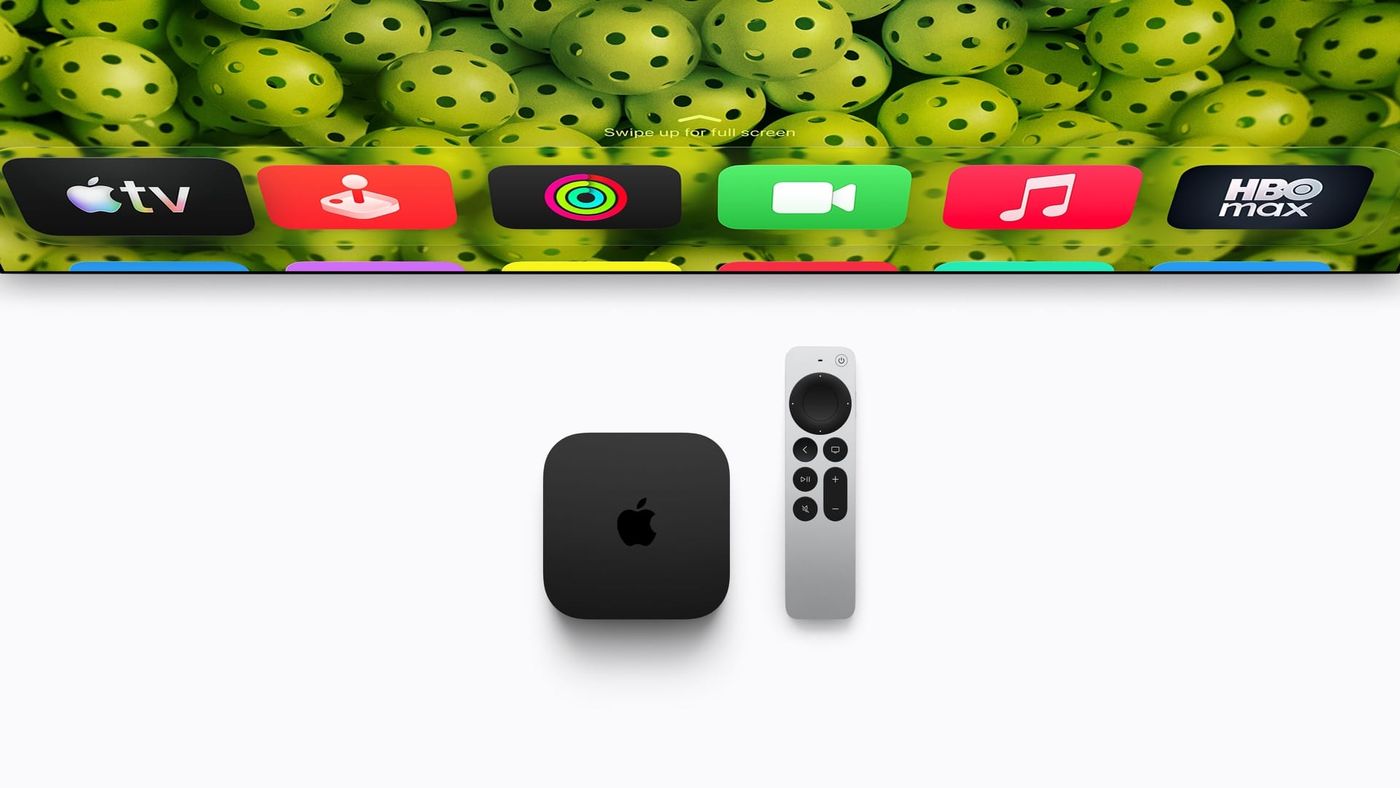
Apple announced the fourth-generation Apple TV 4K on October 13 at its “Welcome Home” event. The box is the same size as the 2022 model, and Apple’s announcement leads with Siri AI, its new version of Siri, which Apple lists as a beta that arrives with tvOS 27.2. It reaches stores on November 13.
What are the new Apple TV 4K’s specs?
The chip is the A19, which Apple says is up to 50 percent faster on the CPU and up to twice as fast on graphics as the previous generation, going by its own tests on preproduction units. The box builds in what the 2022 range kept for its more expensive version: 128GB of storage, Gigabit Ethernet and Thread, the low-power mesh network smart home accessories use. In the box you get the remote and a power cord; the HDMI cable is sold separately, and there’s still no USB port for an external drive. Apple’s store page now lists only the new model, and The Verge reports that the 2022 version is being discontinued.
For games, Apple points to Apple Arcade and the App Store; controllers are sold separately and work with select games. The box also has a dedicated decoder for AV1, a video format that Apple says streams at high quality on less bandwidth. Wireless moves to Wi-Fi 7 with 2x2 MIMO (two antennas sending, two receiving) in countries where it’s supported, and to Bluetooth 6.
Does it support 4K 120Hz or Dolby Vision 2?
No. Apple lists no 4K at 120Hz, no variable refresh rate, and no Dolby Vision 2 or HDR10+ Advanced, and it hasn’t said whether an update could add any of them. Video output stays where it was: up to 4K at 60 frames per second, with Dolby Vision, HDR10+ and Dolby Atmos, according to the specifications.
What can Siri AI do on a TV?
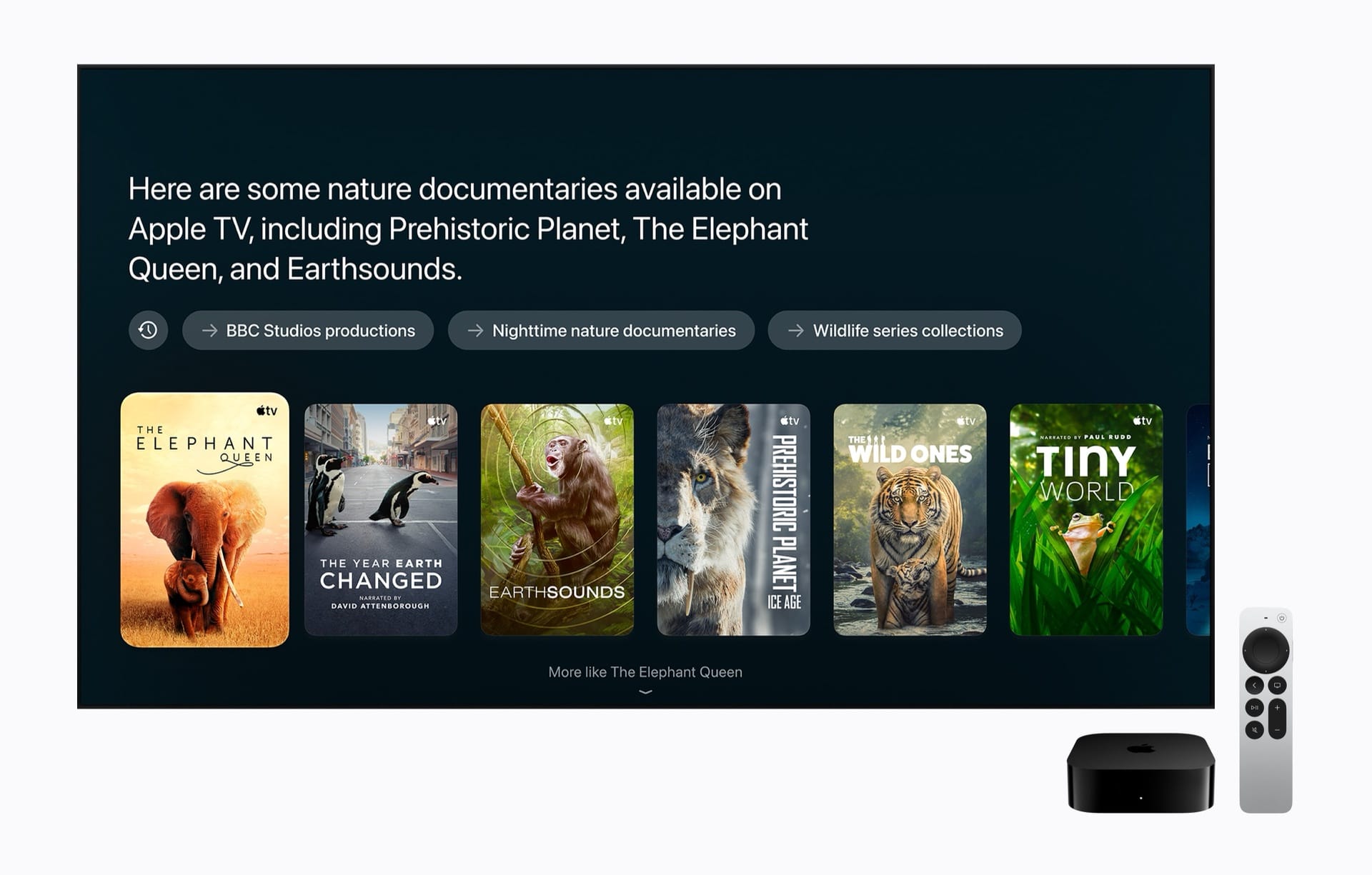
Going by Apple’s examples, mostly help you find something to watch. You can ask which Apple TV shows won at the Emmy Awards this year and get poster art back on screen, or ask follow-up questions about a show while it plays. Answers appear in a compact overlay on top of the video, and The Verge and Engadget report that Siri doesn’t speak them aloud on the Apple TV. Siri AI is built on Apple Intelligence, so with an Apple Intelligence-enabled iPhone it can also use personal context for a request like “Play the show Alinda recommended.”
When can you actually use it?
Not yet, and Apple hasn’t said when. Its footnotes list Siri AI as a beta in tvOS 27.2, which is still in developer testing and has no public release date; Engadget expects it this fall. At first it works in English only, in the US, the UK, Canada, Australia, New Zealand, Singapore, South Africa and India. The owner of the home in Apple’s Home app also needs an Apple Intelligence-enabled iPhone or iPad with Siri AI turned on. No EU country is on the launch list, and Apple’s footnotes add that Siri AI won’t initially be available in the EU on iPhone or iPad either.
Features that use Apple’s server-side models also have daily usage limits, and Apple says expanded access will be available for a fee in the future. It hasn’t said which Apple TV requests count toward those limits or what the fee will be. Requests run either on the device or on Private Cloud Compute, Apple’s own cloud system, which Apple says neither stores your data nor makes it accessible to Apple.
Do you need the new box to get Siri AI?
No. Apple’s press release says the beta is available on the Apple TV 4K second generation or later, which covers the 2021 and 2022 models; the first Apple TV 4K and the Apple TV HD are left out. Those older boxes have no microphones of their own, so you talk to Siri through the remote. Engadget says Apple hasn’t yet clarified which parts of Siri AI and the new home features they’ll get.
What do the built-in microphones change?
You can talk to the box itself, which no older Apple TV can match. Its three far-field microphones, built to hear you from across the room, use echo cancellation, and Apple says they pick out “Siri” or “Hey Siri” even while audio is playing. Hands-free Siri works when the Apple TV’s language is set to English, French, German, Dutch, Mandarin Chinese, Finnish, Hebrew, Norwegian or Swedish. Apple says the microphone audio is processed in Secure Exclaves, protected and separate environments on the A19 whose data tvOS, apps, you and Apple can’t access.
Can you find a lost remote now?
Yes. The included Siri Remote keeps its familiar design and works with Find My, so a lost remote can play a sound or be located with Precision Finding on an iPhone. Precision Finding needs the new fourth-generation remote and an iPhone 17 or later (excluding the iPhone 17e), an iPhone Air or an iPhone Duo. Find My also works with Siri Remotes back to the second generation, but only the new one can play a sound, according to Apple. It’s also sold separately and works with every Apple TV 4K and the Apple TV HD; MacRumors reports its price as $59.
What else does it do around the house?
It’s a home hub, the always-on device that lets the Home app run automations and control accessories from anywhere. Apple’s spec sheet says its Thread radio works with HomeKit or Matter Thread accessories. With a compatible doorbell, your TV can show who’s at the door, and Siri AI can switch scenes and control accessories by voice.
The new box is also the only Apple TV that can drive four HomePods as a surround system. You need four HomePod mini 2 or HomePod second-generation speakers in matching front and rear pairs, and Apple says they recognise their positions and calibrate timing and levels to the room. Earlier Apple TV models top out at a stereo pair of HomePods, according to The Verge. The HomePod mini 2, announced the same day, costs $149. Any receiver or soundbar still works over HDMI, and the remote can turn it on and off, switch inputs and set the volume by IR or CEC.

How is it different from the 2022 Apple TV 4K?
Same size and same video output, with most of what sits around them changed. The table lines up Apple’s official specifications for the 2022 model and the new one.
| Apple TV 4K (2022) | Apple TV 4K (2026) | |
|---|---|---|
| Chip | A15 Bionic | A19 |
| Storage | 64GB (Wi-Fi) or 128GB (Wi-Fi + Ethernet) | 128GB |
| Ethernet and Thread | 128GB model only | Standard |
| Wi-Fi and Bluetooth | Wi-Fi 6, Bluetooth 5.0 | Wi-Fi 7, Bluetooth 6 |
| Microphones | In the remote only | Three far-field microphones in the box, plus the remote |
| AV1 decoding | No | Dedicated decoder |
| Remote | Siri Remote (3rd gen), USB-C | Siri Remote (4th gen), adds Precision Finding and a speaker |
| Video output | Up to 4K at 60fps, Dolby Vision, HDR10+, Dolby Atmos | |
| Size | 93 x 93 x 31 mm | |
| Price | $129 / $149 at launch; $199 / $249 since June 2026 | $299 |
How much does it cost, and when is it out?
$299, and it reaches stores on November 13. Pre-orders are open in the US and 29 other countries and regions, according to Apple’s press release. That’s $50 more than the model it replaces, and $100 more to get in the door. The 2022 model launched at $129 for 64GB and $149 for 128GB with Ethernet, and Apple raised those prices to $199 and $249 in June 2026, citing memory and storage costs, according to FlatpanelsHD and Engadget. The Wi-Fi-only version is gone, so $299 is now the cheapest way into an Apple TV 4K. Outside the US, Apple’s regional stores list it at CA$429 in Canada, £299 in the UK, €349 in Ireland, Germany and France, A$449 in Australia and NZ$599 in New Zealand.
Is the new Apple TV 4K worth it?
I’ve owned every single generation of Apple TV, and honestly, each one has brought so-called generational upgrades, but it’s still just the same proposition at the end. That said, it’s great that this one supports AV1. My older Apple TVs didn’t support the AV1 video codec, so my Plex server’s graphics card had to transcode it for them. It’s also effectively a Thread border router and home hub, which ties right into Apple’s new Home Collection, since those devices run on Thread and need a hub for most of their features. For my surround sound setup, though, what I’d really want is lossless audio sent straight to my receiver, and Apple’s specs still don’t list it. The box decodes to multichannel PCM instead.
Nerd Alert
Your Turn
What are YOUR thoughts
What have your experiences been? Let us know.