News · News · Everyday Tech
E Ink’s Kaleido 4 Promises Better Colour E-Readers, but Only One Tablet Has It
Kaleido 4 is brighter, punchier and faster by E Ink’s numbers, but it says nothing about resolution, and no Kindle, Kobo or Boox uses it yet.
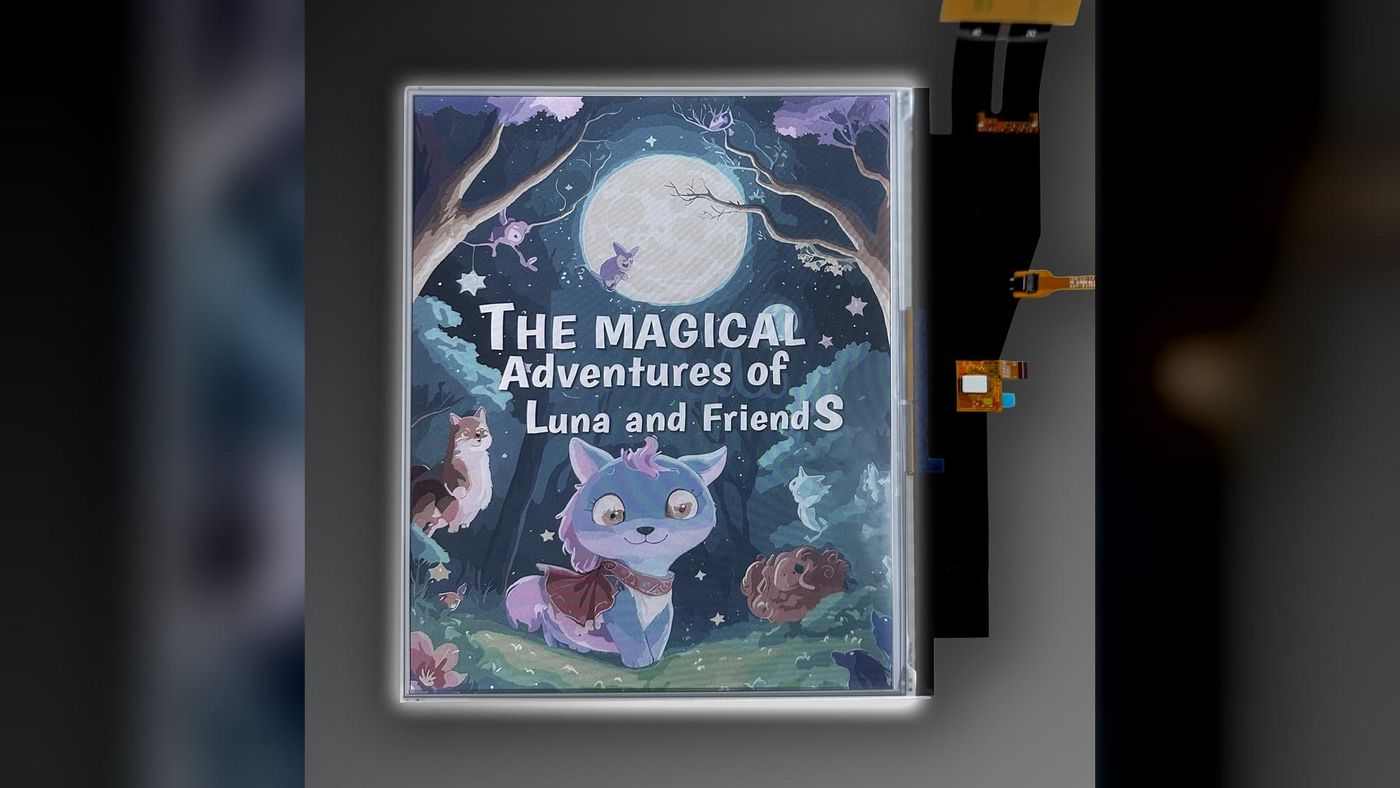
E Ink announced Kaleido 4 on October 15, and this is something I’m very interested in. It’s the successor to Kaleido 3, the colour e-paper that Kobo’s and Boox’s colour e-readers use today. E Ink says it’s brighter and faster. The catch is that the only device with it so far is Hanvon’s M10C II, a note-taking tablet announced for China only.
What does Kaleido 4 change vs Kaleido 3?
More brightness, contrast and colour, plus faster refresh, according to E Ink. Compared with Kaleido 3, E Ink says Kaleido 4 has double the colour gamut volume, reflects 15% more white light and has 50% more contrast. It also says new algorithms let it play video at up to 18 frames per second. And it says the changes make the screen look less grainy. E Ink pitches all of this at colour PDFs, slides, charts and illustrations as much as at books.
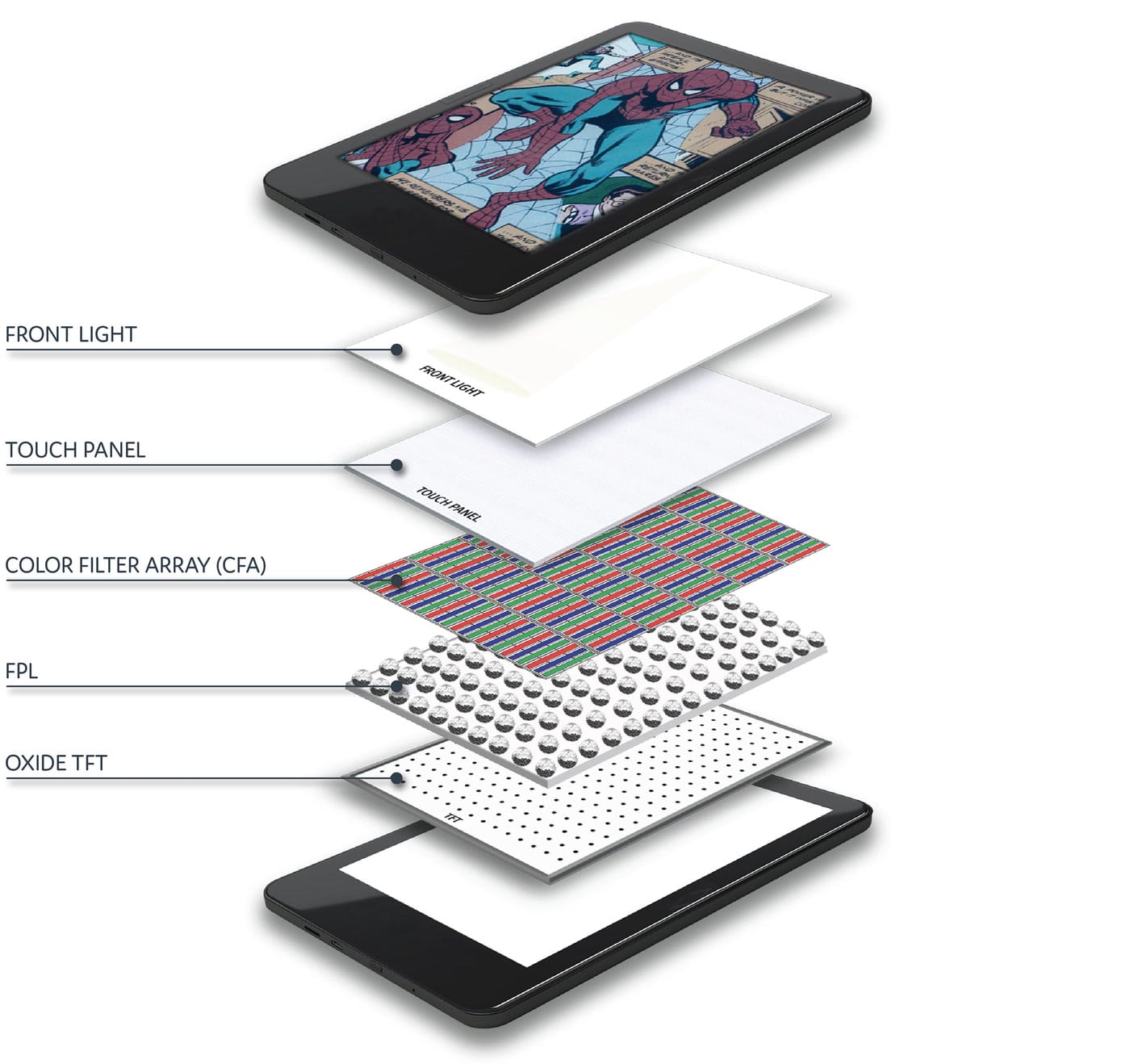
Part of the faster refresh comes from a new oxide TFT backplane, the layer of transistors that drives each pixel, which E Ink says supports higher driving voltages. Oxide backplanes aren’t new to colour e-readers: Amazon built the 2024 Kindle Colorsoft on one for sharper contrast and faster page turns. E Ink also redesigned the front light, which it says makes colour clearer and more natural.
E Ink says the gamut volume doubles “to more than 40K” without saying 40K of what. Its own Kaleido page lists 4,096 colours for current Kaleido screens. Engadget read it as more than 40,000 colours, but doubling 4,096 doesn’t get you there. Until E Ink explains it, treat 40K as E Ink’s own gamut measure.
Is colour any sharper on Kaleido 4?
E Ink hasn’t said: its announcement gives no resolution at all. Today’s colour readers, such as the Boox Go Color 7 (Gen II), list 300 pixels per inch for black and white and 150 for colour. E Ink’s only claim on this front is less visible graininess.
Colour costs sharpness and brightness because of how Kaleido works. A Kaleido screen is a black-and-white E Ink panel with a colour filter laid over it. Each colour dot is built from a group of side-by-side filtered pixels, which is why these readers list half the black-and-white resolution for colour. E Ink’s page for Gallery, its other colour e-paper, says a colour filter attenuates light, “which can be quite significant”, and that light loss is what makes a Kaleido page look darker and greyer. Kaleido 4’s contrast and white reflectance claims go straight at that weakness.
How is Kaleido different from Gallery 3?
Kaleido filters its colour, while Gallery 3 makes colour with coloured ink. Gallery 3 puts cyan, magenta, yellow and white particles in every pixel with no filter on top, which E Ink says avoids the light loss and gives full colour at 300 pixels per inch. The reMarkable Paper Pro is one tablet that uses it.
The trade-off is speed. E Ink lists Gallery 3’s black-and-white page updates at 350 milliseconds, but colour takes 500 milliseconds in its fast mode, 750 to 1,000 in standard and 1,500 for its best colour.
Which e-readers use Kaleido 3 right now?
The Kobo Libra Colour ($259.99), Kobo Clara Colour ($179.99) and Boox Go Color 7 (Gen II) ($269.99) all list an E Ink Kaleido 3 screen outright.
Amazon doesn’t name the panel in the Kindle Colorsoft, though Engadget reports it’s a Kaleido screen Amazon modified. Amazon announced a new Colorsoft two weeks before Kaleido 4, at $289.99 for 16GB or $319.99 for a 32GB Signature Edition. Both are out October 28. Its spec sheet still lists 300 ppi for black and white and 150 ppi for colour, the same split as Kaleido 3.
Should you buy a colour e-reader now or wait for Kaleido 4?
Buy now if a colour reader on sale today suits you, because Amazon, Kobo and Boox haven’t announced a Kaleido 4 reader and there’s no date for one. Nathan Groezinger of The eBook Reader notes that companies usually take a year or two to switch to a new screen. Some keep selling the old one.
Waiting makes sense if the dim, grainy look of today’s colour screens is what bothers you, because that’s what E Ink says it improved. If it’s colour sharpness, nothing announced so far says Kaleido 4 changes that.
What’s the only Kaleido 4 device so far?
Hanvon’s M10C II, a note-taking tablet that Engadget reports is coming to China only. It follows Hanvon’s 10.3-inch M10C from May 2025, which used Kaleido 3. E Ink says the new screen, together with Hanvon’s own “Enhanced Pressure Floating” technology and T2000 timing controller, makes page turns and scrolling 27% faster on the M10C II.
The rest of the M10C II is aimed at work: a battery-free pen with 8,192 pressure levels, a micro-etched tempered-glass surface for a paper-like feel, and Hanvon’s OCR, voice and AI office apps. Neither E Ink’s announcement nor Hanvon’s preview gave a price or release date.
Will Kobo or Boox use Kaleido 4?
Neither has said so. Both build their current colour readers on Kaleido 3, and neither has announced a Kaleido 4 model or a date.
What don’t we know yet?
When Kaleido 4 readers will arrive, and at what price. E Ink hasn’t published a colour resolution, and nobody outside E Ink and Hanvon has measured the screen. Groezinger says the early side-by-side photos aren’t very good, and that they make the difference hard to judge.
What does Kaleido 4 mean for my manga?
Better colour, and for manga, that’s great. I do read books, I do read light novels, and I do like manga. Books and light novels aren’t affected so much. But I do prefer the colour option for manga and comics.
I have the Amazon Kindle, but I hate the Kindle ecosystem, and I’ve stopped using it. Kobo and Boox colour readers aren’t tied to the Kindle store: Kobo’s readers support a wide range of ebook formats, and Boox runs Android with Google Play.
Nerd Alert
Your Turn
What are YOUR thoughts
What have your experiences been? Let us know.