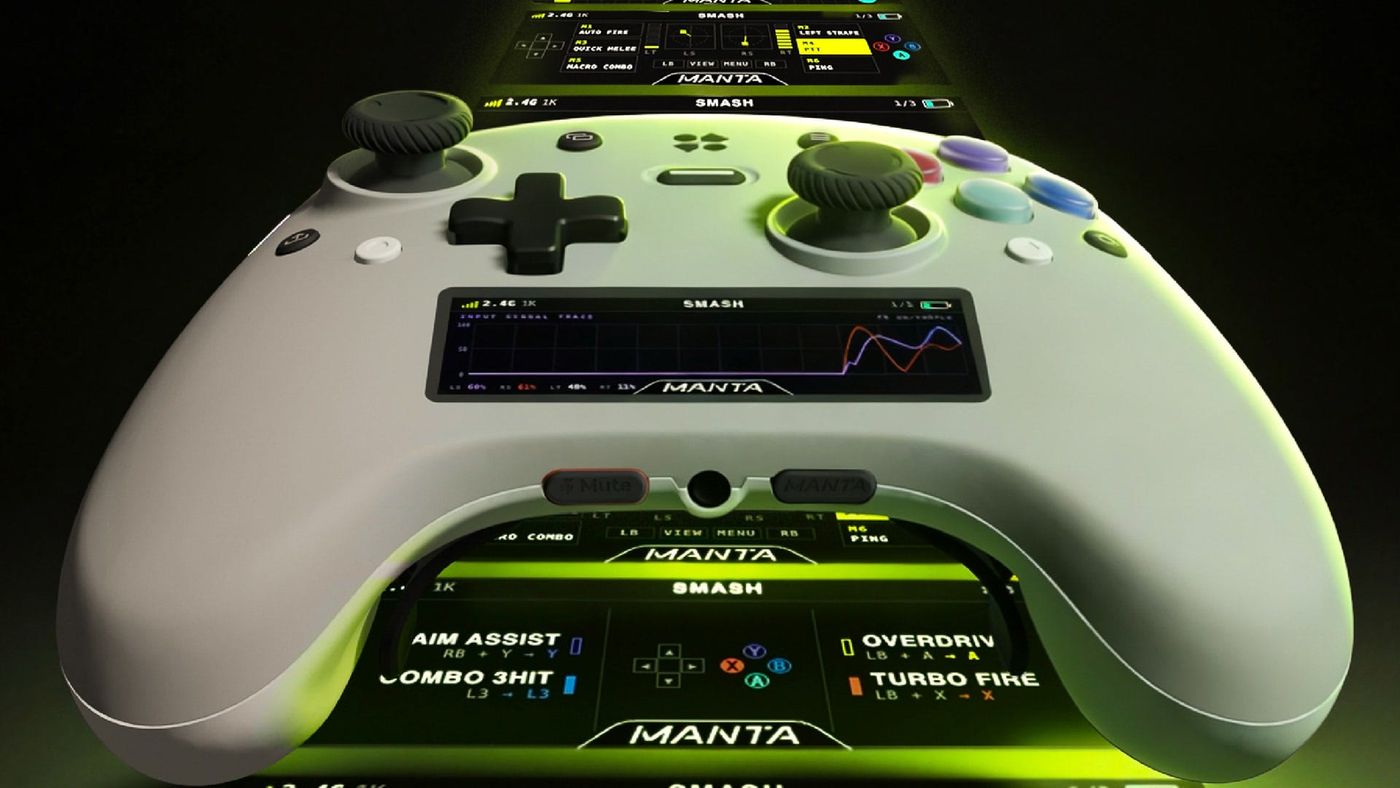
Genki’s Manta controller has finished its Kickstarter campaign with more than $1.15 million pledged by over 4,700 backers, more than 11 times its $100,000 goal. The campaign closed on October 1 after 42 days. The Manta is a pro-style controller for PC, Switch, Switch 2 and Apple devices, built around a 2.79-inch colour display that runs Genki’s own software, MantaOS. Profiles, stick tuning, macros and pairing all live on the controller itself, with no phone or desktop app required. Late pledges are still open on the Kickstarter page, and Genki plans to start shipping in early 2027.
What the Manta is
Genki is the brand of Human Things, a Los Angeles company that began on Kickstarter in 2018 with Genki Audio, a Bluetooth audio adapter for the original Switch. It has since made the Covert Dock, ShadowCast, Waveform and SavePoint, and the Manta is its ninth Kickstarter project. Genki calls it “our most ambitious attempt yet to rethink a familiar piece of gaming hardware.”
The shape is the first thing most people notice. The grips sweep wide and low, and Genki admits that some people need to hold it before the form makes sense. The screen sits low between the grips, because controllers tilt away from the player during play and a lower screen ends up closer to the eyes. The target weight is about 315 g, which Genki says is similar to Sony’s DualSense Edge and lighter than Microsoft’s Xbox Elite Series 2.
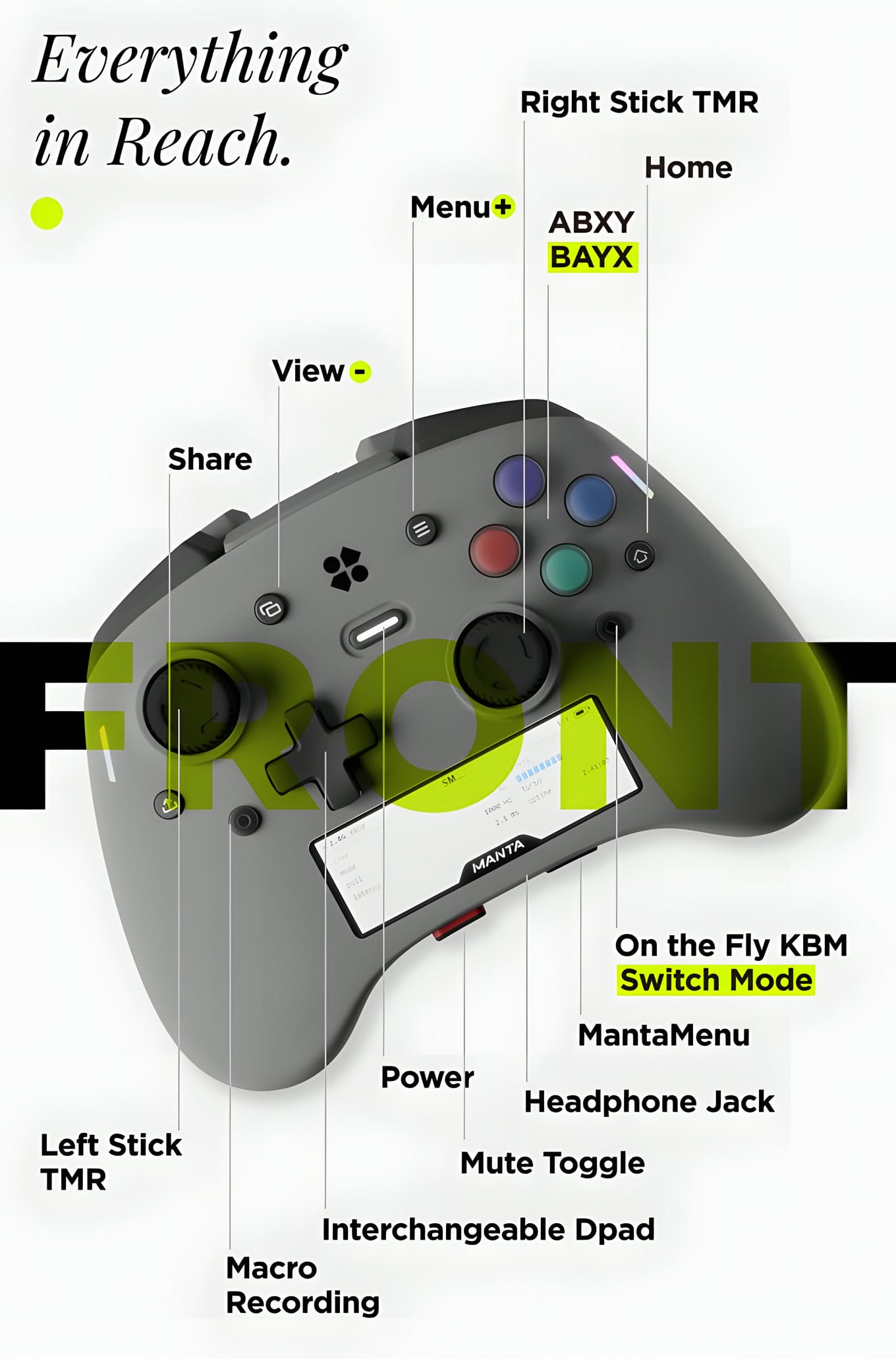
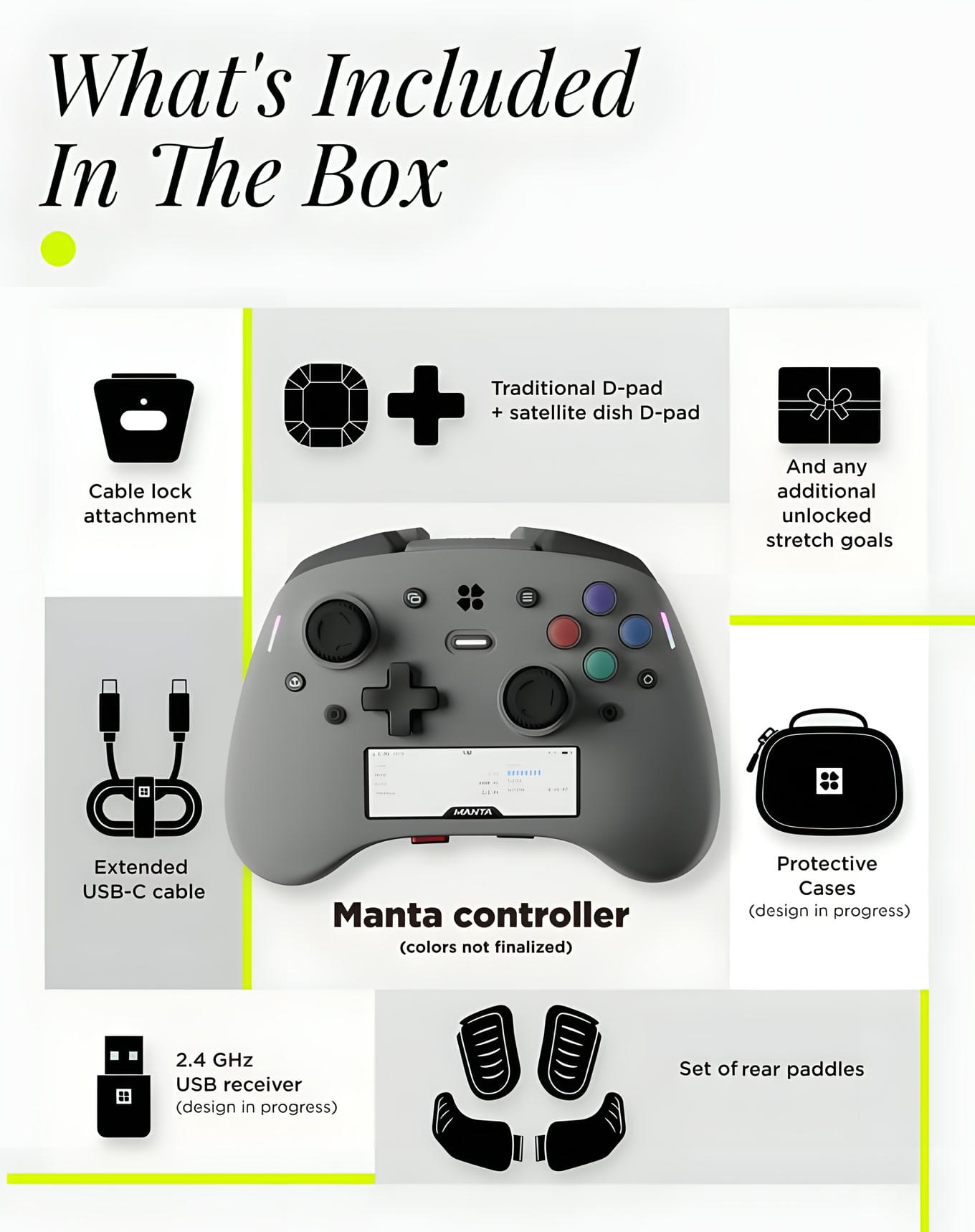
Two D-pads come in the box, a familiar Traditional D-pad and a broader Satellite Dish design, and both use the same mechanism underneath. Along the bottom edge are a headphone jack and a mute button that physically toggles, so its state can be seen and felt. On top, a removable cap can be swapped for a cable lock that holds a USB-C cable in place during wired play. Light bars along the edges show status, and the power button changes colour to show the connection type.
The hardware inside
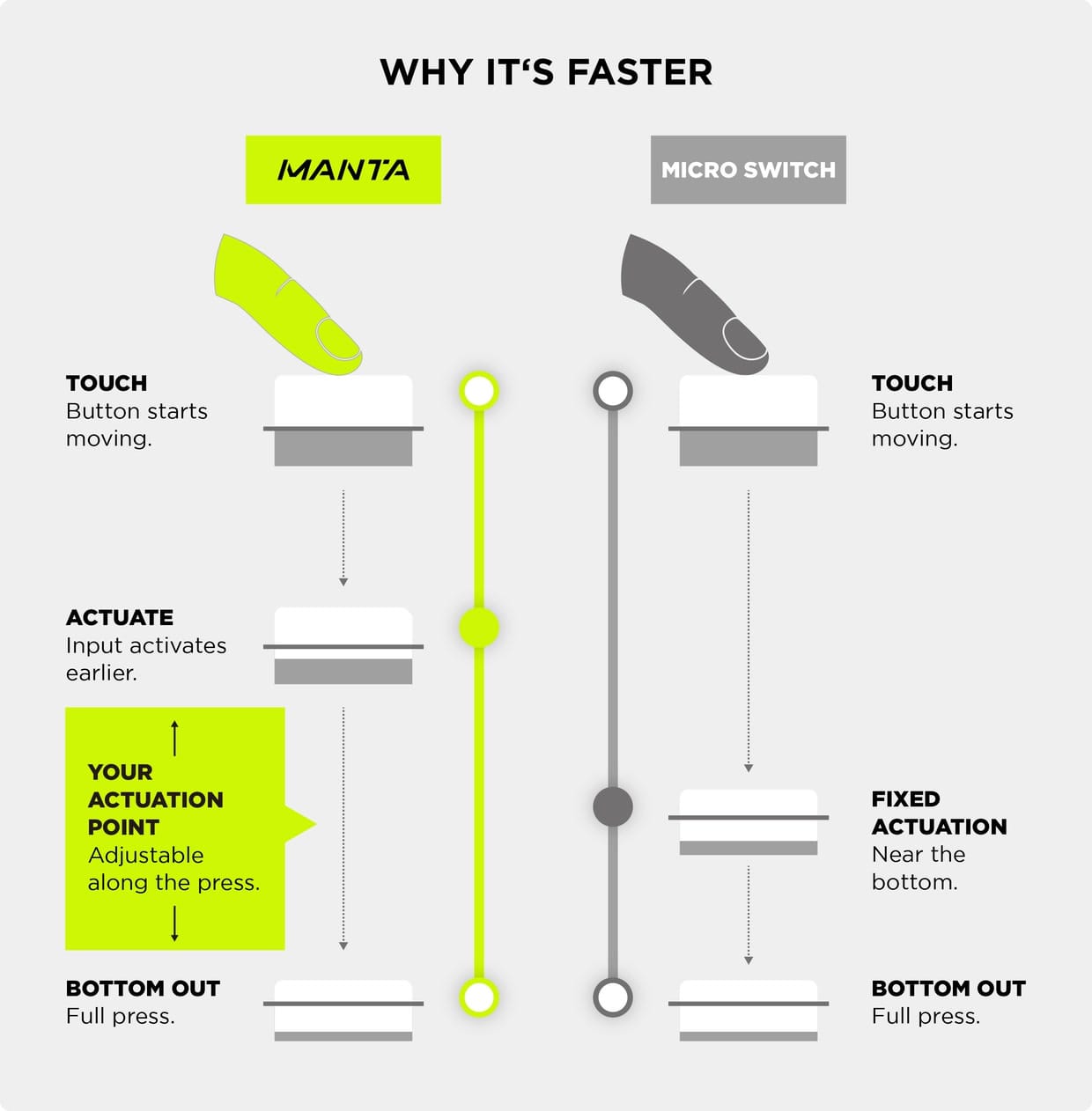
The face buttons are the most unusual part. Genki calls them Pulse Buttons, and they track the full travel of each press with analog sensing, without waiting for an electrical contact at the bottom. That means each button can be set to fire early in its travel and reset quickly, or to need a deeper, deliberate press. Genki also says that without switch contacts there is nothing to wear out or debounce, so the buttons should last longer than conventional ones.
The sticks use TMR sensing, a magnetic method that avoids the resistive tracks behind most stick drift. Their tension can be adjusted from about 30 to 80 gram-force with a twist, without tools or swapping parts. For reference, Genki lists the Switch 2 Pro Controller at about 60 gram-force and the Xbox Elite Series 2 at about 80. MantaOS adds dead zones and response curves for each stick, and the sticks accept KontrolFreek Performance Thumbsticks.
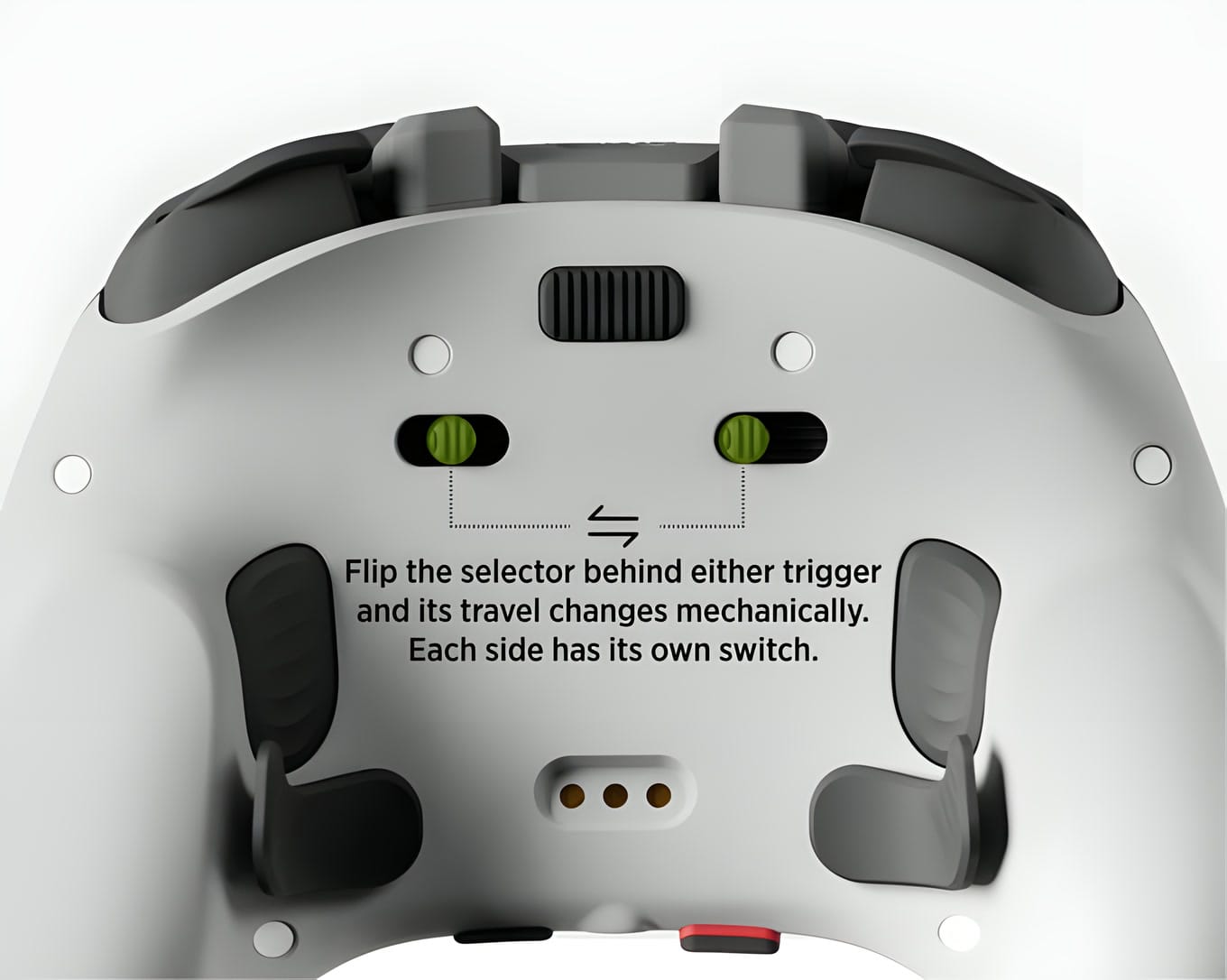
The triggers use Hall effect sensing, and each one has its own physical switch on the back that changes its travel mechanically. The three modes are Digital, Rapid and Analog, and the left and right triggers can use different modes at the same time. Genki says it will detail exactly how each mode behaves before shipping. Six extra controls sit around the back and shoulders: two programmable shoulder buttons, two built-in rear buttons and two removable paddles, which come in two sizes.
Rumble comes from what Genki calls Maglev Haptics. Each grip has its own voice-coil motor, turned so that its force pushes into the palm, and the two sides can fire separately or together. Genki says they can produce sharp knocks, clean pulses and several frequencies at once, and even play sounds through the shell. A nine-axis motion sensor with a gyroscope, accelerometer and compass handles motion controls and gyro aiming.
MantaOS and the screen
MantaOS runs on a Raspberry Pi RP2350 microcontroller with 16 MB of storage, and it drives the 2.79-inch IPS display at 428 by 142 pixels. Everything that other pro controllers send to a phone or PC app is handled on the screen: profiles, button mapping, stick and trigger tuning, pairing and firmware settings. The Manta stores up to eight profiles, and each one can have its own dashboard. During play, the dashboard can show the connection, polling rate and battery, mirror the inputs or display the current button map.
Two features stand out. On-the-Fly KBM turns the controller into a keyboard and mouse at the press of a button, which helps on handheld PCs and couch setups when a Windows prompt gets in the way. The Macro Action Timeline records buttons, stick movements, trigger pressure and pauses on separate tracks, which can then be edited in steps as fine as 2 ms. For events that ban such features, a Tournament Mode visibly disables macros, turbo and KBM while keeping ordinary remaps.
Genki also wants MantaOS to run apps. Adding one works like copying a file to a USB drive: connect the controller, enter Disk Mode and drag the app over. Genki says it is exploring a “Genki Forge” with hardware documentation and tools for people who want to build their own. During the campaign, backers voted on stretch goals, and a charging stand, D-Input support and Keyboard Binding were added to the plan.
Platforms and connectivity
Genki is developing the Manta for Windows, SteamOS, Switch, Switch 2 and Apple devices, including the iPhone, iPad, Mac, Apple TV and Vision Pro. Xbox and PlayStation consoles are not on the list. It connects in three ways, with polling rates of 8,000 Hz over wired USB-C, 1,000 Hz over the included 2.4 GHz receiver and 125 Hz over Bluetooth LE. Genki notes that polling rate is only one part of latency, and it has promised to publish full response measurements.
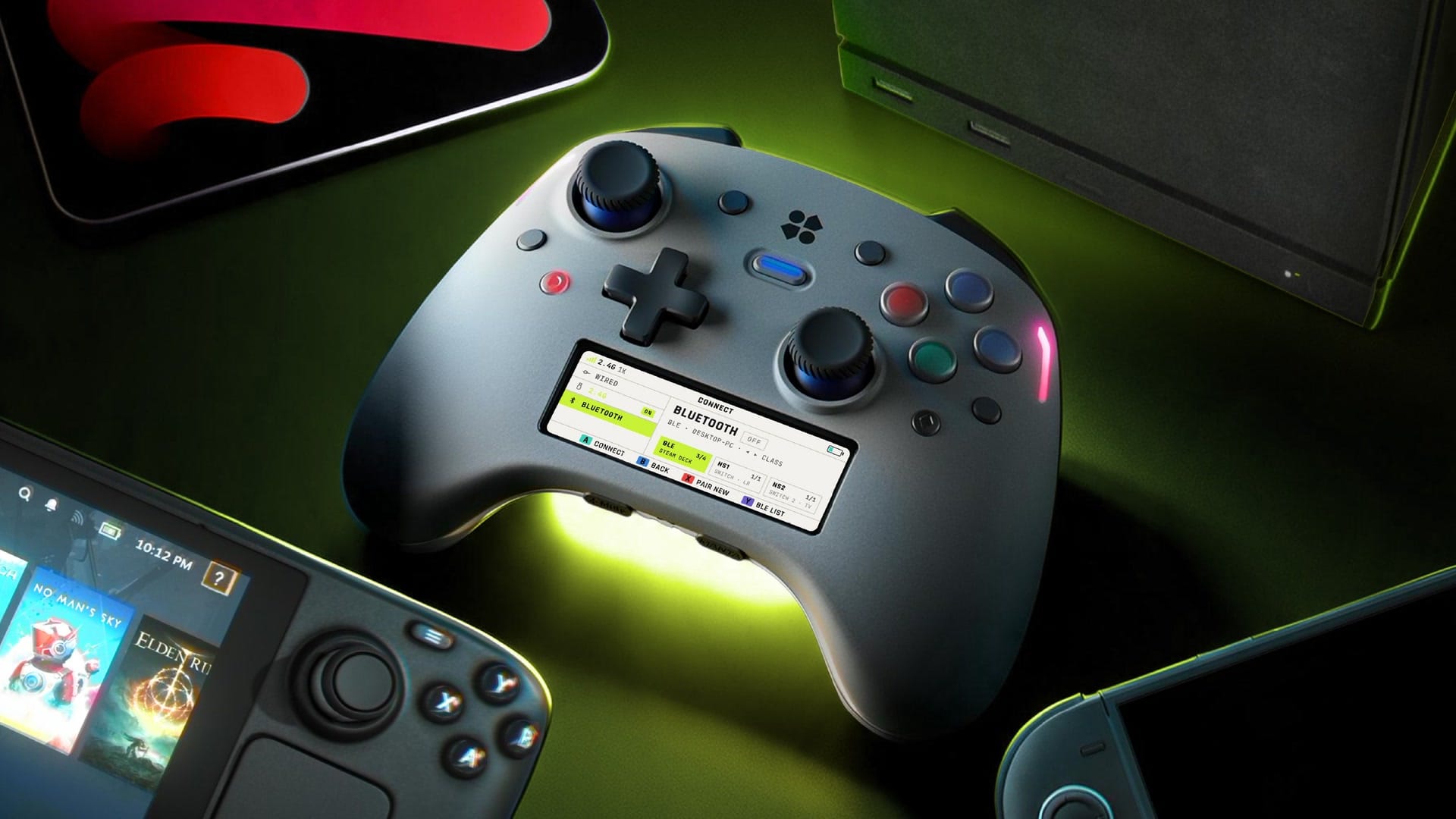
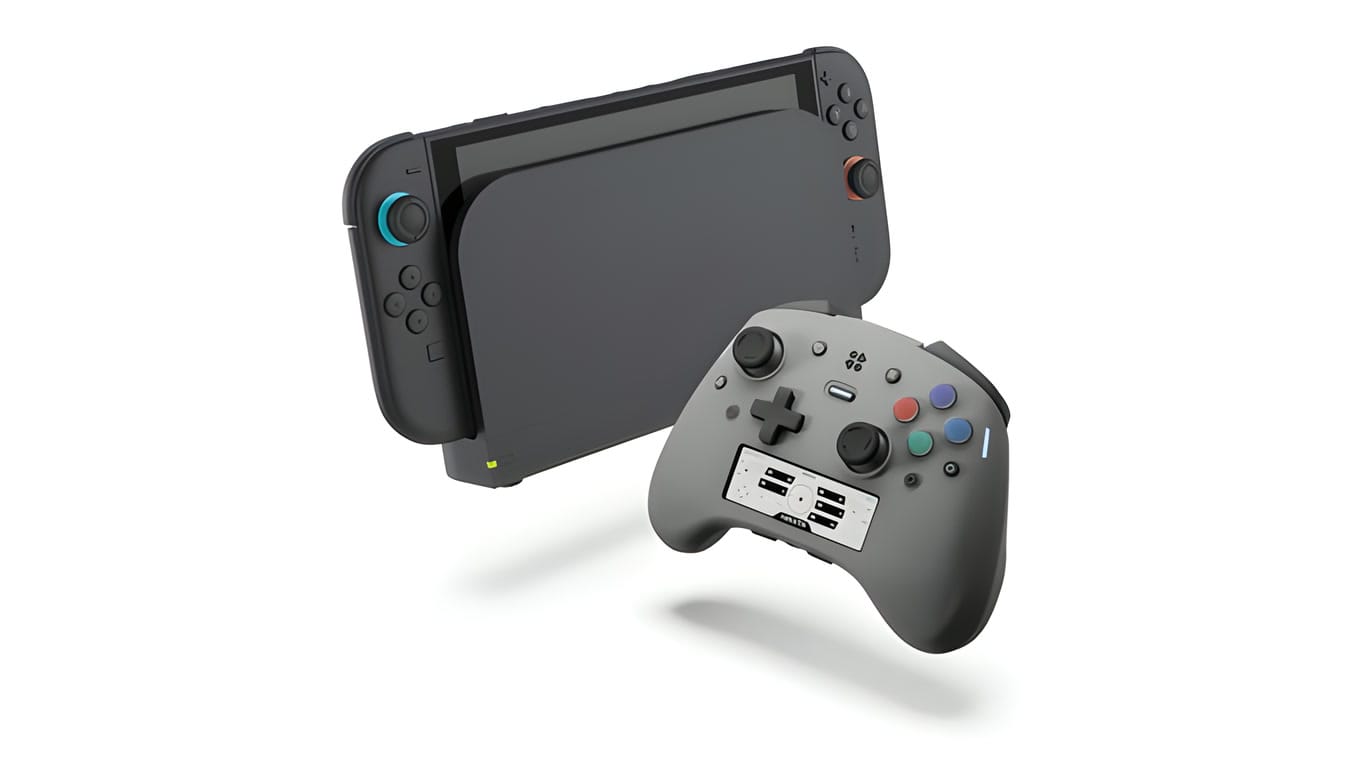
The Switch support goes further than most third-party controllers. The Manta has dedicated Switch and Switch 2 modes, in which the HOME button wakes a paired Switch 2, the KBM button becomes the C Button for GameChat, and the screen switches to Nintendo’s button layout. Native motion controls work in supported games, and supported HD Rumble 2 effects play through the Manta’s haptic motors. Genki notes that its keyboard and mouse mode is not the same as the Joy-Con 2 mouse controls. Among the Switch 2 controllers covered here, PowerA’s Ditto controller is a budget standalone pad without HD Rumble, while the NYXI Hyperion 3 and CRKD Nitro Deck 2 replace the Joy-Con for handheld play.
Specifications
| Specification | Genki Manta (target) |
|---|---|
| Display | 2.79-inch colour IPS LCD, 428 x 142 |
| Processor and storage | Raspberry Pi RP2350 (dual-core), 16 MB |
| Connectivity | USB-C, 2.4 GHz receiver (included), Bluetooth LE |
| Polling rate | 8,000 Hz wired, 1,000 Hz 2.4 GHz, 125 Hz Bluetooth |
| Face buttons | Four analog Pulse Buttons with adjustable actuation |
| Sticks | TMR, adjustable 30 to 80 gf tension |
| Triggers | Hall effect, Digital, Rapid and Analog modes |
| Extra controls | Two shoulder, two rear, two removable paddles |
| Haptics | Two voice-coil motors, one per grip |
| Motion | Nine-axis: gyroscope, accelerometer, compass |
| Audio | Headphone jack, hardware mute toggle |
| Battery | 2,400 mAh (2 x 1,200 mAh), user-replaceable |
| Charging | USB-C and three-pin contacts |
| Weight | About 315 g |
| Warranty | One year |
Price, the Founder’s Edition and shipping
Genki plans to sell the Manta for $279 at retail. Kickstarter backers paid less: the $189 Super Early Bird tier sold out, and a single controller is still available as a late pledge for $209, or $369 for two. Shipping is charged separately in the post-campaign survey, and Genki estimates $10 to $15 for one controller to the United States. Every tier includes the 2.4 GHz receiver, the cable lock attachment, an extended USB-C cable, both D-pads and the removable rear paddles.
The Founder’s Edition cost $349 and was limited to 1,000 units, all of which sold. Each one is serialized from 1 to 1,000 and comes in an exclusive colourway that Genki says will never be sold again. It also gets a special case and packaging and a Founder’s mark on the controller itself, with more details still to come. Genki has not yet shown what the Founder’s Edition looks like.
Genki’s optimistic goal is to begin shipping in January 2027, with a more conservative window of January to April 2027, and the reward tiers list an estimated delivery of February 2027. The company says it has spent more than a year on development and that the remaining work is refinement: stick feel, trigger behaviour, haptics, latency, compatibility and manufacturing tolerances. It has promised two development updates a month until the controllers ship.
Backing hardware on Kickstarter
A Kickstarter pledge is not a store purchase. Genki’s FAQ says that once a campaign ends, refunds are no longer simple, and several features are still described as being finalised, including how the trigger modes and rear buttons will behave on each platform. The Manta has been shown at Gamescom, PAX West and Tokyo Game Show, and Notebookcheck went hands-on at Gamescom, but no independent reviews of a production unit exist yet. Every specification in this article is a target until then.

Genki’s history works in its favour. The company has run eight successful Kickstarter campaigns before this one and has shipped products such as the Covert Dock and ShadowCast. In its latest update, Genki was also open about the strain of the campaign, from slow comment replies to a typhoon that cut Tokyo Game Show short. A controller this complex still carries more risk than an adapter or a dock, so delays would not be surprising.
Why I backed it
The caveats are real, but so is my enthusiasm for what the Manta represents. It is a new controller designed from the ground up for extensibility, and it is packed with next-generation input technology: face buttons whose actuation point I can set myself, sticks whose tension changes with a twist, and a selector behind each trigger that changes its travel mechanically. Add haptics that can play sound, an operating system that can load new apps, and a design shaped by community input, with backers voting on which features to add at each major campaign milestone, from a charging stand to Keyboard Binding. Very few controllers try this much at once, and I am hopeful the finished Manta delivers on all of it.
I backed the Manta myself at the Founder’s Edition tier, so one of the 1,000 serialized controllers is coming my way. I am looking forward to testing it when it arrives, and a video will follow, covering how the Pulse Buttons, sticks and triggers feel, how useful MantaOS is in practice, and how it works across PC and Switch 2. Until then, everything in this article comes from Genki’s campaign and early coverage.