Sega Dreamcast (1999)
Sega’s last console, from 9/9/99 and a modem in every box to the PowerVR2 chip, the VMU and the fans who keep it alive.
So, the Dreamcast
If you weren’t there, the numbers alone don’t do it.
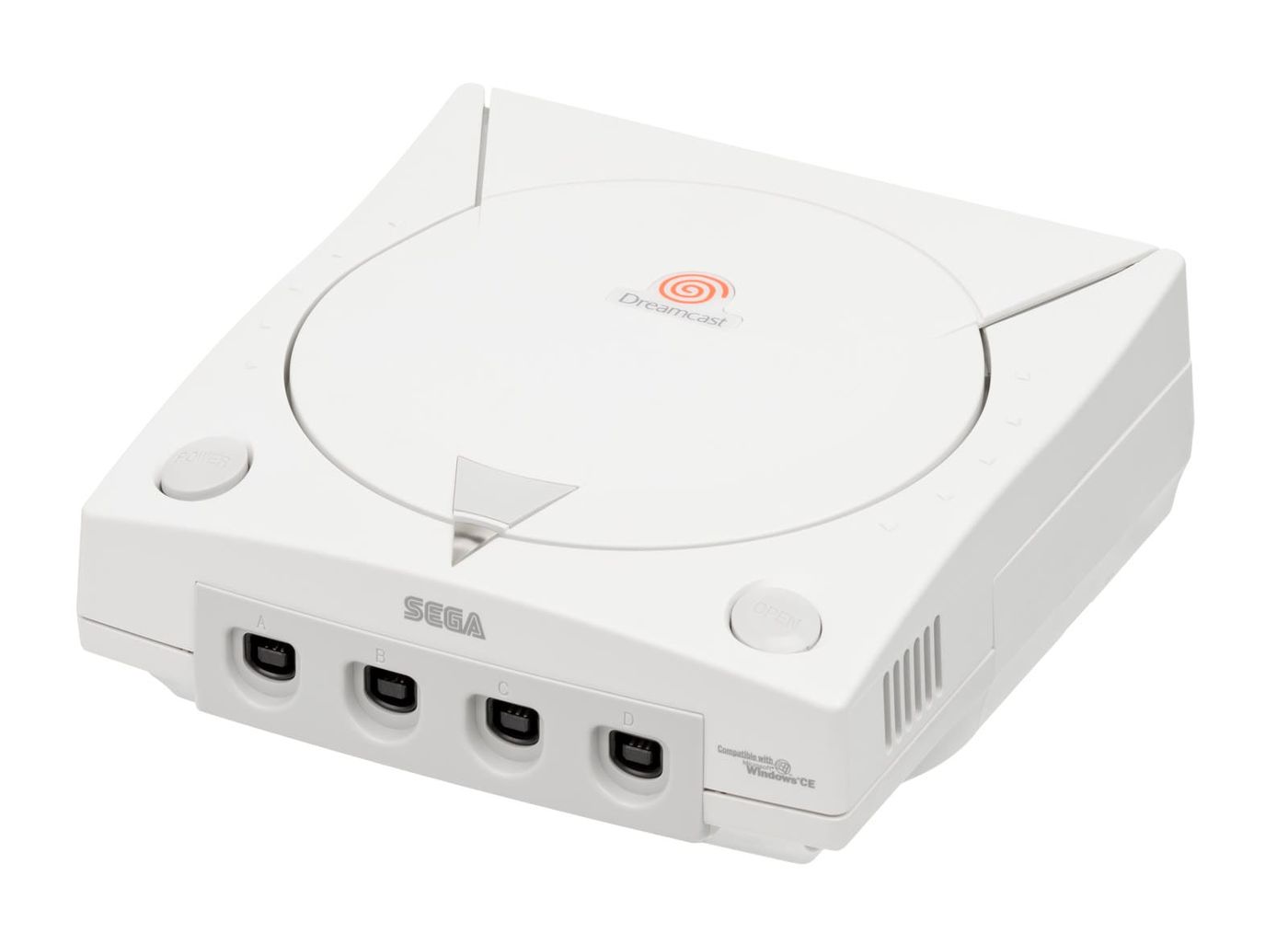
It was Sega’s last console. It came out in Japan on November 27, 1998, hit the US and Canada on September 9, 1999 for $199, and Europe on October 14, 1999. By March 2001, Sega was done. Done making it, done making consoles, period. Less than two and a half years.
The name came from a public contest. Sega went with “dream” plus “broadcast”: a machine that broadcasts dreams to people. The modem part of this story is where that makes sense.
9/9/99
In the States, the launch date was the whole marketing campaign. Nine, nine, ninety-nine. People started lining up on the evening of September 7, and more than 400 stores opened at 12:01 in the morning on the 9th. Midnight launch.
Here’s a number Sega put out the next day: $97,904,618.09 in the first 24 hours. Sega called it the biggest 24 hours in entertainment retail history. You’ll see people say $98.4 million, or $100 million, but neither of those traces back to Sega. The one with nine cents on the end is the real one. Sega also said it tripled the opening day of The Phantom Menace, which had done $28 million a few months before. A game console, outselling Star Wars.
The games helped. Sega had 18 launch titles, Soulcalibur among them: GameSpot gave it a 10 and said the home version beat the arcade version in just about every way. Sonic Adventure was Sonic’s first full 3D adventure. NFL 2K let you pick your play on the little screen in your controller, so your buddy sitting right next to you couldn’t see what you were about to run. And that was just the first day. Shenmue, Jet Set Radio, Crazy Taxi, Phantasy Star Online and plenty of others came later, and a lot of them are classics now.
Japan had it first, and it was rough
Japan got the Dreamcast about ten months before the US did, and it didn’t go great. Sega couldn’t get the two main chips made fast enough, so they couldn’t ship what they’d planned, and the launch date had already slipped a week, from November 20 to November 27. About 400,000 sold that first holiday season. Sega dropped the price to ¥19,900 in June 1999, and all the way to ¥9,900 by March 2001.
The ads, though. Sega put one of its own executives, Hidekazu Yukawa, in TV commercials where schoolkids tell him to his face that Sega is lame and PlayStation is more fun. A company roasting itself on national TV to sell a console. It won the top TV commercial award in Japan that year, and on launch day “Yukawa senmu” was in Akihabara handing consoles to people himself.
It came with the internet in the box
Every single Dreamcast had a modem built into it. Not an add-on you bought later. In the box, every unit, every region.
You’ll hear “the first online console”, and that’s not quite right. The Saturn had a NetLink add-on. The Super Famicom had Satellaview. Sega’s own wording was more careful: the world’s first home console with a built-in 33.6 kbps modem. The new thing was that it came standard. You took it home, plugged in a phone line, and you were online. The modem popped out, too, so you could swap it for something faster down the road. Japan and Europe got 33.6k, North America got 56k.
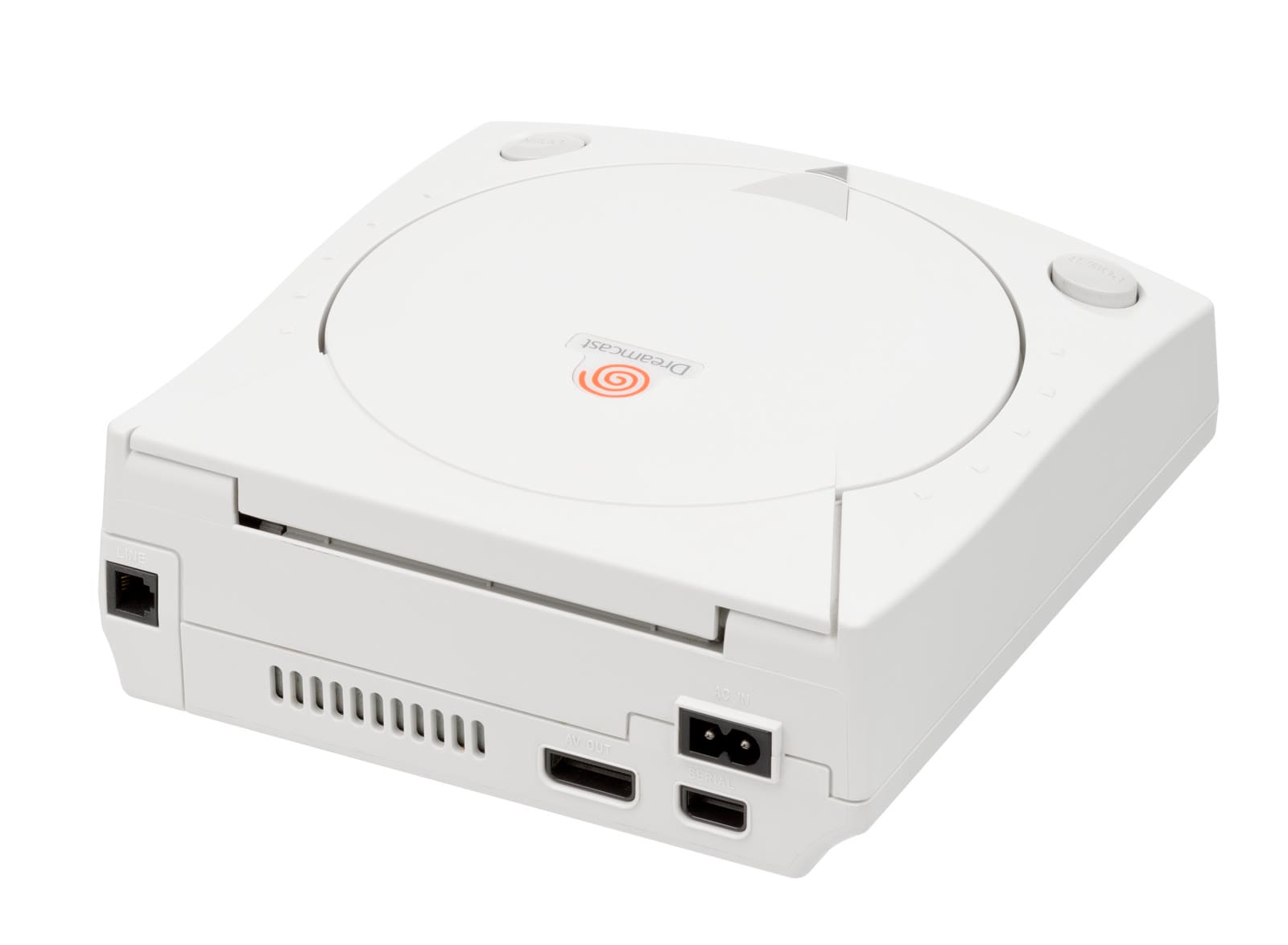
Sega argued about that modem internally because of what it added to the cost, and it ended up in every box anyway. In Japan, Sega ran its own internet provider and made the connection free. Europe got Dreamarena, free, at launch. The US got SegaNet in September 2000 at $21.95 a month, and Sega would give you a free Dreamcast if you signed up for 18 months. By October 2000, Sega counted 1.55 million people registered online around the world. That’s the “broadcast” in Dreamcast.
The games
Shenmue showed up at the end of 1999 in Japan, one of the most expensive games ever made at that point, trying to put a whole living town into a game. Seaman was a talking man-fish you raised by speaking to it through a microphone plugged into your controller, and Sega says it was the Dreamcast’s biggest hit in Japan. Yes, a man-fish. Jet Set Radio went all in on cel shading. Crazy Taxi came home from the arcade almost untouched. Phantasy Star Online, end of 2000, had more than 200,000 people playing online together, and Sega calls it the first successful online RPG on a console. Sonic Adventure is reported to be the best seller at about 2.5 million copies, but Sega never published a number, so hold that one loosely.
How it ended
The PlayStation 2 came out in 2000, and that was that. Sega’s own annual report for that year says its hardware numbers “fell far short of their targets”. On January 31, 2001, Sega’s board voted to stop making the Dreamcast, production ended that March, and Sega turned into a company that makes games for other people’s consoles.
You’ll hear piracy killed it, and piracy was real. A boot disc came out in mid-2000 that let the console run copied games. But Sega’s own financial reports never blame piracy. They blame missed hardware targets, the cost of launching and cutting prices, and the competition. Piracy was one pressure out of several. It wasn’t the cause.
How many did it sell? Depends who you ask, because the numbers don’t agree. Sega’s own annual report says 8.2 million by the time production stopped. The 9.1 million you see most often looks like that 8.2 million plus the roughly 930,000 consoles Sega still had sitting in warehouses and sold off through 2001. Sega Japan’s own history page says “more than 10 million” shipped. About 9.1 million is the fair number. If somebody tells you 10.6 million, that one came from a fan estimate that got copied around until it looked official.
The man who paid for it
That same board meeting, January 31, 2001, the one where they killed the Dreamcast? At that meeting, Sega also accepted a gift from its chairman, Isao Okawa. His shares in Sega. His shares in his other companies. Other assets on top. The press at the time put it at about ¥85 billion, roughly $695 million. Sega’s own books recorded it at ¥77.9 billion net, and those two numbers measure different things, so treat the exact figure as disputed. What nobody disputes is what he did: he gave Sega his personal fortune on the day the Dreamcast died. Then he died himself, about six weeks later, on March 16, 2001. He was 74.
One more, and take this one as reported, because it comes from a GamePro story in 2002: the last Dreamcast off the production line was signed by the heads of Sega’s studios and given away in a contest, along with every first-party game Sega ever made for it.
How it was made
If you don’t care about chips, skip down to the last section. Sega didn’t design most of this stuff from scratch. They took parts other companies made and had them shaped to what Sega wanted. And it worked.
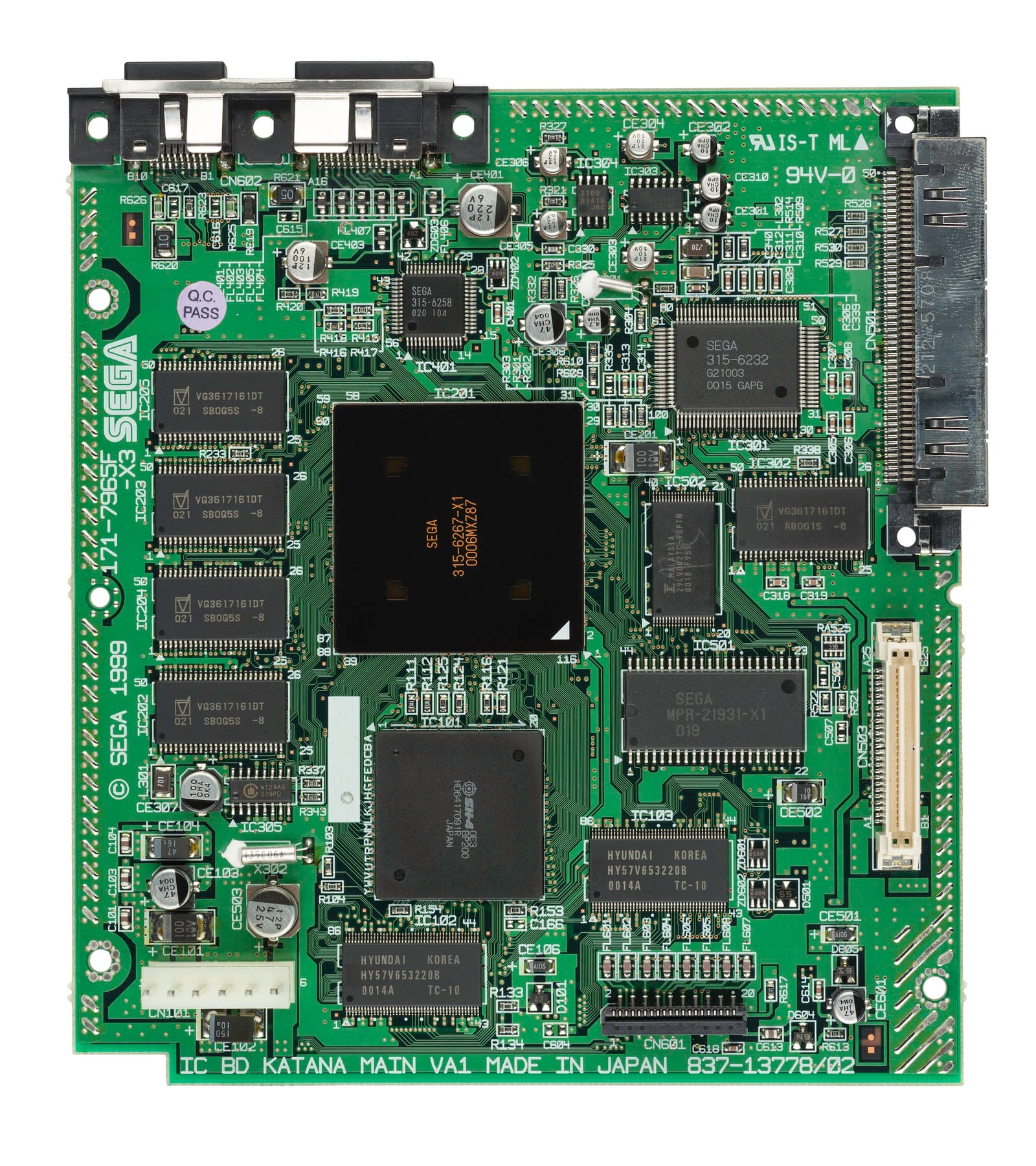
The brain. The main processor is a Hitachi SH-4 at 200 MHz. Hitachi’s own engineers called it the processor “for SEGA’s game machine, Dreamcast”, and Sega says it was built with Sega’s requests baked in. What made it good for games is a math unit that could crunch four numbers at the same time, which is exactly what you need when you’re moving and lighting thousands of triangles every frame. Sega marketed the whole thing as a “128-bit” console. That’s marketing. The SH-4 is a 32-bit chip that can do 128-bit-wide math for graphics, and that’s where the number came from.
The graphics chip, which is British. The graphics chip is the PowerVR2, designed by a British company called VideoLogic and manufactured by NEC. VideoLogic got a royalty on every Dreamcast sold. The chip’s trick was tile-based deferred rendering, and it’s why a $199 console could look the way it did.
Most graphics chips back then drew everything in the scene. Every polygon, including the ones hidden behind other stuff, and then they sorted out the mess afterward. The PowerVR2 chopped the screen up into little tiles, figured out which surfaces you could actually see in each tile before drawing a single pixel, and skipped everything you couldn’t see. Each tile got finished inside the chip. So it needed way less memory and way less bandwidth than a chip that draws everything. Cheaper, cooler, and it still pushed more than 3 million polygons a second by Sega’s count.
The rest of the insides. 16 MB of main memory, 8 MB for graphics, 2 MB for sound. The sound chip is a Yamaha part with its own little ARM computer inside it, mixing 64 channels at once. People quote a clock speed for that ARM, and they all quote different ones, so I’m not going to.
The discs. Games came on GD-ROM, Sega’s own format. It looks like a CD, but it packs the data in tighter, about 1 GB per disc by Sega’s count, and the drive read it at 12x. Why not DVD? Money, reportedly. A GD-ROM could be pressed for close to what a CD cost, back when DVD was still expensive. You’ll see “1.2 GB” quoted, and that’s from raw disc dumps that include the error-correction data, so it’s bigger than what a game could actually use.
Windows. Sort of. There’s a Windows logo on the front of the console. Sega worked with Microsoft on a custom Windows CE with DirectX so PC games could be ported over more easily. Most developers didn’t use it. Sega says most games ran on Sega’s own libraries and a simple OS, and the Windows route was the exception. Sega Rally 2, the first game you could play online, was one of the few that did.
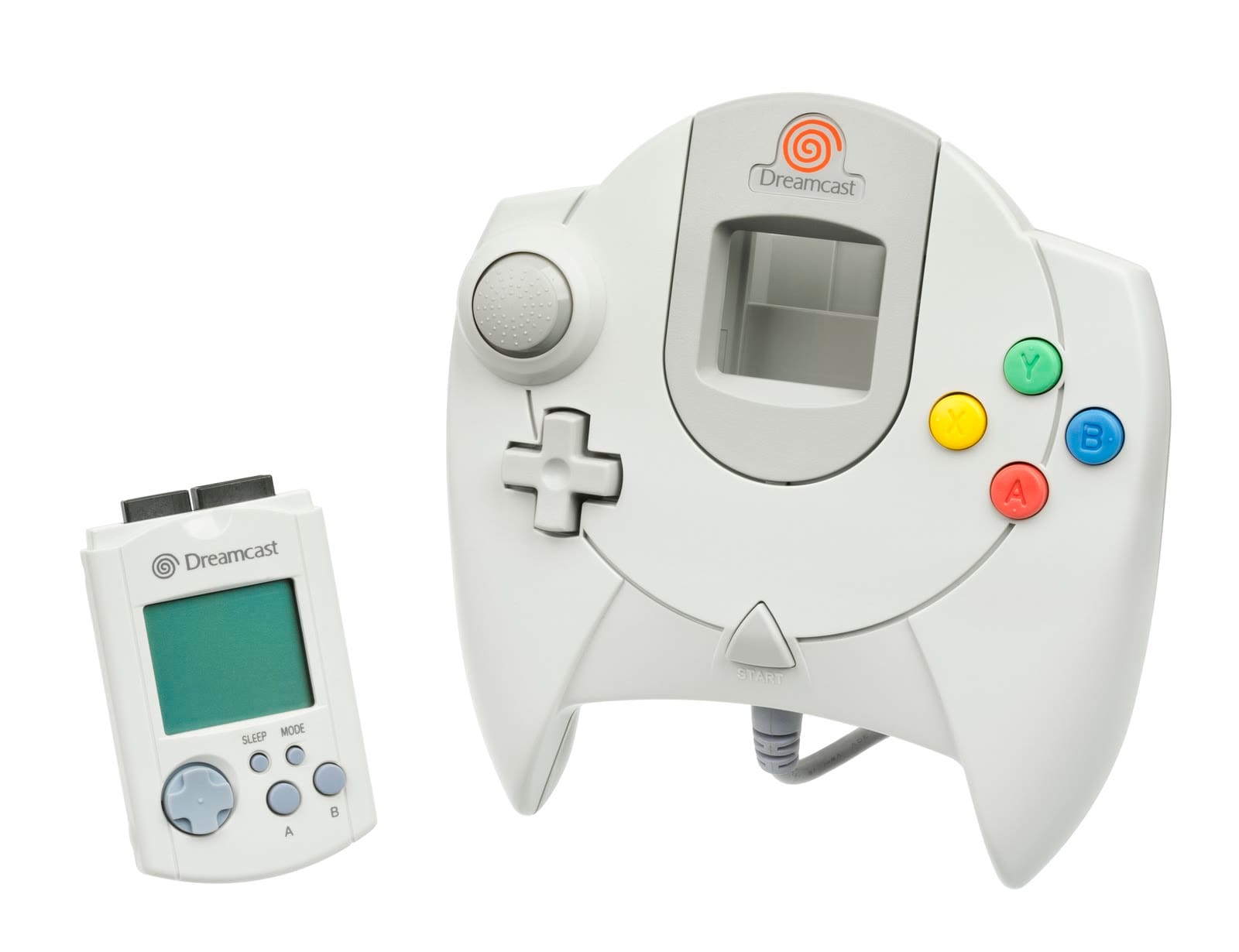
The controller and that little screen. The controller has an analog stick, two analog triggers, and two slots on top. For anybody who’s dealt with stick drift: the stick and triggers used magnetic sensors, the same Hall effect idea that controllers advertise today as drift-proof. That’s from an iFixit teardown in 2022. The design grew out of the Saturn’s 3D pad, and the console had four controller ports built in, so four players, no adapter.
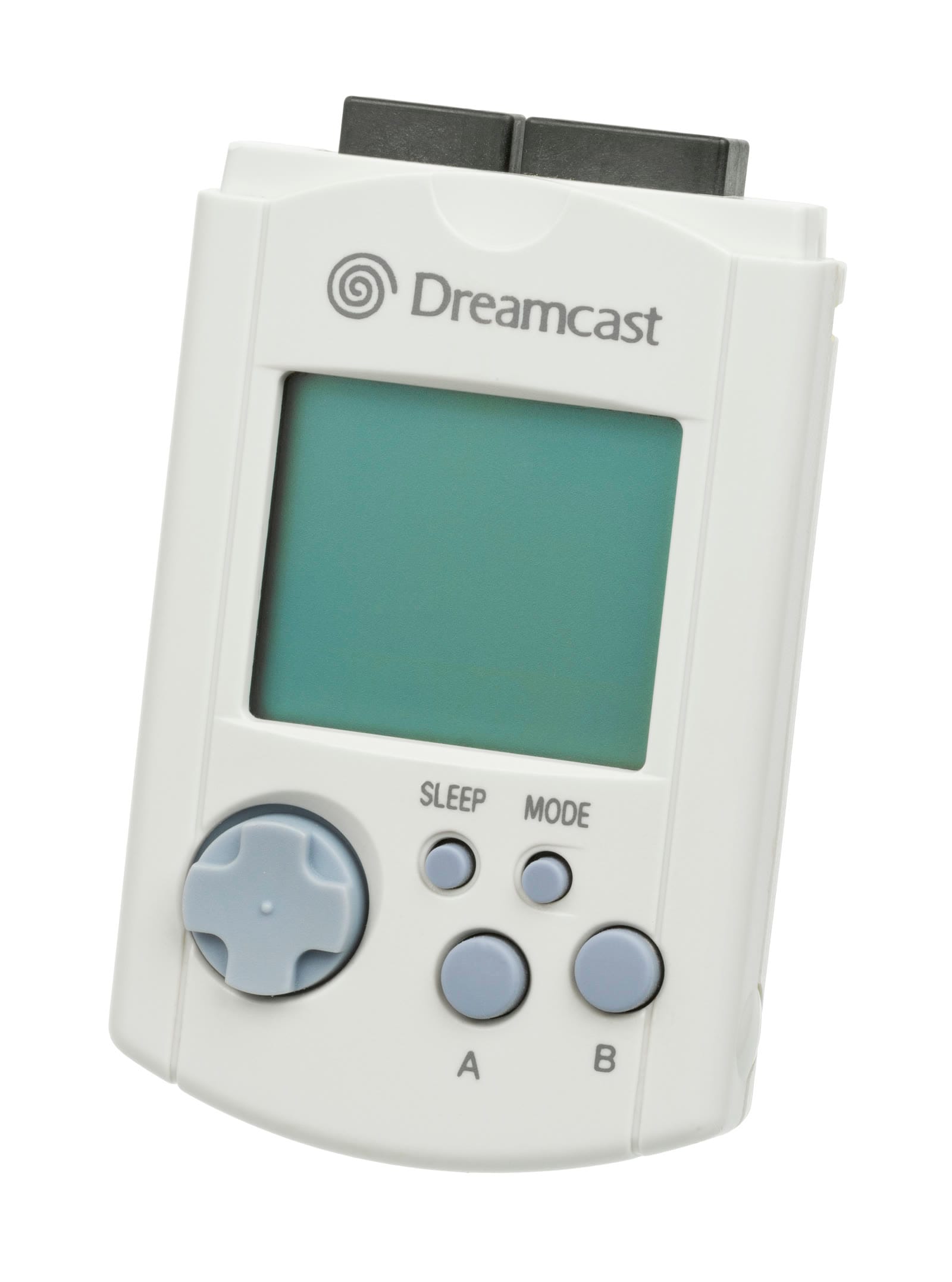
Those slots on top take a VMU, a rumble pack, or a microphone. The VMU, the Visual Memory Unit, is the memory card, and it’s a tiny computer all by itself. An 8-bit processor, a 48 by 32 pixel black-and-white screen, a D-pad, buttons, and 128 KB of storage, which is the 200 blocks you might remember if you ever juggled save files. You plug it into the controller and the screen faces you through a window in the pad. A private second screen. That’s how NFL 2K hid your play from the guy next to you on the couch. Pull it out and it ran little downloaded games on its own, and two VMUs could plug into each other to trade data. In Japan, Sega sold the VMU before the console came out, with a Godzilla mini-game on it.
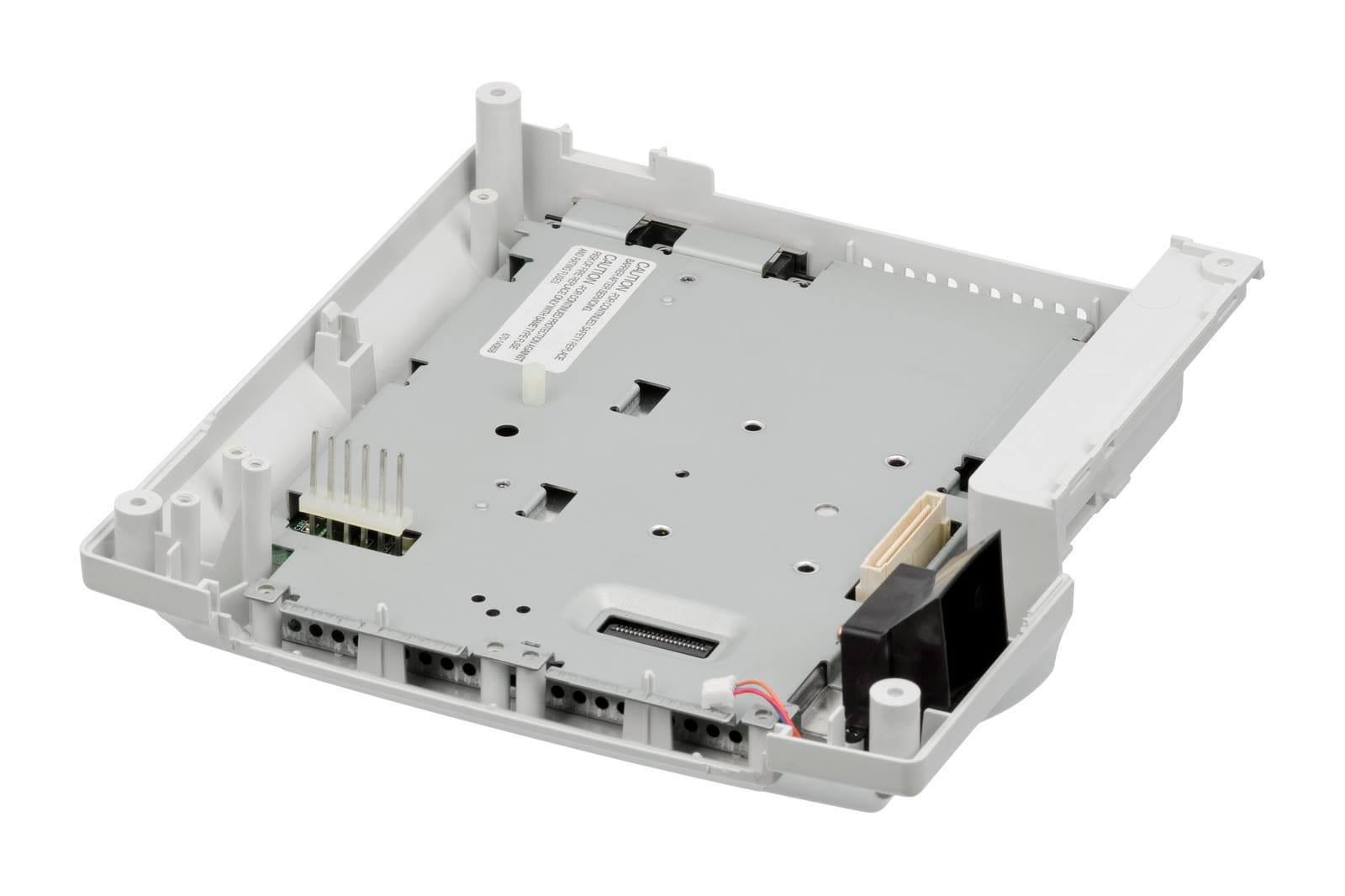
The box, and its arcade twin. The console is about 19 by 20 centimeters and 7.5 centimeters tall, weighs about 1.5 kilos, and draws about 22 watts. The swirl on top is orange in Japan and North America and blue in Europe, because Sega Europe wanted its own identity, going by the coverage at the time. The shell was designed by an outside Japanese firm, and the accounts of exactly who did what don’t line up, so the names stay out.
The Dreamcast had a twin in the arcades. Sega’s NAOMI arcade board was built on the same technology, with more memory and a ROM board instead of a disc drive. That’s why Crazy Taxi and Power Stone and the rest came home almost identical. The arcade and the console were basically the same machine. NAOMI 2 kept that design running in arcades until around 2009, years after the console was gone.
It never really died
KallistiOS, the free homebrew toolkit people use to make Dreamcast games, started in 2000, and it’s still being worked on. Its code repository had a commit on October 20, 2026. New games have come out for this console from 2003 right up through this decade. The fans brought the online side back, too. Dreamcast Live lists 58 games with online play restored. Phantasy Star Online still runs seasonal events on a fan server called Sylverant. Sega Rally 2, the very first online Dreamcast game, came back online in September 2026.
Sega walked away from consoles 25 years ago. The fans never walked away from this one.
Nerd Alert
Your Turn
What are YOUR thoughts
What have your experiences been? Let us know.