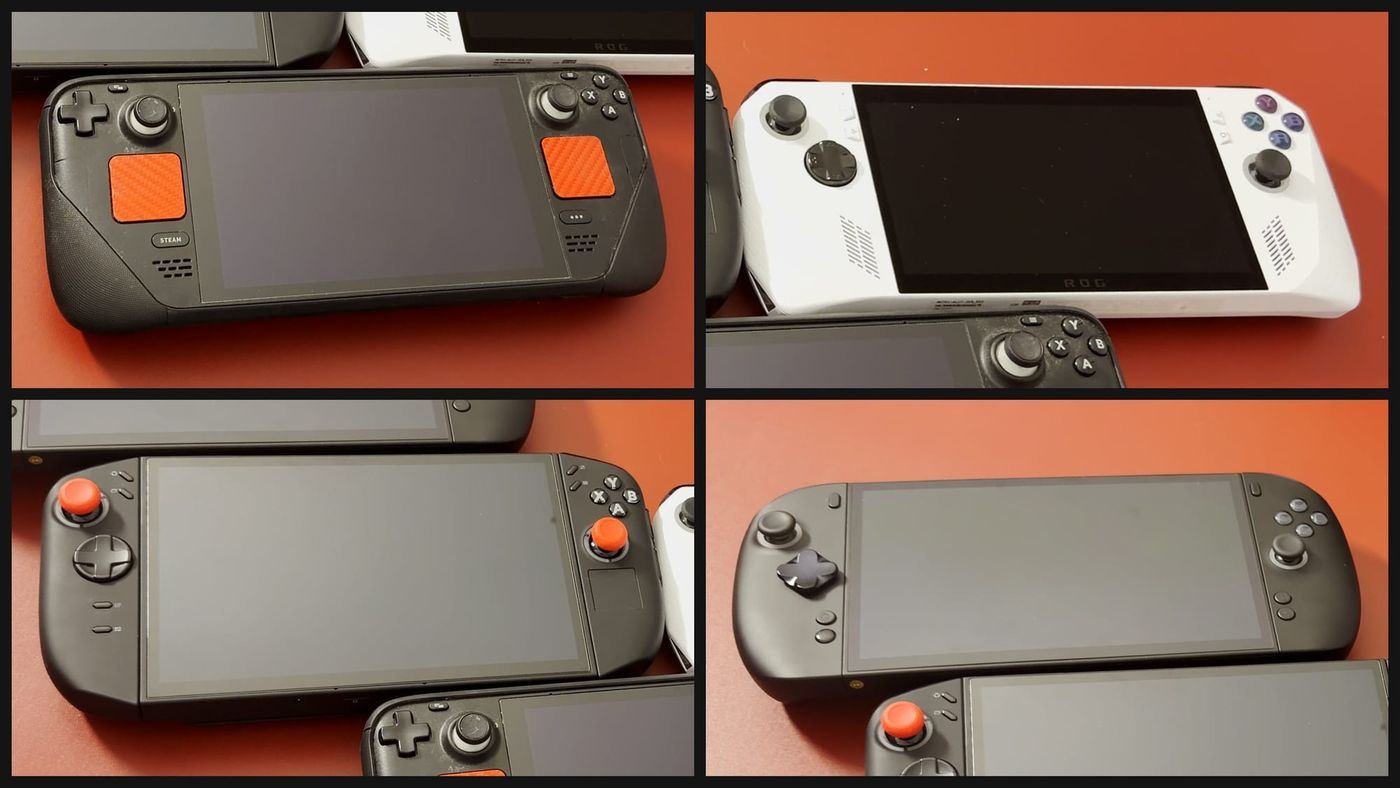
Four handhelds at very different prices raise an obvious question: how much performance the extra money buys once games are running. The comparison covers my LCD Steam Deck, original ROG Ally, Legion Go 2 and OneXPlayer X2 Mini Pro. Each ran Guardians of the Galaxy, Black Myth: Wukong, Cyberpunk 2077 and Red Dead Redemption 2 at several power settings. A separate look at weight, screens and everyday use covered the other half of the decision.
Some results matched my expectations, and others were surprising enough that I repeated the test. The Ally also had a persistent problem with Red Dead Redemption 2, covered in its own section below. The sections that follow move from the lowest power setting to the highest.
How the devices were tested
I tested at 15 W, 25 W and 35 W power settings, using each game’s quality presets. These wattages describe the processor power setting selected on each device. They do not describe the total power drawn from the battery.
All four devices took part at 15 W. The Steam Deck stops at that level, so the 25 W group was the Ally, Legion and X2. At 35 W, only the Legion and X2 remained. I tested the original Ally in its unplugged 25 W mode.
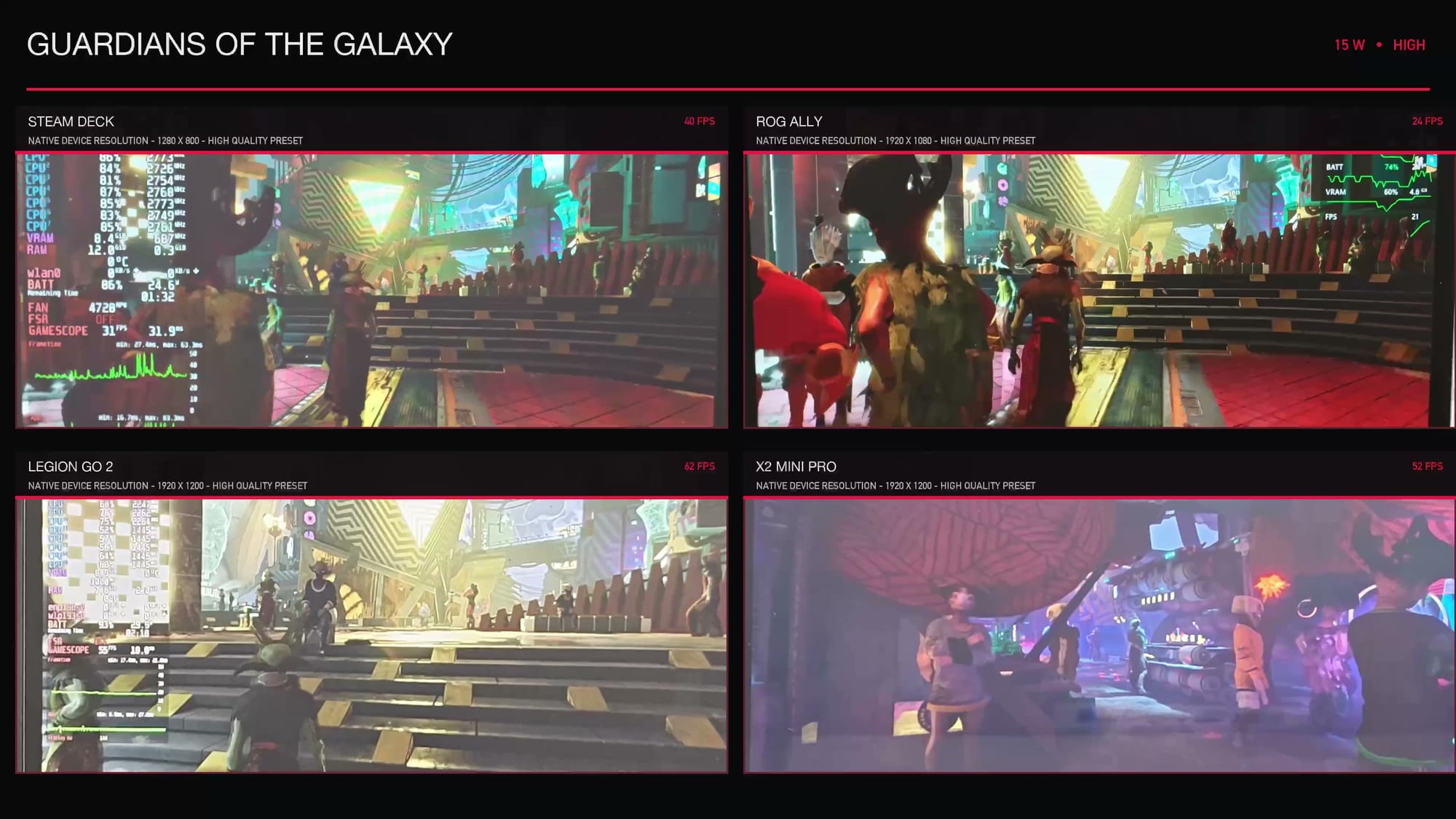
My method was to select a preset and run the game, without manually matching every individual graphics option across the four machines. A preset can use upscaling, which builds the displayed image from a lower resolution, or frame generation, which adds frames between rendered ones. Selecting Medium on each device can therefore leave different amounts of work going on underneath. The results show how each configuration behaved as delivered by its preset.
The X2’s Cyberpunk and Wukong figures below include generated frames. They show how those particular setups responded to more power. A precise comparison of the chips themselves would need a separate test with the rendering settings matched. Each device ran at its native resolution, so the same preset asks a different amount of work of each machine.
At 15 W, the Steam Deck held its own
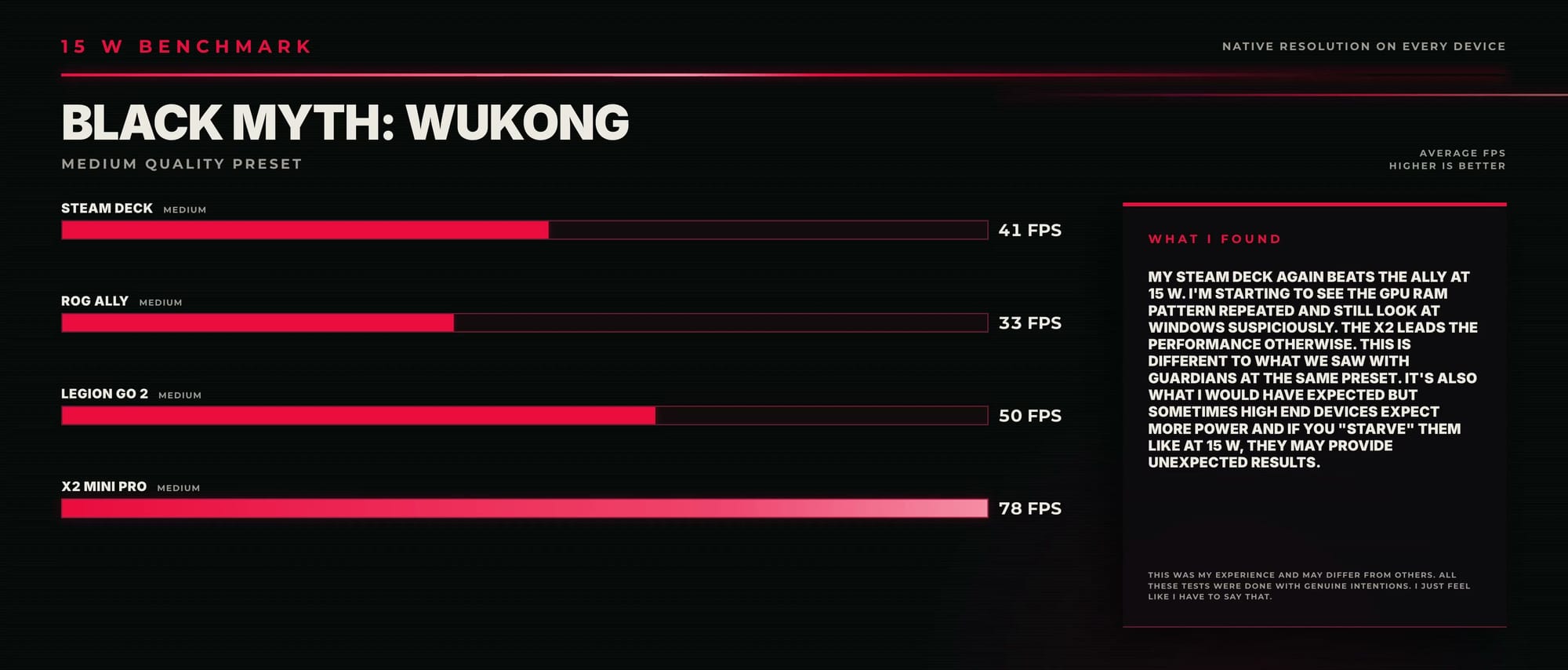
The Steam Deck remains a compelling machine. At 15 W, it repeatedly finished ahead of the original Ally in the configurations tested, a result surprising enough that I checked it a second time. That puts an older handheld level with, or ahead of, a machine with a newer and more powerful chip.
Wukong is a useful example. The Deck’s Medium run averaged 41 FPS, while the Ally’s Medium run averaged 33 FPS. The Deck’s output was 1280 × 800 and the Ally’s was 1920 × 1080. That difference belongs alongside the numbers, because the Ally was driving the higher-resolution output.
In Cyberpunk, the Deck averaged 30 FPS on both Medium and High. The reason the two averages landed on exactly the same number has not been established. That explanation remains open.
Around 40 FPS or better is my comfort threshold. Below that, a game that keeps dropping starts to feel like a compromise to me. Other players are perfectly happy around 30 FPS. Knowing one’s own tolerance matters before judging whether someone else’s result is good enough.
One possible reason for the Ally’s weaker showing at the lower setting is the amount of graphics memory the games reported. That theory still needs investigation. What my testing does show is that the Deck remained worth taking seriously at 15 W.
At 25 W, the Ally performed closer to expectations
More power made a noticeable difference to the Ally in these runs. Wukong’s Medium average went from 33 FPS at 15 W to 49 FPS at 25 W. That moves it past the rough 40 FPS comfort line. A gain of that kind matters more than a small improvement to an already-high number.
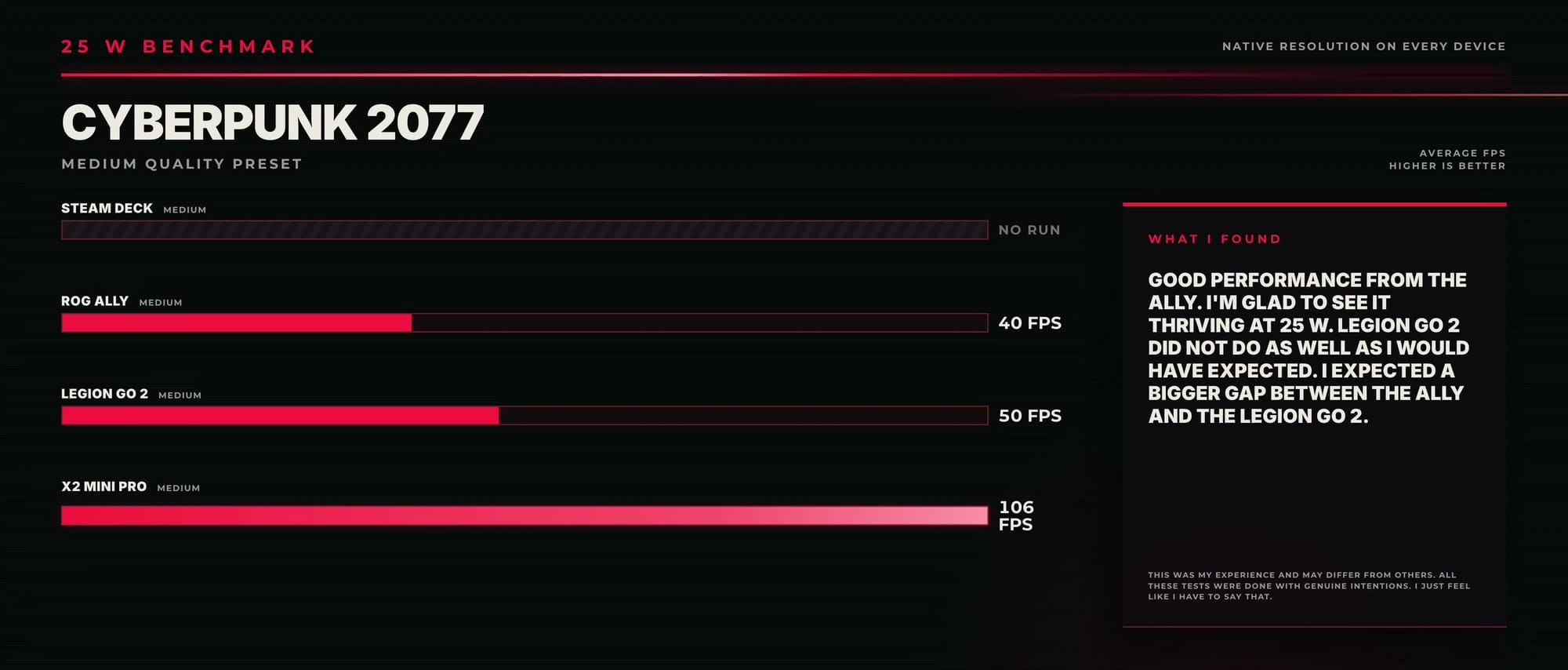
The Legion improved as well. In Cyberpunk at Medium, its recorded average went from about 34.8 FPS at 15 W to 49.6 FPS at 25 W. For anyone aiming at the same comfort threshold, that is a useful gain.
The X2 also began to show the performance that made it interesting in the first place. Its later Cyberpunk Medium run reported 105.7 FPS at 25 W, including frame generation. That result raised the question of how much further the setup would go.
Wukong produced another notable result on the X2. Its High-preset benchmark reported 112 FPS at 25 W. Because the jump looked substantial, I repeated the test set, and the results stayed in the same general range. That consistency makes the figure hard to dismiss.
At 35 W, the game mattered as much as the power setting
At this level, the Legion and X2 were the two devices left in the comparison. The X2 was expected to have more headroom, and in several runs it did. The extra ten watts still did not produce the same kind of improvement everywhere.
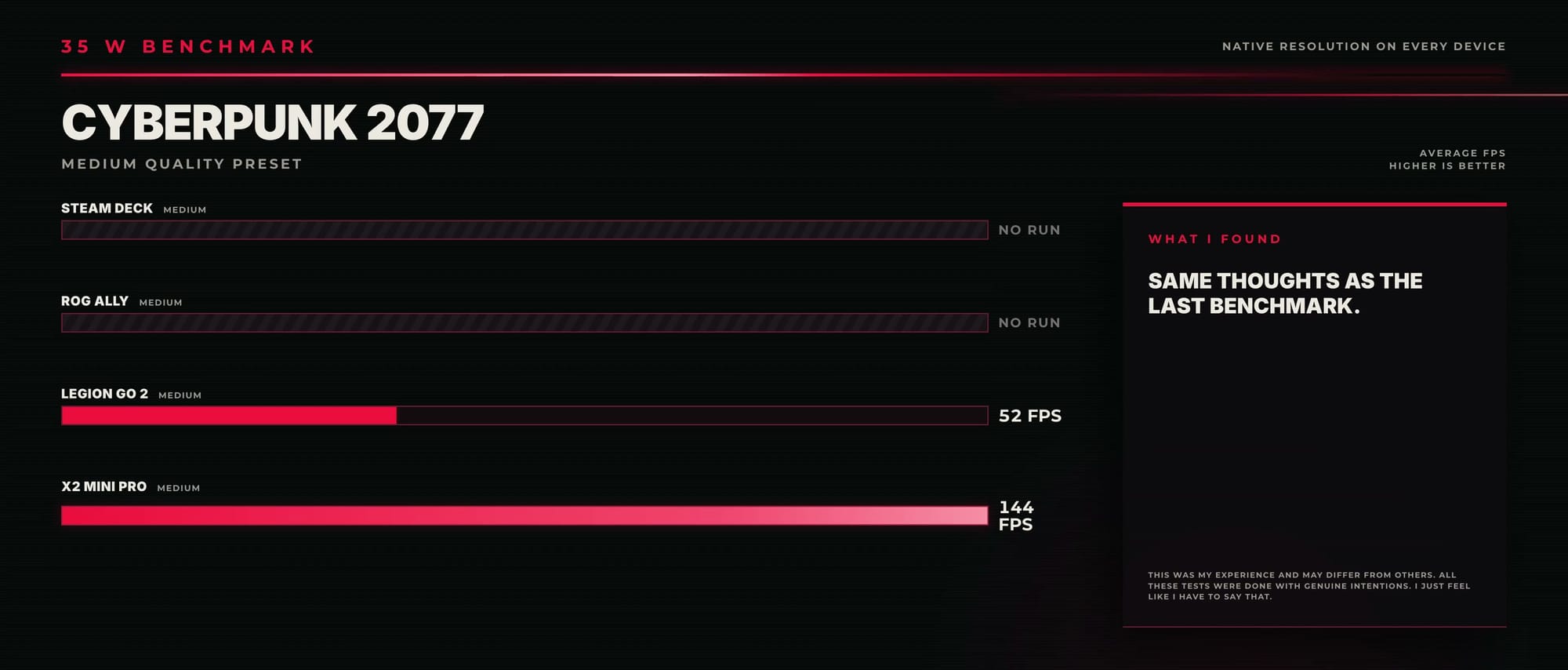
On the Legion, Cyberpunk Medium went from about 49.6 FPS at 25 W to 52.4 FPS at 35 W. The improvement is visible in the result. Whether those few frames justify the extra power depends on how the device is being used.
The X2’s Cyberpunk Medium result went from 105.7 FPS at 25 W to 143.6 FPS at 35 W, with frame generation enabled in both. That setup still had quite a bit to gain. Cyberpunk on the X2 is the clearest case in this comparison for raising the power setting.
Wukong behaved differently. On the X2, High reported 112 FPS at 25 W and 111 FPS at 35 W. A one-frame difference is too small to count as a meaningful loss. The useful point is that this pair of runs showed no appreciable average-frame-rate benefit from the higher setting.
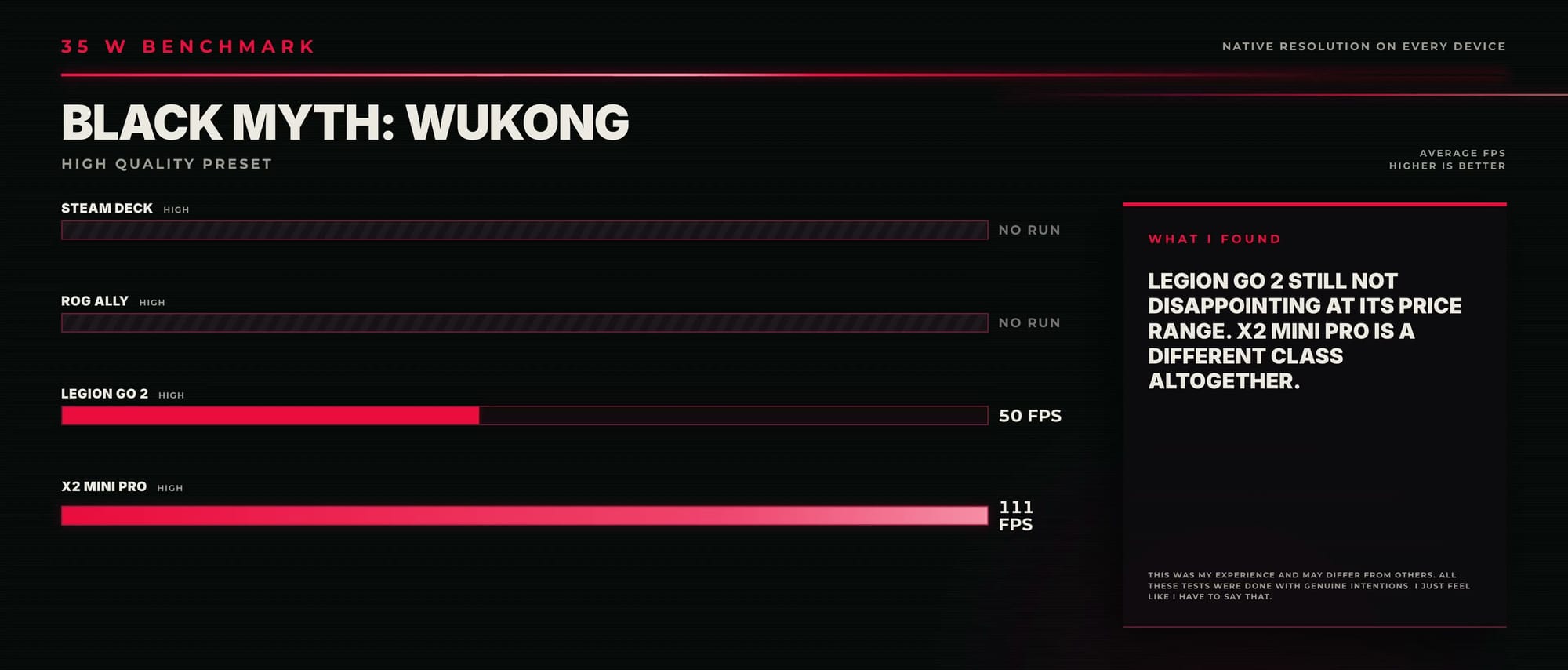
For that reason, 35 W, or the 40 W setting I often prefer for everyday play, should not become a default for every game. Cyberpunk gave a reason to try more power. The Wukong result gave a reason to stop and check whether the lower setting was already enough.
The Legion also appeared to be working harder, particularly in the amount of audible fan noise. The X2 seemed more comfortable during these sessions. This is my hands-on observation, and I did not run a controlled noise comparison to put a reliable number on the difference.
Guardians of the Galaxy produced unclear results
Guardians of the Galaxy was the awkward game in this group. Medium and High frequently came back much closer together than expected. Increasing the wattage did not always produce the expected progression either.
I checked for an in-game frame limit, and it was not enabled. Beyond that, there is no confirmed explanation for the pattern. The results are best treated with caution until the cause is understood.
The pattern makes Guardians a weaker choice as a main benchmark going forward. My future testing will lean more on Cyberpunk and dedicated benchmark tools. Those results can then be checked against actually playing the games.
Red Dead Redemption 2 would not finish on the Ally
The Red Dead Redemption 2 benchmark failed on my Ally in about six attempts across different settings. Each time it started, began stuttering, froze and eventually crashed. Restarting and trying again did not produce a completed result.
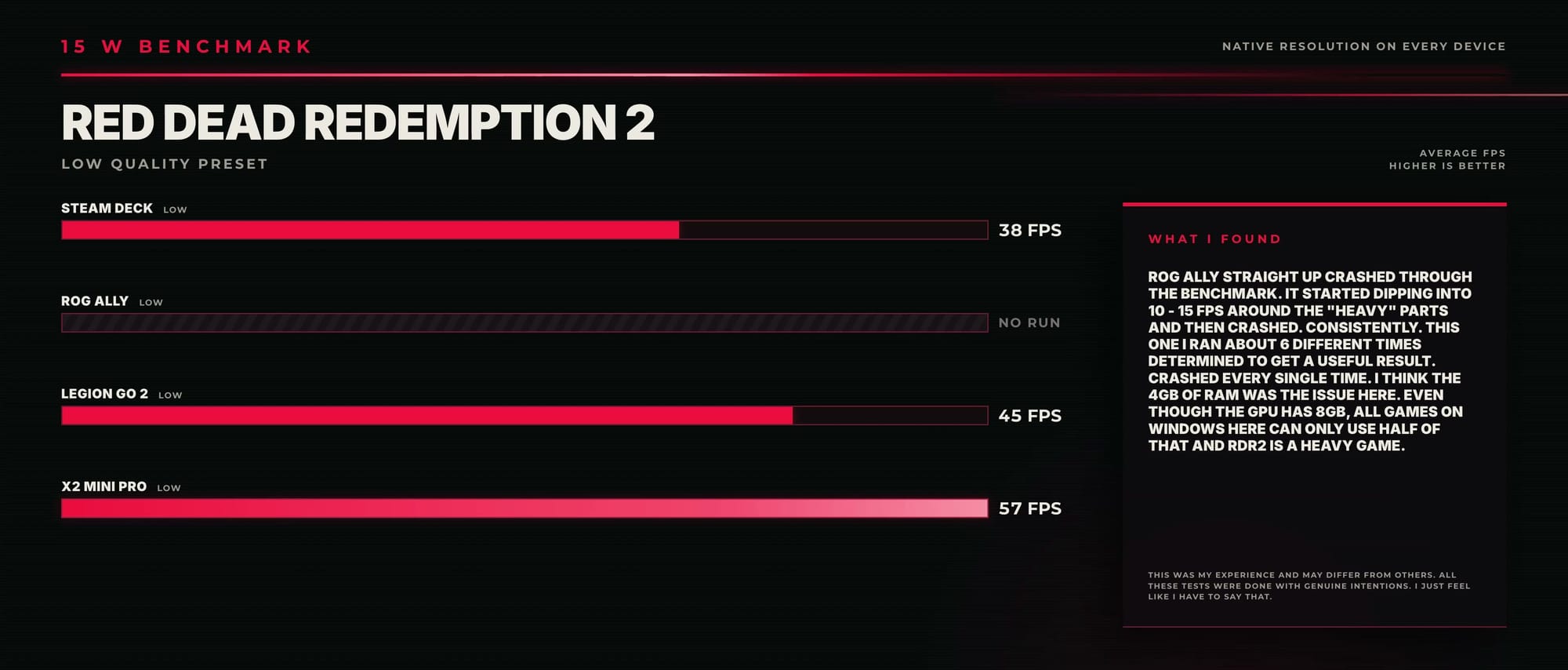
The failure stands out because the Ally had improved in the other games at 25 W. Red Dead Redemption 2 was the one title where that improvement could not be measured. Every attempt ended in the same failed run. For reference, the X2 Mini Pro completed the same benchmark at 65 FPS on the High preset at 25 W.
The game reported less graphics memory than expected from the selected allocation. That is a lead worth investigating, but it has not been established as the cause of the crashes. The problem could be specific to my setup, so other Ally owners should not assume their game will behave the same way.
There is no valid average FPS for that session. Ally owners who run Red Dead Redemption 2 without this problem are invited to share their settings and findings. Comparing notes may help identify what is different.
Not every preset was run on the other devices either. On the Deck, Medium was already below my preferred frame rate, so I did not test High. On the Legion, I did not complete Ultra at 35 W after seeing High’s behavior. My goal was to find playable settings, and there are no completed results for those skipped combinations.
The extra performance comes at a price
The X2’s performance was impressive across this testing. It also cost roughly $1,100 more than the Legion at the prices I paid. That gap frames every result above.
The Legion remained capable enough for many of the settings a player would realistically use. The X2 offered more room to push things further. Whether that difference is worth the extra money depends on how often it will be used, which games are being played and what else the money could do.
I bought all four devices myself, and as a hardware enthusiast, I see exploring the hardware as part of their value. Someone who wants one handheld for a particular collection of games faces a different decision. For that buyer, the benchmark numbers are only one input.
These results belong alongside the discussion of weight, price, and everyday use. A handheld still has to be held, packed, charged and lived with after the benchmark closes. Those factors can outweigh a frame-rate advantage in daily use.
Before you pick one
The practical approach is to start with the games that matter, try a sensible power setting and check whether raising it noticeably improves the experience. Cyberpunk on the X2 gained substantially from 25 W to 35 W, while Wukong on the X2 did not. Some games will reward more power, and others will already be good enough. Players who are comfortable around 30 FPS can accept lower settings than those who want 40 FPS or better.