NVIDIA’s DGX Spark HPC Kit Turns Four Desktop AI Boxes Into One 512GB Cluster
NVIDIA’s new kit cables four DGX Spark desktop AI computers into a ring: 512GB of memory, no switch, models up to 700 billion parameters. No kit price yet.
https://averagetechnerds.com/nvidia-dgx-spark-hpc-developer-kit-four-node-cluster/

Four small boxes, no network switch, and 512GB of memory between them. That’s NVIDIA’s new DGX Spark HPC Developer Kit, announced at the SC26 supercomputing conference in Chicago. It’s a desk-sized cluster for AI models too big for one box, up to 700 billion parameters, so you don’t have to wait your turn on a shared GPU cluster.
What is the DGX Spark HPC Developer Kit?
It’s four DGX Sparks working as one. If you haven’t met one, the DGX Spark is NVIDIA’s desktop AI computer, a small box built around its GB10 Grace Blackwell chip, with up to 128GB of memory that the processor and graphics share. NVIDIA rates it at up to 1 petaFLOP of AI performance, a quadrillion simple calculations a second. On its own, it’s already one of the bigger desktop machines you can buy for running AI models locally.
The kit takes four of them and cables each one to the two next to it, in a ring. NVIDIA aims it at researchers, academics and developers who’d otherwise wait in line for time on a shared GPU cluster. HPC stands for high-performance computing, which is what supercomputers do.
What’s inside one DGX Spark?
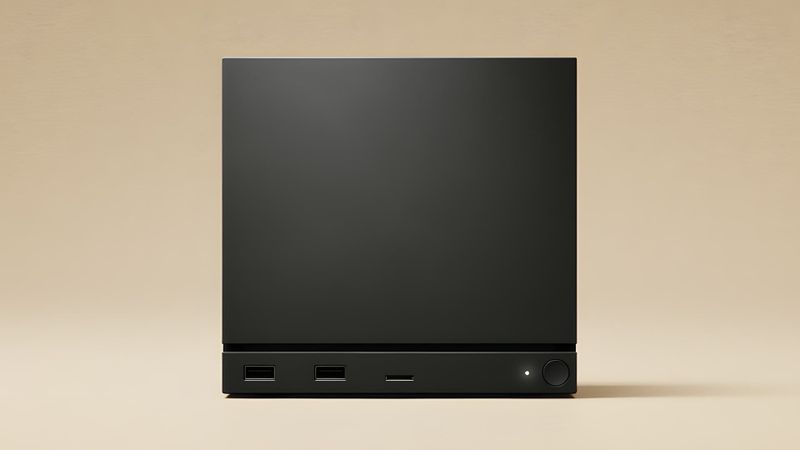
A lot, for a box that fits in your hand. It’s just 15 centimetres square, and inside is one NVIDIA chip, the GB10, that holds both the processor and the graphics. The two share one pool of memory, so the graphics side can use almost all of it for AI.
That shared memory is the point. Even the biggest gaming graphics card tops out at 32GB, and most have far less, so a big AI model simply doesn’t fit. The DGX Spark gives the model up to 128GB to work with.
| Spec | One DGX Spark |
|---|---|
| Chip | NVIDIA GB10 Grace Blackwell |
| CPU | 20 Arm cores (10 Cortex-X925, 10 Cortex-A725) |
| AI performance | Up to 1 petaFLOP at FP4 (NVIDIA’s figure, using sparsity) |
| Memory | 128GB LPDDR5x shared (64GB on some partner models), 273 GB/s |
| Storage | Up to 4TB NVMe, self-encrypting |
| Fast networking | ConnectX-7 at 200 Gbps, for linking Sparks together |
| Other connections | 10 Gb Ethernet, Wi-Fi 7, Bluetooth 5.4, 4 USB-C, HDMI 2.1a |
| Power | 240W power supply; the chip itself is rated at 140W |
| Size and weight | 150 x 150 x 50.5 mm, 1.2 kg |
| Software | DGX OS, NVIDIA’s Linux based on Ubuntu |
How do four boxes act like one?
They talk to each other directly, so you skip the usual networking gear. Each DGX Spark has NVIDIA’s ConnectX-7 networking built in, and in the kit each box connects straight to its two neighbours. That’s the part NVIDIA keeps pointing at: no network switch to buy or set up. Each link runs at up to 200 gigabits a second, far faster than a home network. It also scales down. You can start with one box and add more, up to four, and NVIDIA’s Sync app, which you run from your laptop, sets the boxes up as a cluster.
Software splits the work across them. For AI, a model too big for one box gets divided up, so each box holds a piece. For science, NVIDIA is preparing an HPC SDK playbook, a set of setup steps for its supercomputer tools, so researchers can build and test programs across all four boxes before moving them to a real supercomputer. That playbook is “coming soon”.
What can it run?
Big models, mostly. With all four boxes and NVIDIA’s NVFP4 format, NVIDIA says you can run models up to 700 billion parameters on your desk. Its example is DeepSeek V4.1. NVFP4 is a compact way to store a model’s numbers, which is how that much model fits in 512GB.
One box already handles models most home users never touch. Four boxes go further. Model size is counted in parameters, the numbers a model learned in training, and by NVIDIA’s own figures it looks like this:
| Setup | Memory | Run a model up to | Fine-tune a model up to |
|---|---|---|---|
| One DGX Spark | 128GB | 200 billion parameters | 70 billion parameters |
| The four-box kit | 512GB | 700 billion parameters | Not stated by NVIDIA |
Running a model means asking it questions. Fine-tuning means training it further on your own data, and that takes much more memory, so the limit is lower.
Science is the other half, and one example shows why labs want this. A chemistry group at UC Berkeley took a 120-billion-parameter model and fine-tuned it on a single DGX Spark. Before, that meant days in a queue for a shared cluster. Now they run 8- to 24-hour training sessions back to back, on their own desk. With four boxes, NVIDIA has also shown materials and molecular simulations running across the whole ring.
Where did the DGX Spark come from?
It was promised cheaper and sooner. NVIDIA first showed it at CES in January 2025 as Project DIGITS, a $3,000 box due that May. It arrived as the DGX Spark in October 2025 instead, at $3,999, with PC makers like Dell, ASUS and Lenovo selling their own machines built on the same chip.
Then the memory shortage hit. NVIDIA raised the price twice in 2026, and in October it added a cheaper 64GB model, sold only through partners. The HPC kit is the next step: the same box, sold as a set of four.
How much does it cost?
NVIDIA hasn’t said, so you’ll have to ask. The blog post says the kit is “available for sale” through its partners and NVIDIA Marketplace, with no price attached. What you can price is the box it’s made of:
| DGX Spark | Price | Notes |
|---|---|---|
| 128GB, at launch (October 2025) | $3,999 | The original price |
| 128GB, February 2026 | $4,699 | First increase, for memory supply |
| 128GB, now | $6,950 | After a second increase in October 2026 |
| 64GB | $4,999 | Through NVIDIA’s partners only |
Buy four 128GB boxes at today’s price and you’re at $27,800, before the cables that link them. Partners set their own prices too, and they vary, some below NVIDIA’s and some above.
How does it compare with other local AI machines?
The DGX Spark isn’t the only way to get lots of memory on a desk. Apple’s Mac Studio with the M5 Ultra goes up to 512GB in a single box. AMD’s Ryzen AI Max+ PRO 495 machines reach 192GB, covered in our Beelink GTR9 Pro 495 article. On memory alone, one of those can beat a single Spark.
What the Spark has is NVIDIA’s software. Most AI tools are written for CUDA first, NVIDIA’s own way of programming its graphics chips, and the Spark runs the same software stack as NVIDIA’s data-centre machines. Something you build on it moves up to a bigger NVIDIA system with few changes, which is exactly why research labs want it, and why the kit exists.
Is it worth it for local AI at home?
Not as a kit. It’s built for labs with grant money and a queue they want to skip. But the idea behind it is the same one home users are already playing with. Memory decides how big a model you can run, and adding a second machine is often cheaper than buying one huge one.
Apple’s Claris is testing the same move with Macs. Its Harbor app, still in private preview, is built to pool several Macs for local AI, covered in our Harbor article. If one DGX Spark’s 128GB is enough for what you run, that’s still the box to look at. The cluster is for when it isn’t.
Nerd Alert
Your Turn
What are YOUR thoughts
What have your experiences been? Let us know.