News · News · Everyday Tech
Purism’s Librem 5 v2 Is a $1,599 RISC-V Linux Phone You Fund Now and Get in 2028
The Librem 5 v2 swaps ARM for an eight-core RISC-V chip and keeps the kill switches and removable battery. What it costs, when it ships, what could go wrong, and who it’s for.
https://averagetechnerds.com/purism-librem-5-v2-risc-v-linux-phone/
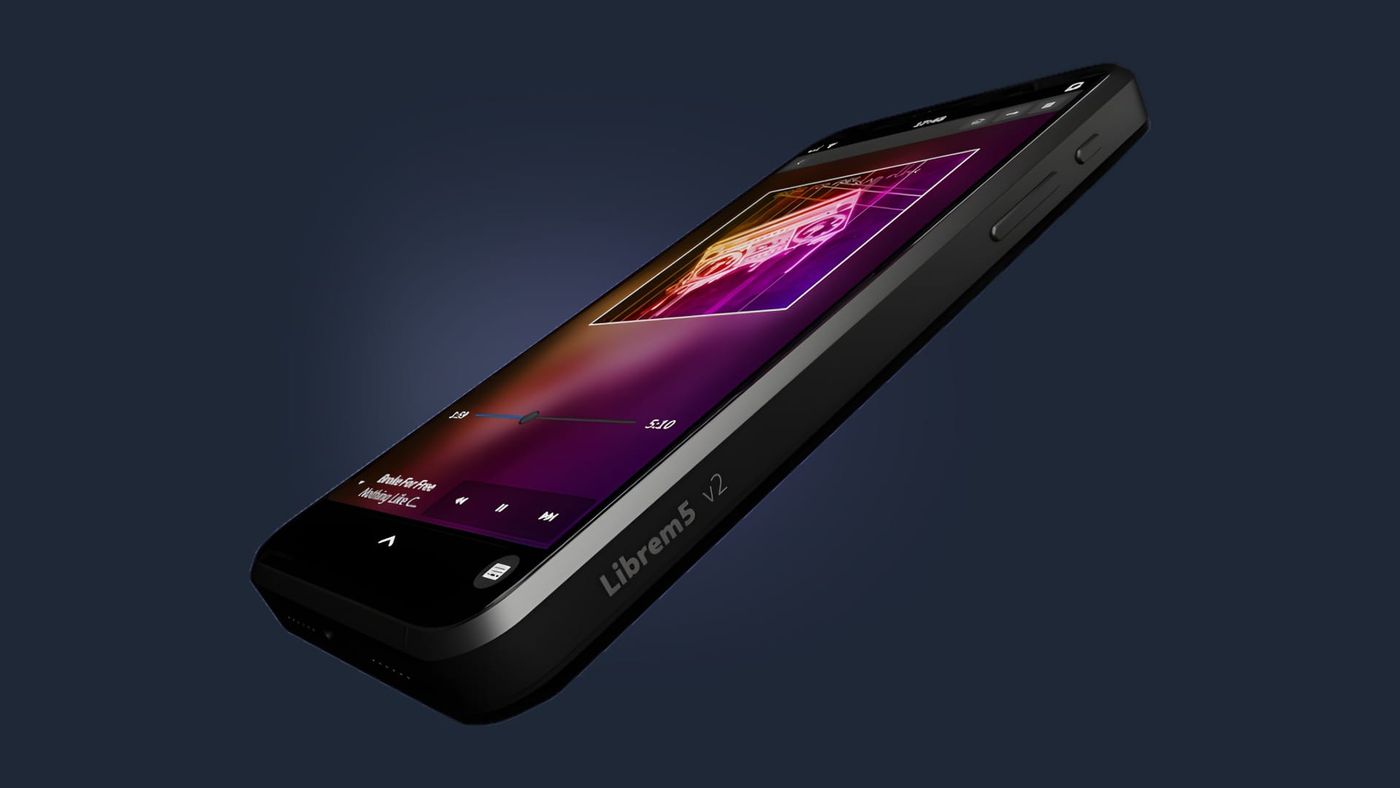
Imagine flipping a switch on the side of your phone and knowing, for certain, that the microphone is off. That’s the kind of phone Purism builds, and the Librem 5 v2 is its next one. It trades the original Librem 5’s ARM chip for one built on RISC-V, an open chip standard, runs Purism’s own Linux, and costs $1,599. You’d pay now, through a crowdfunding campaign that opens to everyone on November 17, and wait until around 2028 to get it. You’ve got until February 15 to decide.
What is the Librem 5 v2?
It’s the second version of the Librem 5, in the same body as the first. If you haven’t met the original, think of it as the opposite of an iPhone: no trackers, no terms of service to agree to, and its software released as open source, as Purism tells it. It runs PureOS, the same Linux Purism puts on its laptops, adapted for a phone, instead of Android or iOS.
The big change is inside. The first Librem 5 used a quad-core ARM chip from NXP. The v2 moves to a RISC-V chip, the SpacemiT K1, with eight cores.
Why does RISC-V matter here?
Because it’s open. Every processor speaks a language, called an instruction set, and RISC-V is one that anyone can build on without paying royalties or signing secrecy agreements. ARM, the one in nearly every phone, doesn’t work that way. Purism’s long-term goal is a phone you can check from the chip up, and it says there’s no ARM phone chip left that doesn’t need closed, proprietary code to run.
There’s a catch, and Purism says it out loud: RISC-V doesn’t get it all the way there yet. The K1 still needs some of that closed code too. Think of it as a step in that direction, with more independent chip designers to work with along the way.
What’s better than the first Librem 5?
Almost everything inside. The big promise is that it runs cooler, and that fixes a lot, since heat was what held the first one back. Cooler means faster and longer on a charge. You also get almost three times the memory, and the camera finally takes full-resolution photos and HD video. And it’s dual SIM now, though Purism hasn’t settled whether the second SIM shares the microSD slot or is a built-in eSIM.
| Librem 5 | Librem 5 v2 | |
|---|---|---|
| Processor | Four ARM cores (NXP) | Eight RISC-V cores (SpacemiT K1) |
| Memory | 3GB | 8GB |
| Photos and video | HD photos, choppy SD video | 13MP photos, HD video |
| microSD speed | 10 to 14 MB/s | 80 MB/s |
| SIM | Single | Dual |
| Price | From $799 | $1,599 |
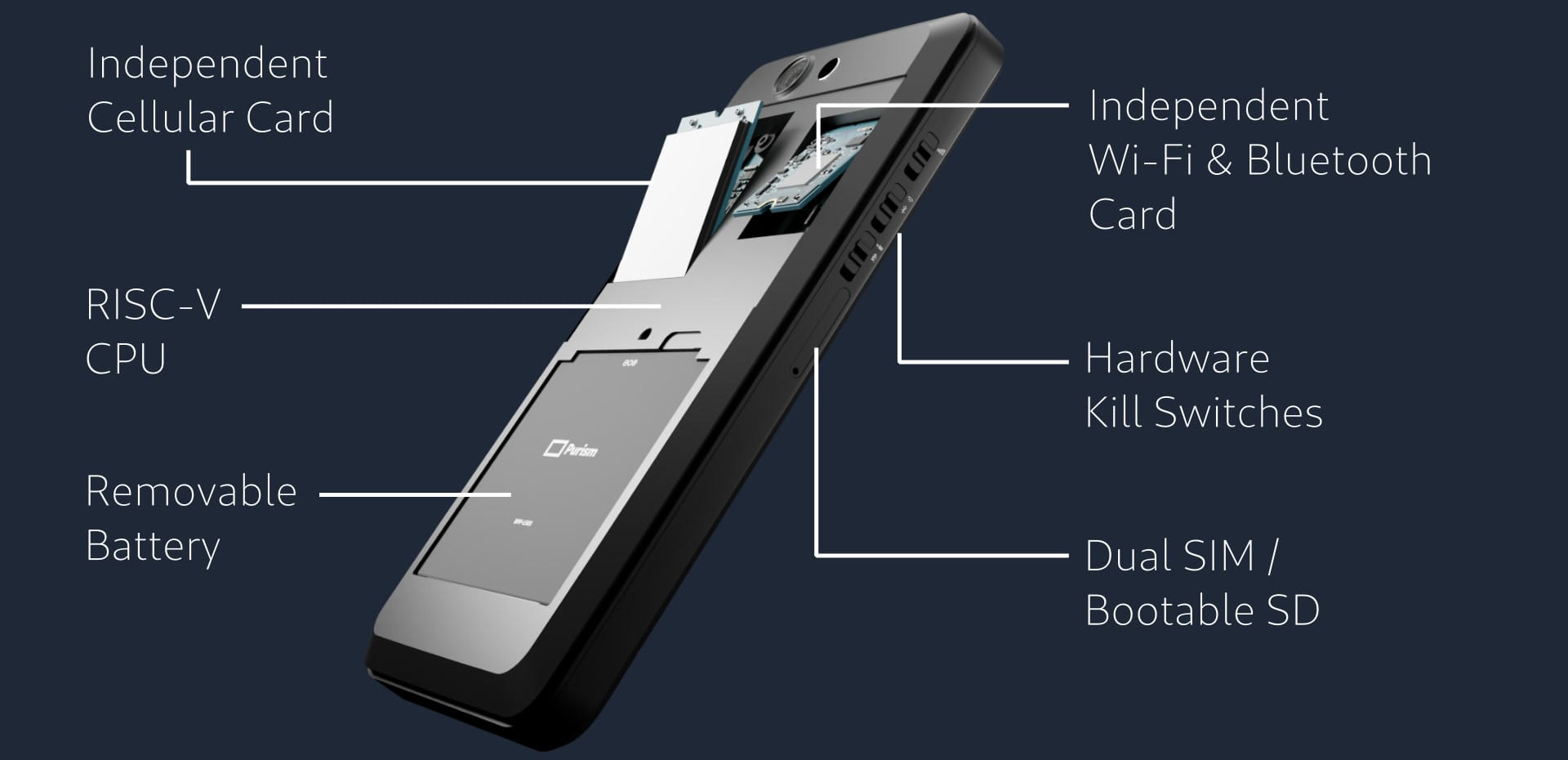
The modular design carries over. The cellular modem and the Wi-Fi and Bluetooth card are separate cards you can remove or upgrade, and the battery comes out. You can even run the whole operating system off a microSD card, which Purism pitches as a security feature: take the card out, and your system goes with you.
The kill switches are the same three as before: one for the cellular modem, one for Wi-Fi and Bluetooth, and one for the microphone and cameras. Flip all three, and the GPS, the accelerometer and other sensors go off too.
What doesn’t it have?
A few things you’d expect on a $1,599 phone. It’s 4G only for now, with a 5G modem planned for later. It’s unlocked, so you can bring your own carrier, but check that your carrier’s 4G is covered before you back it.
There’s no NFC at launch either, so no tap-to-pay, though Purism is thinking about putting the NFC radio on the board so it can be added later. And there’s no fingerprint reader or face unlock, on purpose. Purism’s reasoning is that you can refuse to hand over a passcode, but not your fingerprint or your face.
How much does it cost?
$1,599 for the phone. If that’s a lot to drop at once, you can put $129 down and pay $99 a month for 15 months, which comes to $1,614. Purism’s own cellular service is extra, at $99 a month, so you can skip it and use your own carrier. If $1,599 is too much, Purism still sells the first Librem 5 from $799, though it’s on backorder.
The earlier you back it, the more you get. The first 100 public orders come with a Founders Edition, which Purism hasn’t described yet, and an accessories pack, and the next 150 get the pack. After that, it’s one extra that depends on when you order, ending with a privacy screen.
If you’re a developer, look at the add-ons. One of them is a DevKit, an early-stage v2 taken apart, with the mainboard, screen, modules and battery for you to work on.
When will it ship?
Not soon. The campaign runs until February 15, 2027, and Purism’s own plan calls for delivery about 15 months after it closes. That points to around May 2028. Backers who opt in can get a beta unit first, which Purism plans to ship in late 2027.
It also has to hit its goal, and that’s a long climb. Purism wants 2,500 orders, and three days before the public launch it had 43. Not all of those have to be phones, either. You can also invest in Purism, and it counts every $1,599 invested as one order.
What could go wrong?
Purism lists the risks itself, and they’re real. Right now, the software that drives the chip’s graphics can put a picture on screen, but it still needs full 3D support and tuning before a phone feels smooth. Most of the chip’s other parts don’t work with standard Linux yet either, so Purism has to adapt the chip maker’s own drivers one by one.
Apps are the other big one. Many Android apps, and the Linux apps on Flathub, the big Linux app store, come built for ARM and PC chips, but not for RISC-V. On a RISC-V chip, the phone has to translate them as they run, and Purism says that translation exists but needs optimisation. Until it’s quick, your favourite apps could feel slow. Battery life and the web browser both need work too.
Read the campaign terms before you pay. Purism doesn’t offer refunds, and it doesn’t guarantee the phone will ship. If it never does, you can turn your pledge into store credit for the full amount, but you won’t get cash back. Purism also expects costs to run over, so the price after the campaign will likely be higher than what backers pay now. Only put in $1,599 you could afford to lose.
There’s history to weigh as well. By Purism’s own timeline, the first Librem 5 was announced in 2017, and it shipped in waves from 2019 through 2023. If you back the v2, plan for the dates to move.
Can it run normal apps?
Some, and more are planned. PureOS comes with its own apps for calls, messages, mail, the browser, the camera and more, and its store has the likes of Chromium, Telegram and GIMP.
The apps most people need are still a plan. Purism wants to run apps like Signal, WhatsApp, Spotify and Uber in a locked-down sandbox, where you decide what each one can see. That runs straight into the translation problem above, so it may take a while. Until it’s done, check that the apps you can’t live without will run.
Who is it for?
People who want a phone they fully control and are willing to wait for it. If kill switches, a swappable battery and open-source software matter more to you than banking apps, it’s built for you.
Already have a first Librem 5? The v2 uses the same body with new electronics inside, and Purism expects to sell those electronics on their own once production allows. That won’t happen during the campaign, though. The 5G modem Purism plans for later is meant to fit your phone too.
If you want privacy on a phone you can use today, there are easier routes. GrapheneOS is a privacy-focused version of Android, so most of your apps keep working. It runs on Pixel phones today, and the Motorola Signature 27 is built to support it, with its version due in 2027. If you just want less phone, the Minimal Phone 2 is due in December.
Nerd Alert
Your Turn
What are YOUR thoughts
What have your experiences been? Let us know.