News · News · PC Hardware
Astro Bot Now Runs Natively on PC Through an Unofficial Port, With DLSS Frame Generation
A hobbyist turned Astro Bot into a native Windows program with DLSS and frame generation. How the port works, how it runs, what you need, and why most people won’t be playing it.
https://averagetechnerds.com/astro-bot-pc-port-astrohybrid-dlss/
Astro Bot won Game of the Year at The Game Awards in 2024, and it has never come to PC, and Sony doesn’t seem in a hurry to change that. A hobbyist has done it anyway. AstroHybrid is an unofficial port that turns your own copy of the PS5 game into a Windows program, then adds NVIDIA’s DLSS, frame generation and Reflex on top. Its first release went up on GitHub on the night of November 12, and it’s been updated nine times since.
What is the Astro Bot PC port?
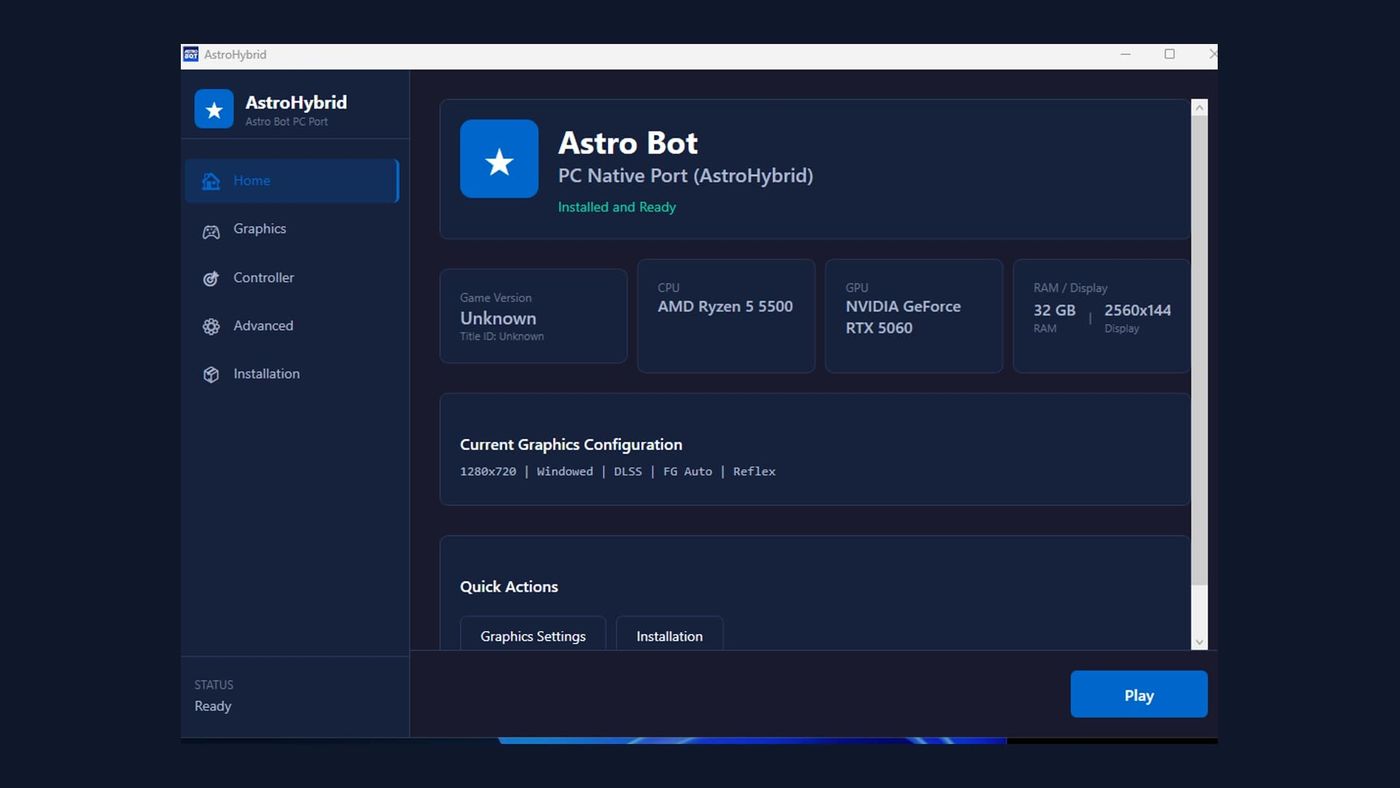
It’s a Windows app called AstroHybrid that builds a PC version of Astro Bot from a PS5 copy you already have. You point it at your dump of the game, it spends about two minutes converting it, and then you press Play. Your dump is only read, never changed.
Don’t expect a company behind it. It started as one person, who goes by imnotsharingmyname on GitHub, running their own copy of the game as a personal research project, with a second contributor now helping on the latest updates. If your copy is a different version of the game, it may still work, but only one version has been tested.
If you were hoping for an official PC version, don’t hold your breath. Sony hasn’t released Astro Bot on PC, and its 2026 annual report no longer promises to bring its games to PC at all (VGC spotted the change).
How is it different from a PS5 emulator?
An emulator pretends to be a PS5 while the game runs. This port doesn’t. The PS5 uses the same kind of processor as a PC, so the game’s code can run on a Windows machine directly. The port relinks that code into a regular Windows program, and swaps the PS5’s system software for Windows versions of the same functions.
The graphics are the tricky part, since the PS5 talks to its GPU in its own way. For that, the port borrows the graphics layer from KytyPS5, an open-source PS5 translation project, which turns the PS5’s graphics work into Vulkan.
The relinking comes from AnyPS5, an open-source tool that only appeared in August and already has more than 50,000 stars on GitHub. That’s a lot of attention for a three-month-old project. Its community keeps a thread for each game people are trying to get running, and there are hundreds, from The Witcher 3 to Ghost of Yōtei. Most are nowhere near as far along as Astro Bot.
What does the port add on PC?
Things the PS5 version never had. The port finds the game’s own upscaling step while it runs and hands it to NVIDIA’s DLSS instead, so RTX cards get a sharper picture. On RTX 40 and 50 cards, DLSS Frame Generation adds smoothness, and an adaptive mode picks the multiplier on its own to hit a target frame rate. NVIDIA Reflex is there to cut input delay.
Controllers get real attention too. A DualSense keeps its rumble, light bar, adaptive triggers and motion controls. Xbox, Switch Pro and generic pads work as well, and whichever pad you press first becomes player one.
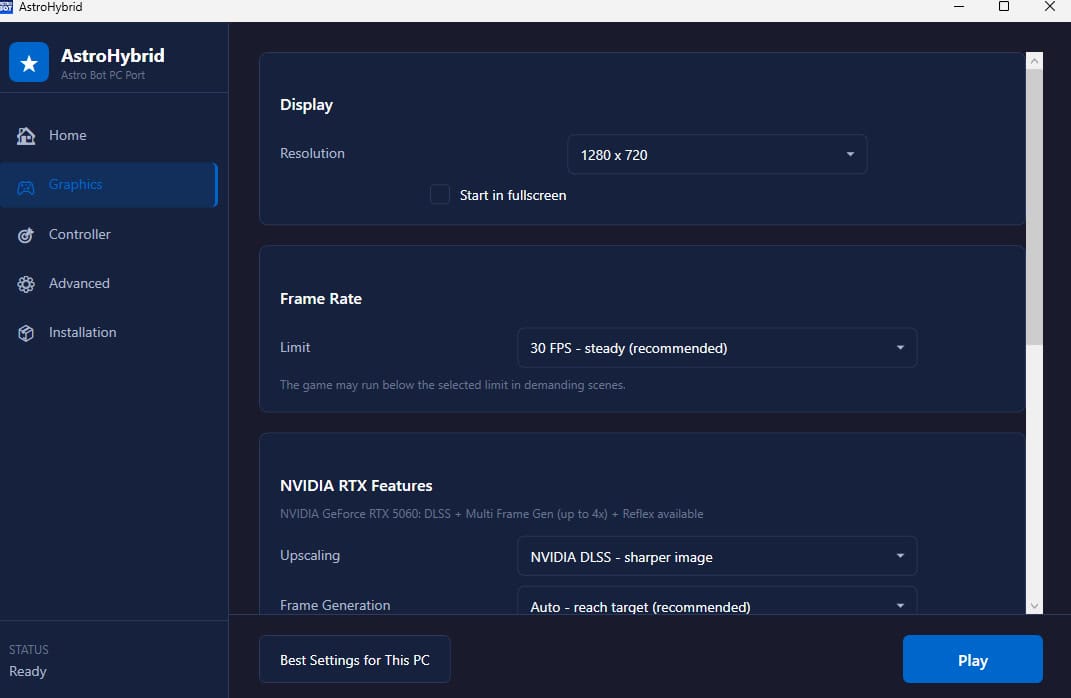
There’s also a “Best settings for this PC” button. It reads your graphics card, processor, memory and display and fills everything in.
How well does it run?
Better than you might expect, on fairly modest hardware. The developer’s PC is mid-range, a Ryzen 5 5500 with an RTX 5060, and the three other levels they measured run somewhere between the high 30s and low 50s. The worst spot they found, Sky Garden, dips to just over 30. The surprise is what holds it back. It’s the processor, and the graphics card has room to spare.
Frame generation is what smooths it out. At 2x, Sky Garden shows about 63 fps on screen. At 4x on that RTX 5060, it’s about 124 to 128.
Treat those as a rough guide, since they come from one PC. If yours is slow, turning the resolution down won’t help much, because the game leans on a single processor core. And how much input lag frame generation adds here hasn’t been measured yet.
What do you need to play it?
More than a download. On the PC side, it’s easy: Windows 10 or 11 and a fairly recent graphics card. The developer puts the minimum at an NVIDIA GTX 16 or RTX 20 series, an AMD RX 6000 series or an Intel Arc, because the game draws with mesh shaders that older cards like the GTX 10 series can’t run. The NVIDIA extras come along in the download, so there’s nothing else to hunt for.
And you need the game. The port works from a decrypted dump of your own PS5 copy, and getting one of those takes a jailbroken PS5, the kind of hacked console covered in the PS5 Linux article. That’s the real barrier here, and it’s why most people won’t be playing this.
Is it legal?
That’s for a lawyer, and it depends where you live. What you can see is that the project is careful. It doesn’t ship a single piece of the game, and it says it has no connection to Sony, Team Asobi or NVIDIA. AnyPS5 takes the same line, calling itself a preservation and compatibility project.
What you do with your own console and your own copy is the part that’s on you. And Sony has a long history of patching the system software flaws that jailbreaks rely on.
What doesn’t work yet?
A few things, and the developer lists them. Astro Bot uses motion controls in places, and on pads without motion sensors, like Xbox controllers, those sections don’t work yet. Rumble on some third-party Switch-style pads is unconfirmed.
With no frame rate limit and frame generation off, the first loading screen stays black for about 35 seconds. It isn’t frozen; it just loads slowly that way. And since only one game version has been tested, others may behave differently.
Why does this matter beyond Astro Bot?
Because it’s part of a bigger wave, and that’s what I find most interesting about it. Unofficial ports of console games are showing up faster than ever, and AI coding tools are a big reason. Decompiling and recompiling a game used to be slow, careful work by hand. Now people hand a lot of it to AI agents, and recompilation, decompilation and emulation are all moving faster for it. AnyPS5 is no exception. It asks every contributor to say whether AI helped with a change, and almost all of its recent ones say yes. AstroHybrid is no different. Its early files included rules for AI agents and a handover note marked as written by Claude, and its two latest updates were committed under the name Codex.
And a recompiled game isn’t tied to its console anymore. It becomes a regular program, so it can pick up things the original never had, like DLSS here. Older recompilations, like the Nintendo 64 ones, now run on Windows and Linux, the Steam Deck included. This one is Windows only for now, and because it reuses the PS5’s own code, it needs a PC processor.
Not everyone in the scene is happy about the AI part. Programmers who do this work by hand worry that ports written mostly by AI will be hard to keep working. There’s an accuracy question too: a port can run fine and still be less true to the original than a good emulator. If that matters to you, Wes Fenlon’s Read Only Memo tracker marks the ports that used AI, so you know before you pick one.
What happens next?
More updates, quickly. The port went from version 1.0.0 to 1.0.9 in under two days, and the developer keeps a public log of every experiment, including the ones that didn’t work.
If one hobbyist can take a PS5 game this far, more of the games in AnyPS5’s threads could follow, at least for people who can dump them. Then there’s Sony, and how it reacts will decide how far this goes.
Nerd Alert
Your Turn
What are YOUR thoughts
What have your experiences been? Let us know.