News / News · News · Local AI · PC Hardware
Axera’s AX8860 Takes On Nvidia’s DGX Spark: What the 25% Claim Rests On
Axera’s AX8860 matches the DGX Spark’s 128GB and 273 GB/s. The 25% faster, half-price claim comes from a partner, with no method. What is known.
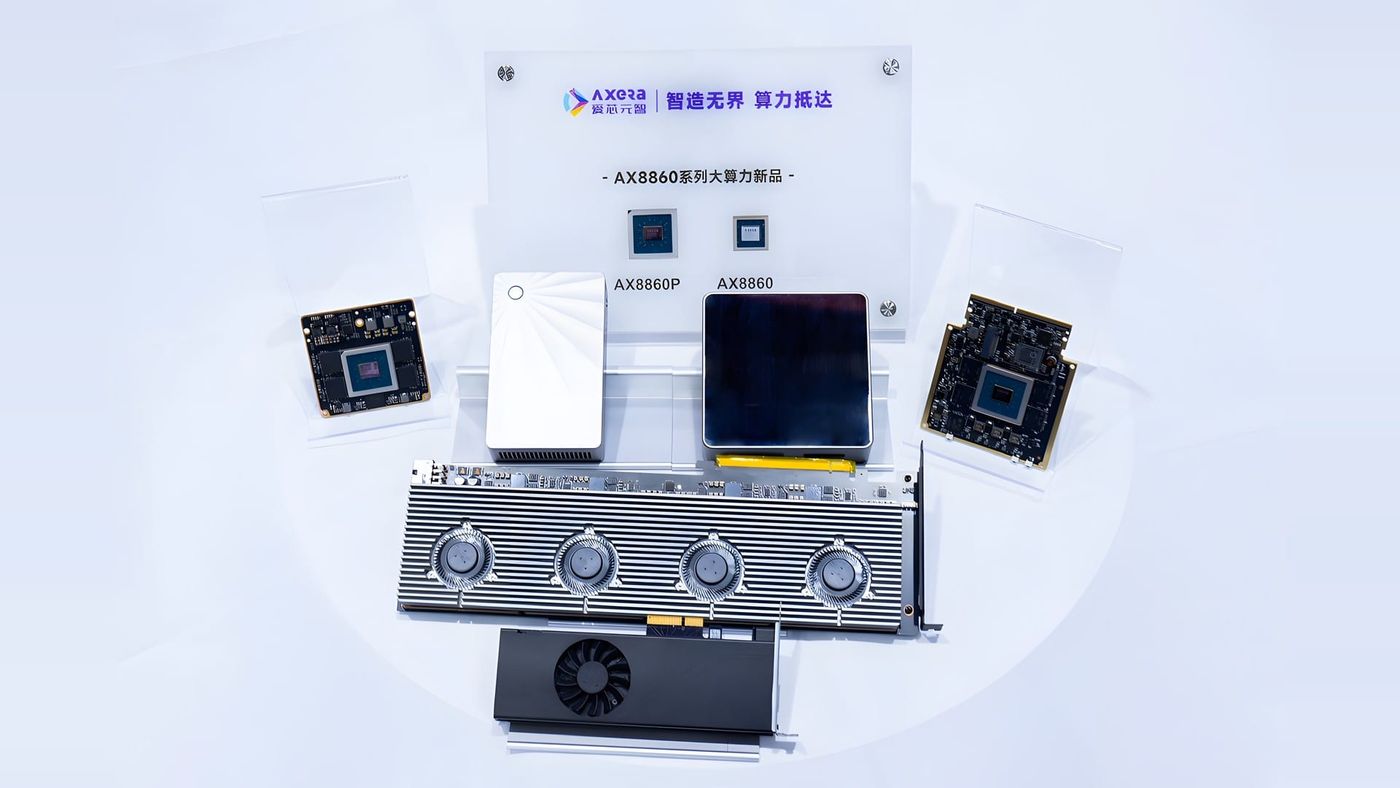
Axera, a Chinese maker of edge AI chips listed in Hong Kong, launched its AX8860 at an industry fair in Shanghai on October 13. Within hours, the chip was being billed in English-language coverage as faster than Nvidia’s DGX Spark at half the price, with Wccftech crediting the claim to Axera. Axera’s own announcement makes no comparison with Nvidia at all. The benchmark comes from Sipeed, a hardware maker building a desktop around the chip, and it arrived without the details needed to check it.
UPDATE What’s new since publishing
Sipeed says its MaixStation will cost under $2,000 with 32GB and about $3,999 with 128GB, CNX Software and Tom’s Hardware report. That’s a little over half the $6,949.99 a 128GB DGX Spark costs now. It launches on Kickstarter at the end of 2026, and Sipeed’s page takes a refundable $30 reservation that’s worth $100 off. Sipeed now lists llama.cpp and Ollama support too.
CNX gives the AX8860P as 128 TOPS, or 256 TOPS in FP4, which likely explains the two figures. There’s still no independent testing, so the speed claims stay Sipeed’s.
Honestly, I’d never heard of Sipeed before this, though it’s been making maker boards like the Lichee Pi and NanoKVM for years. Yes, it’s cheaper than a DGX Spark, but $3,999 is about what the Spark itself launched at, so “cheap” is relative right now: fast memory isn’t cheap anywhere, and every company with an AI box is leaning into that demand. When something costs that much less, it usually gives something up, and here that’s low-power Cortex-A55 processor cores and no Nvidia CUDA. That’s a lot to put into a Kickstarter for a box nobody outside Sipeed has tested, so I’ll believe the speed claims when someone independent puts it next to a Spark.
What are the Axera AX8860’s specs?
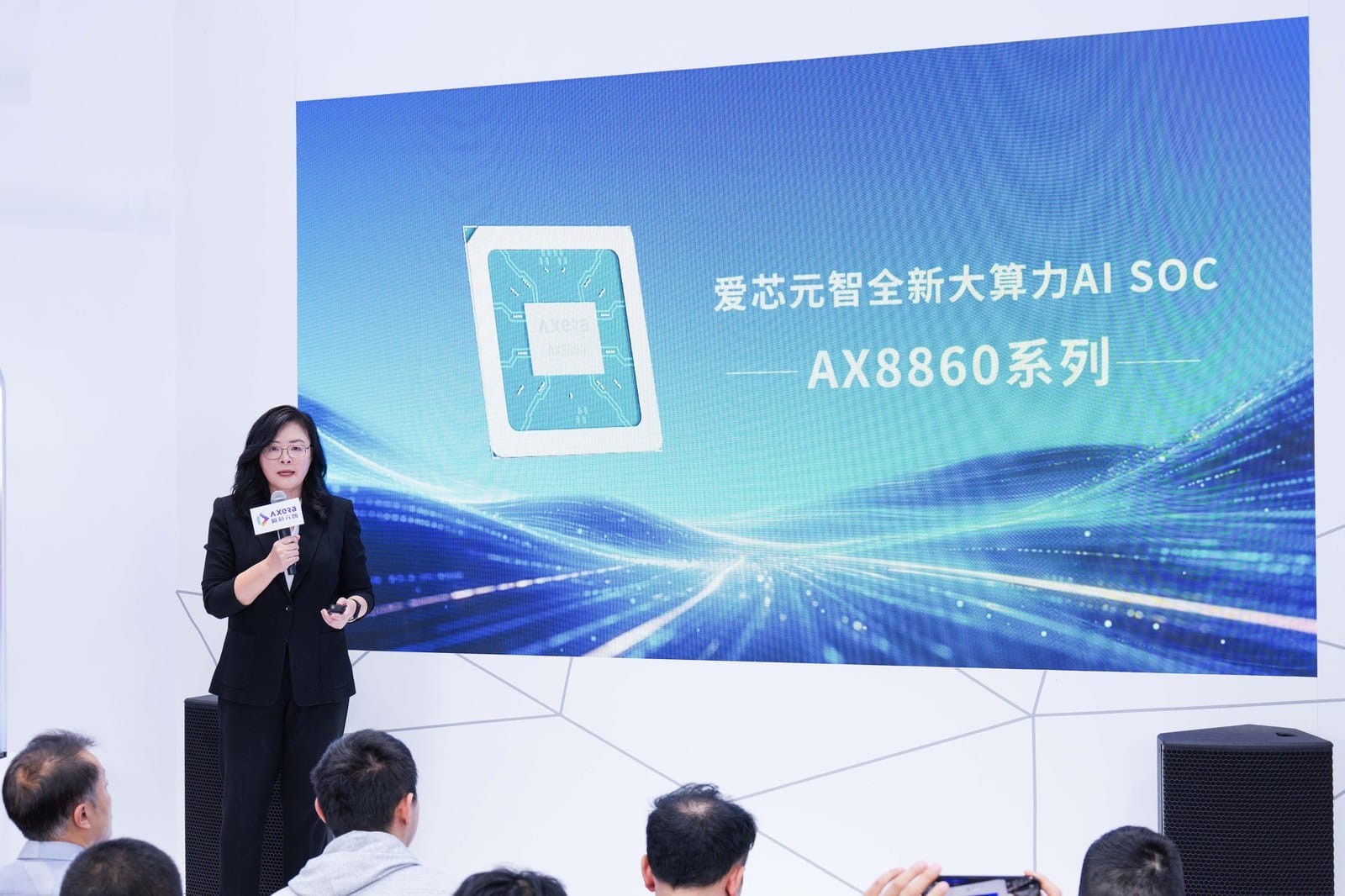
Axera rates the AX8860 at 256 TOPS of mixed-precision compute with native FP4, a compact 4-bit number format that shrinks AI models and speeds them up. Around that sit up to 128GB of LPDDR5X memory at 273 GB/s, PCIe 5.0, Axera’s AXLink for chaining chips together, 64 channels of video decoding and 16 of encoding, and a 6nm process. The launch came at CIIF 2026, the China International Industry Fair, alongside a module and a stand full of hardware, going by Axera’s press release. Axera aims it at factories, warehouses and robots that need large AI models running on site.
Next to the chip, Axera launched the A256S module, which it says runs language, vision-language and multimodal models, and showed inference cards and servers from its Yuanxi range. The stand in the photo at the top held two chip variants labelled AX8860P and AX8860, plus two modules, two small desktops and two PCIe cards. Which variant carries which number isn’t settled yet: a spec preview from Radxa, a single-board computer maker, lists the AX8860P with 16 Arm Cortex-A55 processor cores and up to 128 TOPS, half the figure on Axera’s launch slide. For software, Axera lists the vLLM, SGLang and PyTorch frameworks, an OpenAI-compatible interface and its own tools for quantizing, converting, compiling and profiling models, and it says the software is open source. It doesn’t list llama.cpp or Ollama, and it pitches the chip for inference, with no mention of training.
The AX8860 takes Axera into the territory of the large-memory AI computers Nvidia and AMD sell to developers. Until now its chips have mostly gone into cameras, cars and edge computing boxes, and its investor Qiming Venture Partners describes it as China’s second-largest domestic supplier of assisted-driving chips by 2024 installations. Qiu Xiaoxin, now its chairman, founded the company in 2019, and it listed on the Hong Kong Stock Exchange in February 2026, according to Qiming. Language models aren’t new to its chips, though: M5Stack’s LLM-8850 AI card already runs small ones such as Qwen3-0.6B on Axera’s older 24-TOPS AX8850 with 8GB of memory.
Who says it beats the DGX Spark?
Sipeed. “Coming today! Beat DGX Spark!” it posted on launch day, next to photos of Axera’s slides. Sipeed is a Chinese maker of AI development boards that has built on Axera chips before, including its Maix-III kit in 2022. Its four-chip MaixBlade card sat on Axera’s stand, and it’s preparing an AX8860 desktop called MaixStation. Wccftech reports its other claims: 25% faster prompt processing and 30% faster text generation than the DGX Spark on a Qwen 27B model, a 40W module (Nvidia lists 140W for the Spark’s GB10 chip), and a price of almost half the Spark’s.
The specs came from the chip maker; every speed and price claim came from the partner selling the box. Wccftech’s article does name Sipeed in its body and says the figures need independent testing, but its headline credits Axera. So the 25% is a sales claim until someone tests it independently.
How does it compare with the DGX Spark on paper?
On memory, it’s a tie. Nvidia’s DGX Spark is a compact Grace Blackwell desktop for AI developers, the idea Nvidia is now bringing to Windows laptops as RTX Spark. Both it and the AX8860 have 128GB on a 256-bit interface at 273 GB/s, according to Axera and Nvidia’s spec page, and AMD’s Ryzen AI Max+ PRO 495 matches that bandwidth with up to 192GB. Those two numbers matter most for running large language models at home. Capacity decides which models fit at all. Bandwidth caps how fast a model writes its answer, because every new word means reading the model’s weights from memory again.
| Axera AX8860 | Nvidia DGX Spark | Ryzen AI Max+ PRO 495 | |
|---|---|---|---|
| Memory | Up to 128GB LPDDR5X | 128GB LPDDR5X (64GB through OEMs) | Up to 192GB LPDDR5X |
| Memory bandwidth | 273 GB/s | 273 GB/s | 273 GB/s |
| Peak AI compute (maker’s figure) | 256 TOPS mixed precision, FP4 | Up to 1 petaflop FP4, with sparsity | 55 TOPS NPU, 131 TOPS total |
| CPU | 16 Arm Cortex-A55 cores (AX8860P, per Radxa) | 20 Arm cores | 16 Zen 5 cores |
| Price | MaixStation: about $3,999 (128GB, expected) | $6,950 (128GB), about $4,999 (64GB) | $7,299.99 (AMD Ryzen AI Halo, 192GB) |
| Status | Announced | Shipping | Shipping |
On compute, the Spark leads. Nvidia lists the Spark at up to one petaflop of FP4, and Nvidia partner PNY footnotes that figure as using sparsity, a technique that doubles throughput only for models pruned in a specific pattern. Sipeed has dismissed Nvidia’s number as “sparse,” and the dense equivalent is indeed lower: half a petaflop, about 500 TOPS, which is still roughly twice the AX8860’s 256. Prompt processing, the stage where a model reads your input before replying, leans heavily on raw compute, so a 25% lead there from a chip with about half the dense compute is the one that most needs a published method.
What does the benchmark leave out?
Nearly everything you’d need to check it. Sipeed gave relative percentages only, with no tokens-per-second results (a token is roughly a word or part of one), no Qwen version, no quantization format and no software stack for either machine. Those choices alone can move results by more than 30%. On Nvidia’s developer forum, one DGX Spark owner running Qwen3.8-27B in Nvidia’s 4-bit NVFP4 format measured 11.4 tokens per second of text generation with speculative decoding off and 24.7 with it on. Speculative decoding drafts several words ahead and checks them in one pass, so the same hardware and bandwidth write faster.
With both chips reading memory at 273 GB/s, a dense 27-billion-parameter model hits a similar speed ceiling on each, so a steady 30% lead most plausibly comes from software choices such as quantization or speculative decoding. Both run on the DGX Spark too, as the forum results show. A fair test would run the same model, format and decoding settings on both machines and report the actual speeds.
The multi-chip numbers come with a footnote, literally. Axera’s slide, photographed in Sipeed’s post, shows two chips reaching 512 TOPS and four reaching 1,024 TOPS at about 80% combined efficiency, and the footnote says the numbers are based on lab simulation data. Four times 256 is exactly 1,024, so the 80% appears to describe the usable share of that total. Sipeed also describes a 256 Gbps link for clustering, faster than the Spark’s 200 Gbps networking, but no one has shown a real model running across several AX8860 chips yet.
How much will it cost, and when can you get one?
Nobody has said. With no published price from Axera or Sipeed, “almost half” depends on which DGX Spark Sipeed means. Nvidia raised the 128GB model to $6,950 on October 2, as The Register reported, and a 64GB model is expected at around $4,999 through Acer, ASUS, Dell, Gigabyte, HP and MSI. Half of those is about $3,475 or $2,500. For scale, AMD’s own 192GB Ryzen AI Halo costs $7,299.99.
Dates are just as vague. Sipeed said a MaixStation pre-order page would open within about a day and that its AX8860 devices would ship this year, according to Wccftech; no listing was live on Sipeed’s site when this was written. Axera hasn’t said which markets will get the chip. There’s a cost beyond the price, too: AI work runs through Axera’s own NPU (the chip’s AI engine) and toolchain, and CUDA, the Nvidia software many AI tools are built around, doesn’t run on it.
What should you watch for?
Three things will decide whether the AX8860 is a real alternative to the DGX Spark: absolute benchmark results with full settings, a price, and independent testing on shipping hardware. The memory side of the pitch holds up on paper, with the same 128GB and 273 GB/s as Nvidia’s box. Axera or Sipeed could settle much of the speed question by publishing tokens-per-second results with the model version, format and software named. Once MaixStation or another AX8860 machine reaches reviewers, it can be measured properly against the Spark and the Ryzen AI Max+ machines, including Lucebox’s Zero 495, which makes its own claims against Nvidia’s box.
Nerd Alert
Your Turn
What are YOUR thoughts
What have your experiences been? Let us know.