Hands-on / Review · Reviews · Handheld Gaming · Retro Gaming · Retro handhelds
Anbernic RG 55G1 vs AYN Odin 2 Portal: How Much Handheld Does $175 Buy?
Anbernic’s first Snapdragon handheld looks like a Switch Lite. I put it against my Odin 2 Portal Max: PS2 yes, Switch no, and one test the $175 one won.
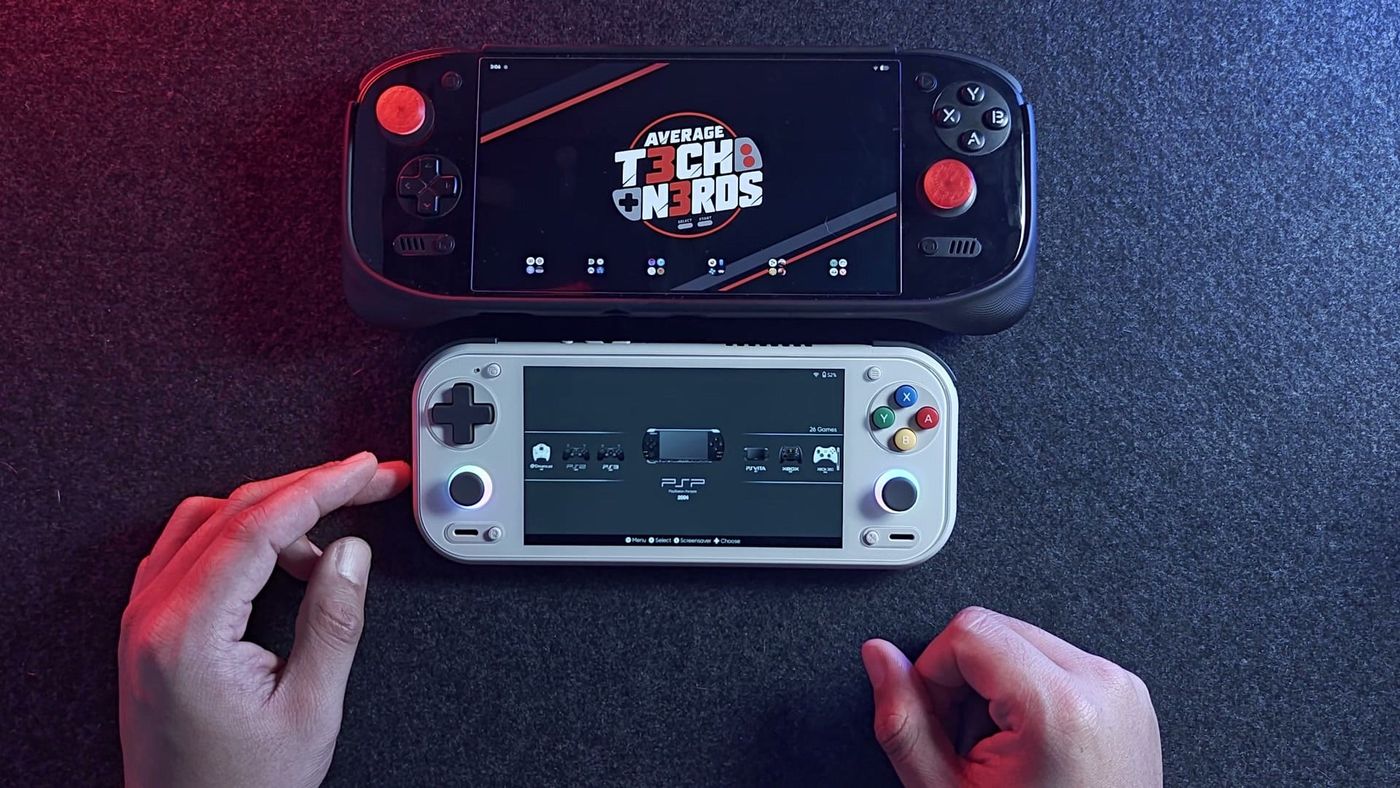
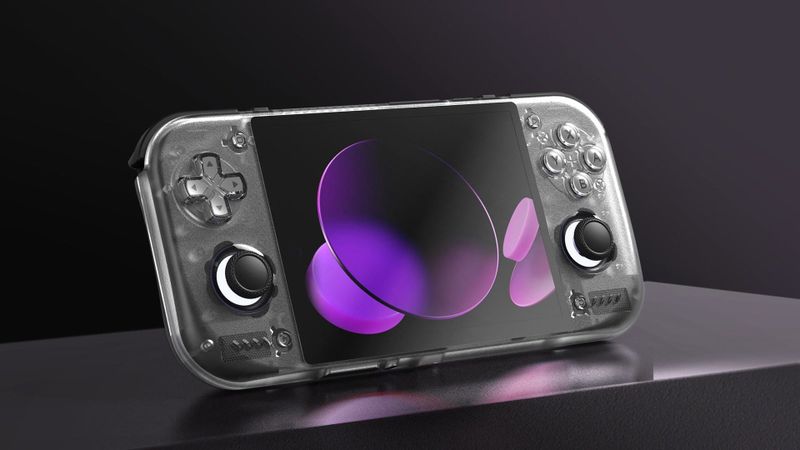
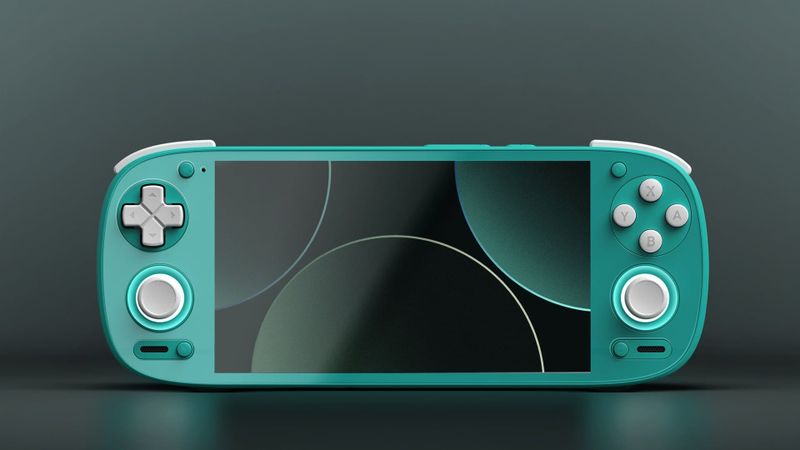
Anbernic’s RG 55G1 looks a lot like a Switch Lite, and that shape asks a question before you’ve even turned it on. Does it play Switch games? It doesn’t, and I’ll show you exactly where it gives up. In one test, though, the cheap one came out ahead.
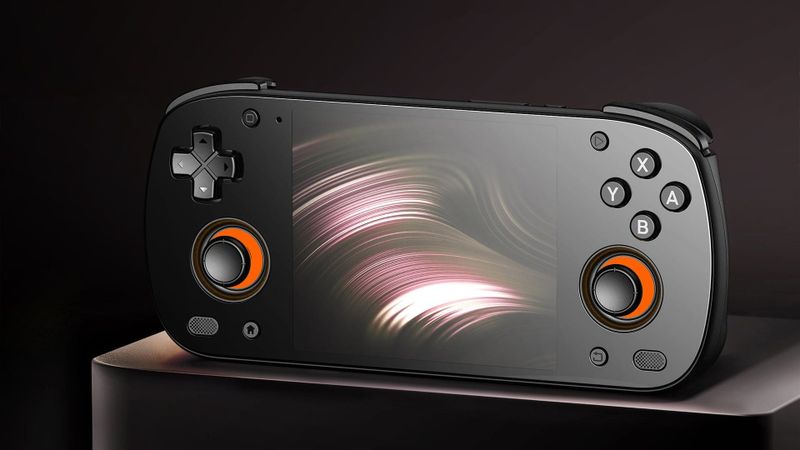
The 55G1 is Anbernic’s first handheld with a Snapdragon chip, and I paid $175 for the 8GB version. So I put it next to my favorite handheld, the AYN Odin 2 Portal Max, which cost me $529. Which one is better was never in doubt. The Odin wins that, with the stronger chip and more of nearly everything. What I wanted to know is how much of the Odin you get for $175. In the companion video I went through the screens, the controls, a polling test, four games and the batteries on both, and this is the written version.
What are the RG 55G1 and the Odin 2 Portal, and what do they cost?
Two Android handhelds with Snapdragon chips, from two very different price brackets. The RG 55G1 came out at the end of August, right around the time I started this channel, and I’ve watched how people took it ever since. The reception was lukewarm. Retro Game Corps titled the review “No Man’s Land,” and the Retroid Pocket 5 kept coming up in the comments as the better place to put the money. I was curious anyway.
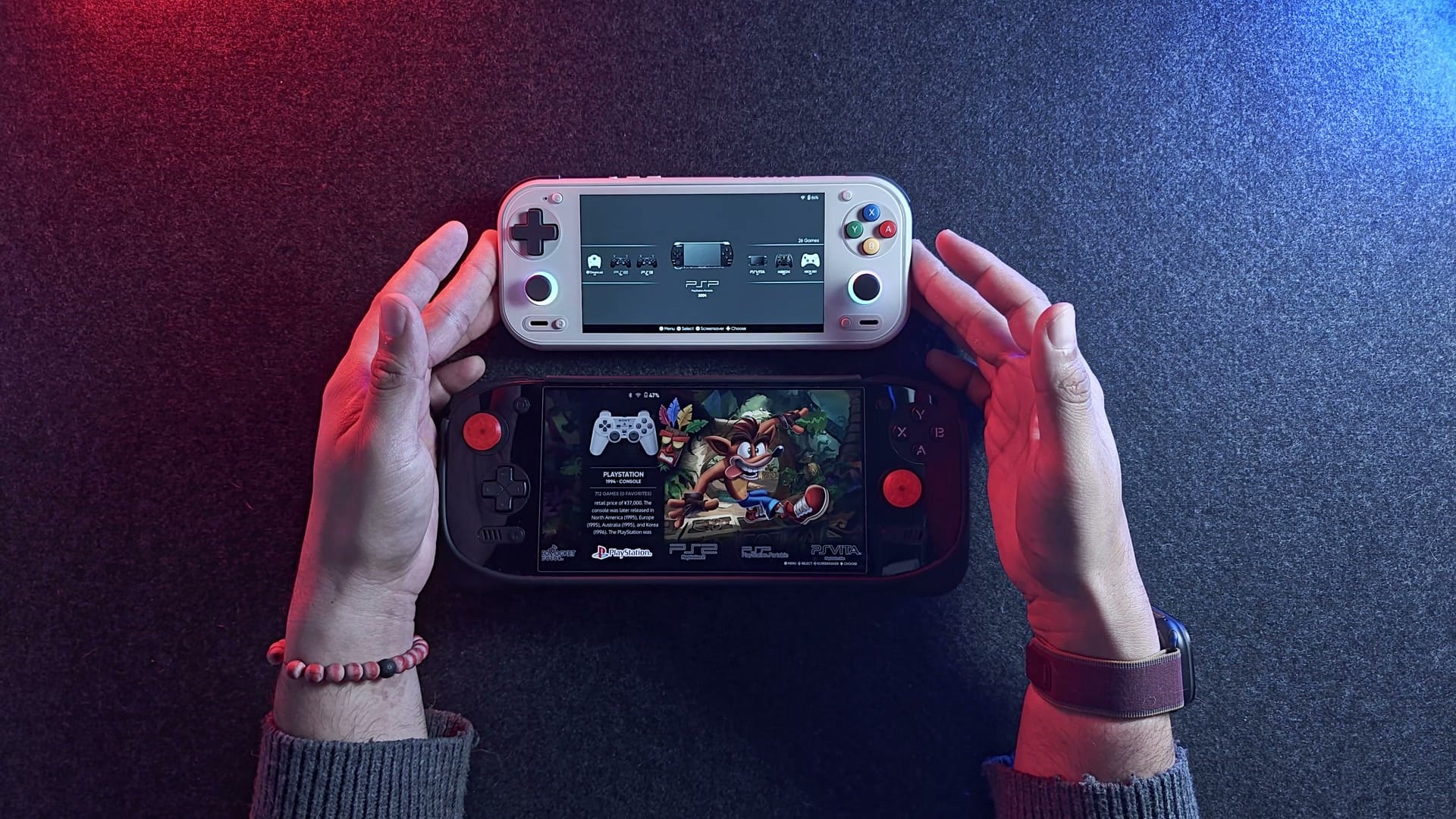
Anbernic sells it in two versions, 4GB of memory with 64GB of storage for about $150, and the one I bought, 8GB and 128GB, for about $175. It’s on sale on Anbernic’s store right now for a little less.
The Odin 2 Portal comes in three tiers, and mine, the Max, is the top one: 16GB of memory and a terabyte of storage for $529. The Base launched at $349, and it’s $259 on sale right now, the only tier AYN still has in stock. Every tier runs the same Snapdragon 8 Gen 2, so the extra money on mine bought memory and storage and nothing else. What I’m really comparing is chip against chip, and the cheapest Odin gets you the same performance I’m showing.
The two chips aren’t close. The 55G1 runs the Snapdragon G1 Gen 2, the entry chip in Qualcomm’s line made for gaming handhelds. Its processor holds up fine. Its graphics chip, the Adreno A12, is the weak link, and graphics is exactly what Switch emulation leans on. The Odin’s Adreno 740 belongs to a flagship phone chip, and it shows the moment you load something heavy.
| Spec | Anbernic RG 55G1 | AYN Odin 2 Portal Max |
|---|---|---|
| What I paid | $175 (8GB/128GB) | $529 (16GB/1TB) |
| Price, November 7, 2026 | 8GB $160.19 and 4GB $135.86, both on sale | Base 8GB/128GB $259 on sale, the only version in stock |
| List or launch price | 8GB $174.99, 4GB $149.99 (list) | Base $349, Pro $429, Max $529 (launch, October 2024) |
| Chip | Snapdragon G1 Gen 2 | Snapdragon 8 Gen 2, on every tier |
| Graphics | Adreno A12 | Adreno 740 |
| Memory and storage | 8GB, 128GB, microSD | 16GB, 1TB, microSD |
| Screen | 5.5-inch IPS, 1920x1080, 60 Hz | 7-inch OLED, 1920x1080, up to 120 Hz |
| Weight | 339 g | 430 g without a case |
| Battery | 6,000mAh, 18W charging | 8,000mAh, 27W charging |
| Wi-Fi and Bluetooth | Wi-Fi 5, Bluetooth 5.0 | Wi-Fi 7, Bluetooth 5.3 |
| Video out to a TV | No wired output listed (wireless screen projection only) | Yes, over USB-C |
| Software | Android 14 | Android 13 (mine runs LineageOS, Android 17) |
| Sticks and triggers | Hall effect sticks, analog Hall effect triggers | Hall effect sticks, analog Hall effect triggers |
| Extras | A fan, gyro, rumble and a microSD slot | A fan, gyro, rumble and a microSD slot |
How do they compare side by side?
Both have an all-glass front that runs edge to edge, and I love it. It makes a handheld look and feel premium. Glass has a price, though. It cracks more easily than plastic, and on my black Odin it’s a fingerprint magnet. The 55G1 I have is the white one, and on that color you barely see the prints, so that’s one point for picking a lighter shell.
On the scale, the 55G1 comes in at 339 grams and the Odin at 430 without a case. Mine wears a case for a deeper grip, so in practice the gap is wider. The screens are 5.5 inches against 7, both 1080p, which means the Anbernic packs the same pixels into a smaller panel and looks sharper up close, about 400 pixels per inch against the Odin’s 315. Then there’s the panel. The 55G1 is IPS and the Odin is OLED, so the Odin’s blacks are truly black and its contrast pops in a way the Anbernic can’t match.
On software, my 55G1 shipped with Android 14 and is fully up to date. A question I kept seeing in the comments was whether it comes with the Google Play Store. Mine did. I don’t use it or sign into it, but it’s there. The Odin shipped with Android 13. Mine doesn’t run the stock software anymore: I replaced it with LineageOS, and it’s on Android 17.
Is the RG 55G1 comfortable to hold?
Mostly, with one catch, and it comes from the flat back. There’s no curve to wrap your fingers around, so I end up cradling it from the sides. That makes the sticks very easy to reach. The D-pad is another story. It sits on top, with the left stick right below it, and on a small face that stick is close. In a fighting game, where you roll your thumb through quarter-circles for every special move, my thumb catches the stick unless I keep it arched the whole time. That’s the catch.
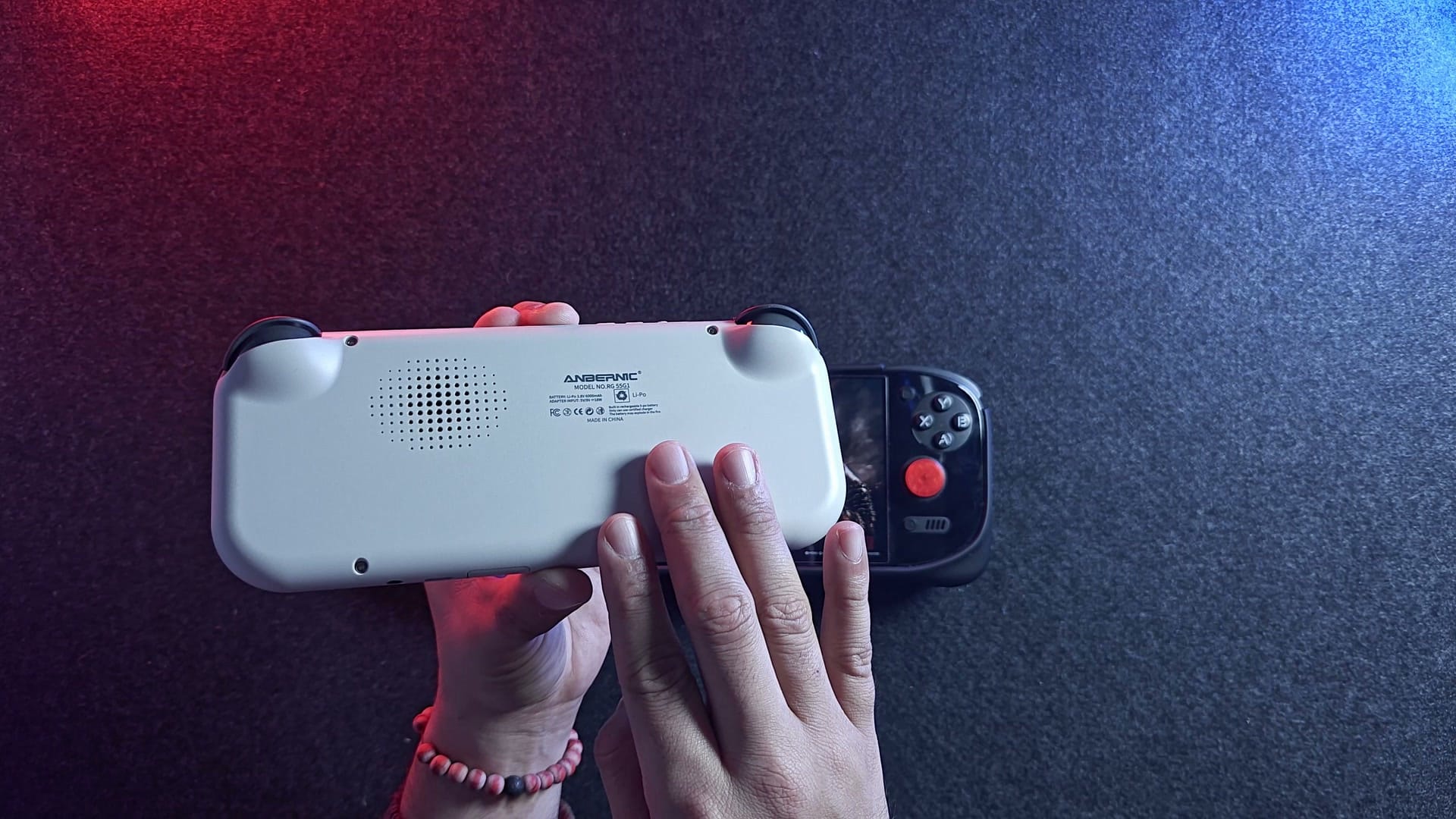
Some people love a flat back. I prefer a curve, which is exactly why my Odin wears a case with a pronounced one. My hands are medium-sized, and I already run into this, so larger hands will feel it more. If you were hoping to fix it with an official grip, Anbernic doesn’t sell one: its store lists a carrying bag for the 55G1 and that’s it, though people do make 3D-printed grips for it. None of this is a complaint about the price, which I think is great for what you get. It’s just worth knowing before you buy.
How do the buttons, D-pad and triggers compare?
The Anbernic’s face buttons are rubber membrane with double-shot letters, molded in so they won’t wear off. They’re stiff and bouncy. For something shaped like a Switch Lite, they feel nothing like a Switch Lite. There’s no click, but the rubbery bounce gives you a kind of tactile feedback, and they spring back up fast.
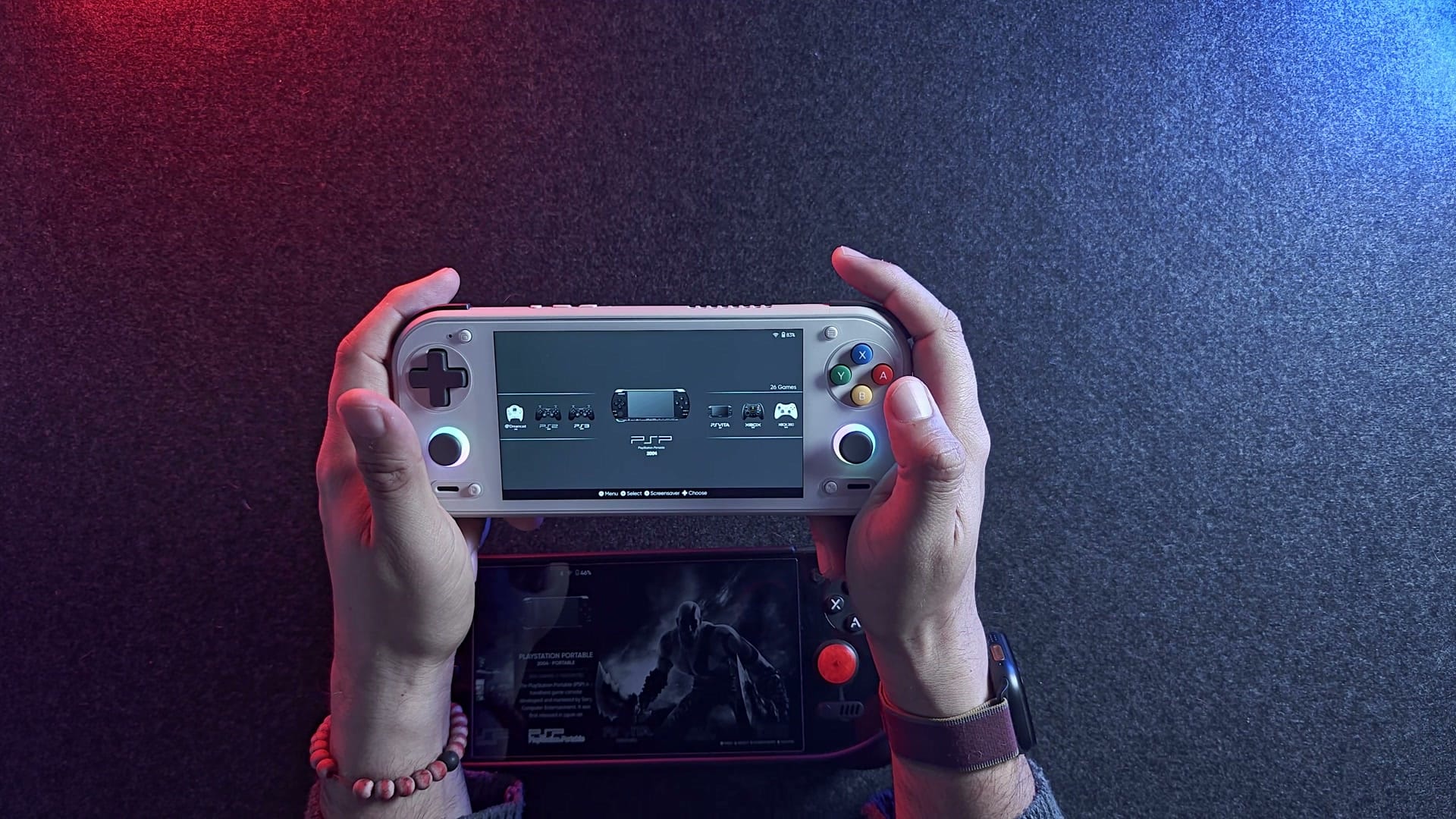
They also take more pressure than the Odin’s. Mashing is where it shows. It’s harder on the Anbernic, because the buttons are taller, so I lift my finger higher between presses, and they push back harder on the way down. The Odin’s are shorter, with less travel, and easier to press. They’re the more traditional kind, and they’re the ones I’d mash on.
Both D-pads are full size, and the difference is where they sit: on top on the Anbernic, on the bottom on the Odin. People have strong feelings about this, and whatever you prefer is fine. On the 55G1 my problem is only the stick crowding it, as above. On the Odin, with the D-pad already at the bottom, it never comes up.
Both have Hall effect, analog triggers, which read how far you press them. That’s great in a racing game, where half a squeeze means half throttle. The Odin’s are easy to press, with a nice fluid motion. The Anbernic’s are a little smaller, with shorter travel and more resistance, so you press a bit harder. It’s no big deal. The difference is there, though.
Which handheld won the polling test?
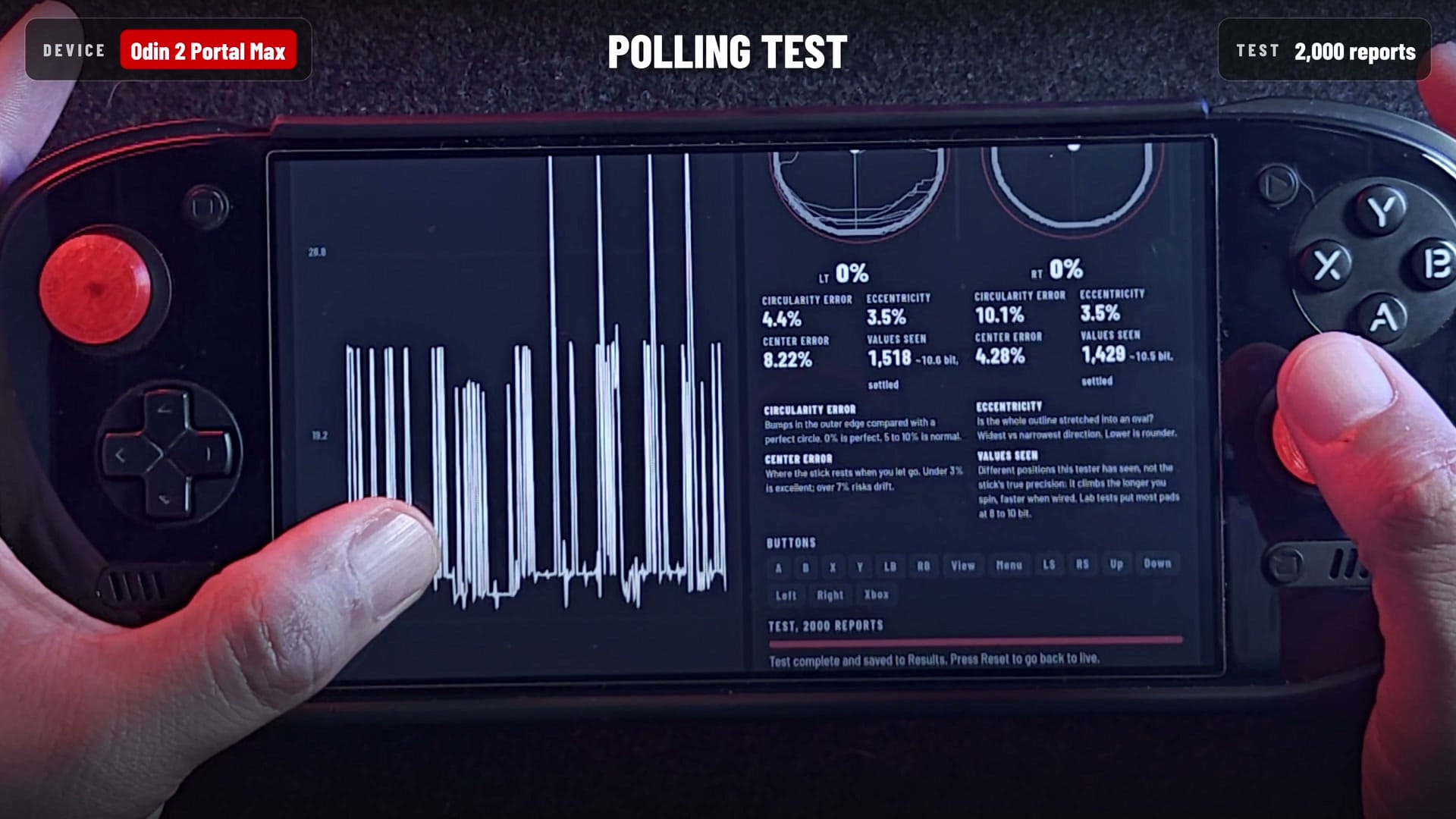
The $175 one, by a lot. How a stick feels under your thumb is one thing, and numbers are another, so I ran both through my controller polling test. The page logs every report a controller sends while I spin both sticks and press every button, and it stops at 2,000 reports. Same page, same settings, on both handhelds.
The polling rate is how many times a second the controls tell the system what your hands are doing. The 55G1 did it 182 times a second, an update about every 5.5 milliseconds. The Odin managed 71, about every 14. Then there’s jitter, which is how uneven those gaps are. Lower is steadier, and the Anbernic came in at 1.5 milliseconds against the Odin’s 5. The cheaper handheld won this one outright.
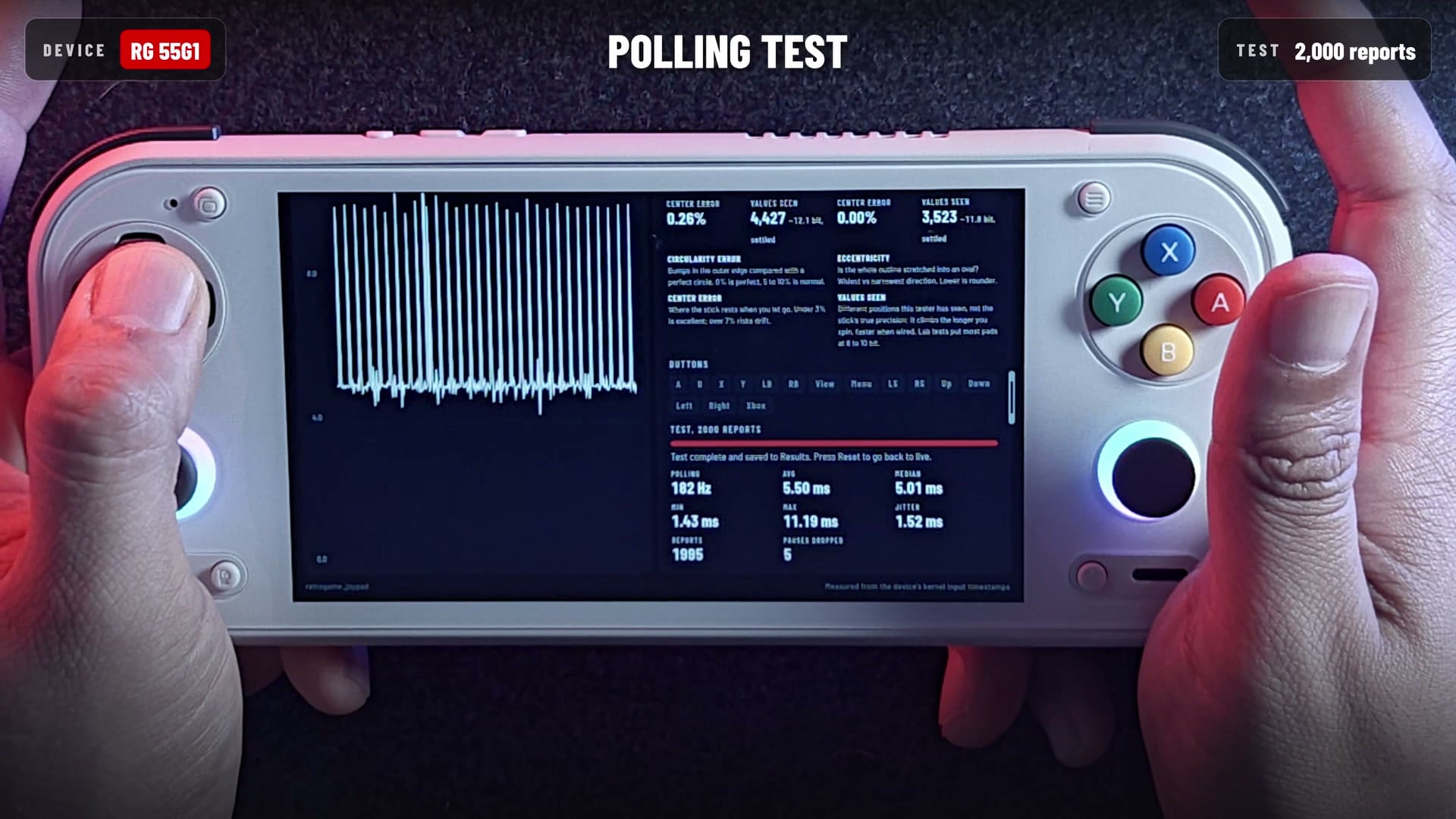
Now the stick drawings. The Anbernic’s sticks trace a square. Anbernic sends each direction all the way to 100% on its own, so pushing diagonally reaches the corner. The Odin’s sticks trace a circle, the way an Xbox controller’s do, because AYN trims the diagonals. Neither one is a defect; it’s how each maker maps the stick. The test page grades sticks on how round their outline is, so a square scores badly there by design. The 55G1’s scores landed right where a perfect square would, which tells you its sticks are doing exactly what Anbernic set them up to do.
Its center error read 0%, which looks perfect, but there’s a catch. The Anbernic has a 9% dead zone set in its settings, so any small movement near the center is reported as zero before the test ever sees it. So that 0% hides the center. It proves nothing.
The Odin needs a tune-up. Its left stick rested 7.6% off center, past the page’s 7% line where drift becomes a risk, and its right stick’s circle stopped about 8% short of the edge. Both point the same way: my sticks likely need a recalibration in AYN’s settings. Its triggers did their job, showing how hard I pressed as a percentage.
| Result | RG 55G1 | Odin 2 Portal Max |
|---|---|---|
| Polling rate | 182 reports a second | 71 reports a second |
| Average gap between reports | 5.5 ms | 14.0 ms |
| Jitter (lower is steadier) | 1.5 ms | 5.0 ms |
| Stick shape | Square, diagonals reach the corners | Circle, like an Xbox controller |
| Center error | 0%, behind a 9% dead zone | Left 7.6%, right 0% |
Can it play PSP, GameCube and PS2?
Yes to all three, with PS2 as the ceiling. The Odin plays all of these without breaking a sweat, so these runs are about the Anbernic.
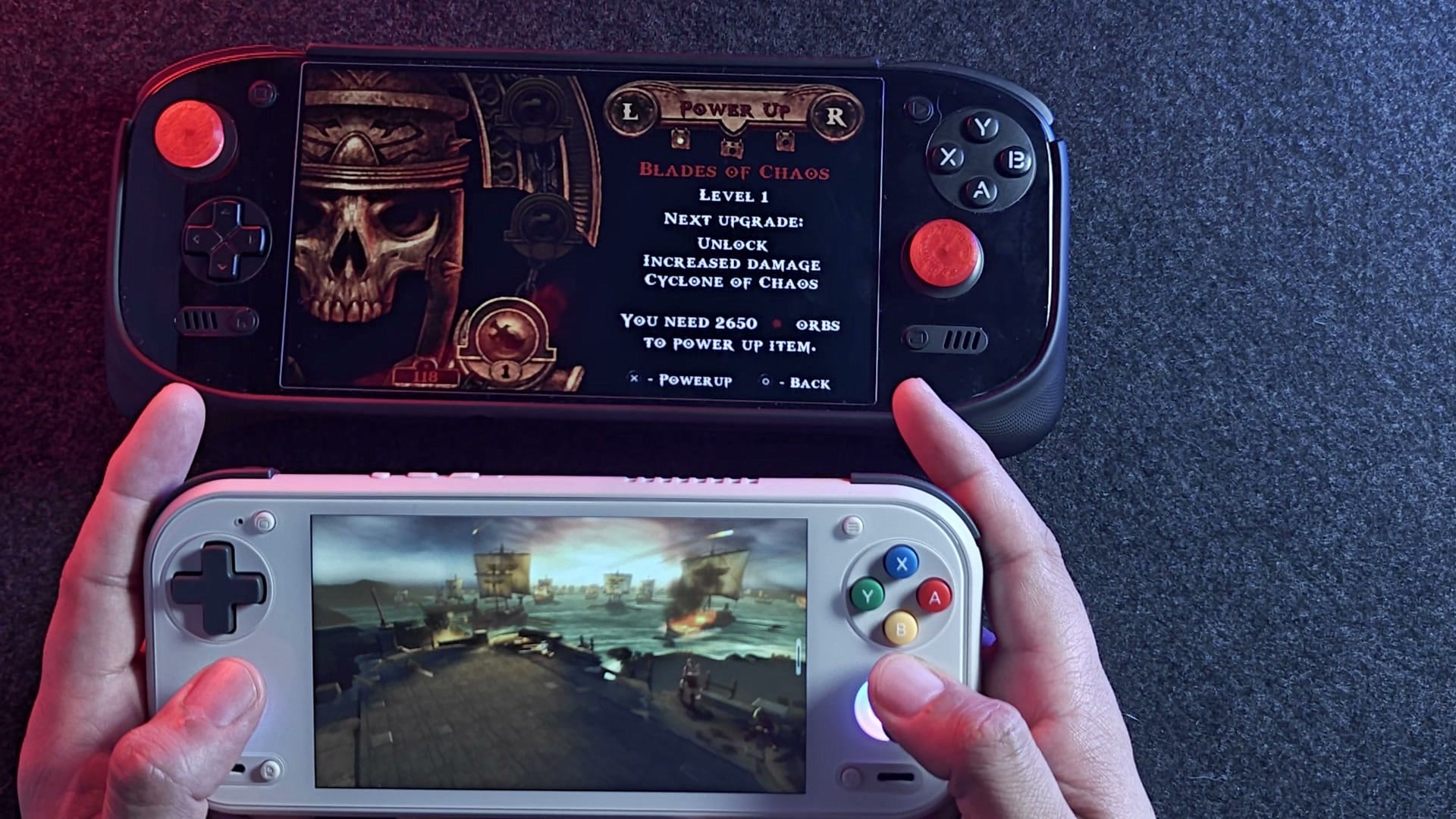
PSP is where the 55G1 shines. I played God of War: Chains of Olympus, one of the more demanding PSP games, at twice the original resolution, and it ran with no issues at all. It has room for 3x or more.
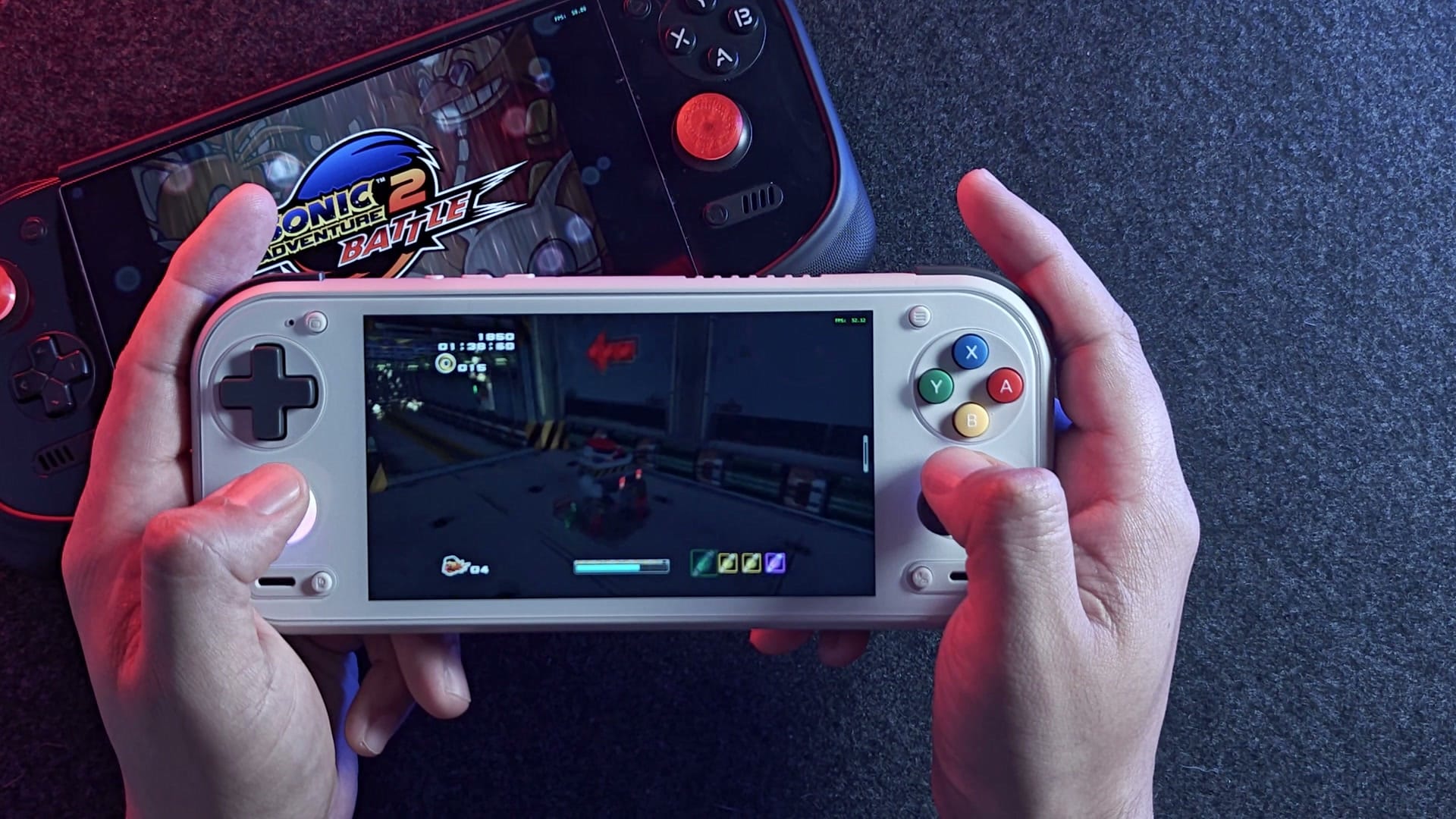
For GameCube I went with Sonic Adventure 2: Battle. The Anbernic ran it at 2x, mostly at a smooth 60 frames per second, and dipped into the 40s when the action got busy. At 3x it couldn’t hold 60. The Odin ran it at 3x without trouble. I still call the 55G1’s dips playable. Anything from 30 to 40 frames per second is good enough for me, though that part is personal. This is a much cheaper handheld with a far weaker chip, so there are trade-offs, and you can still play.
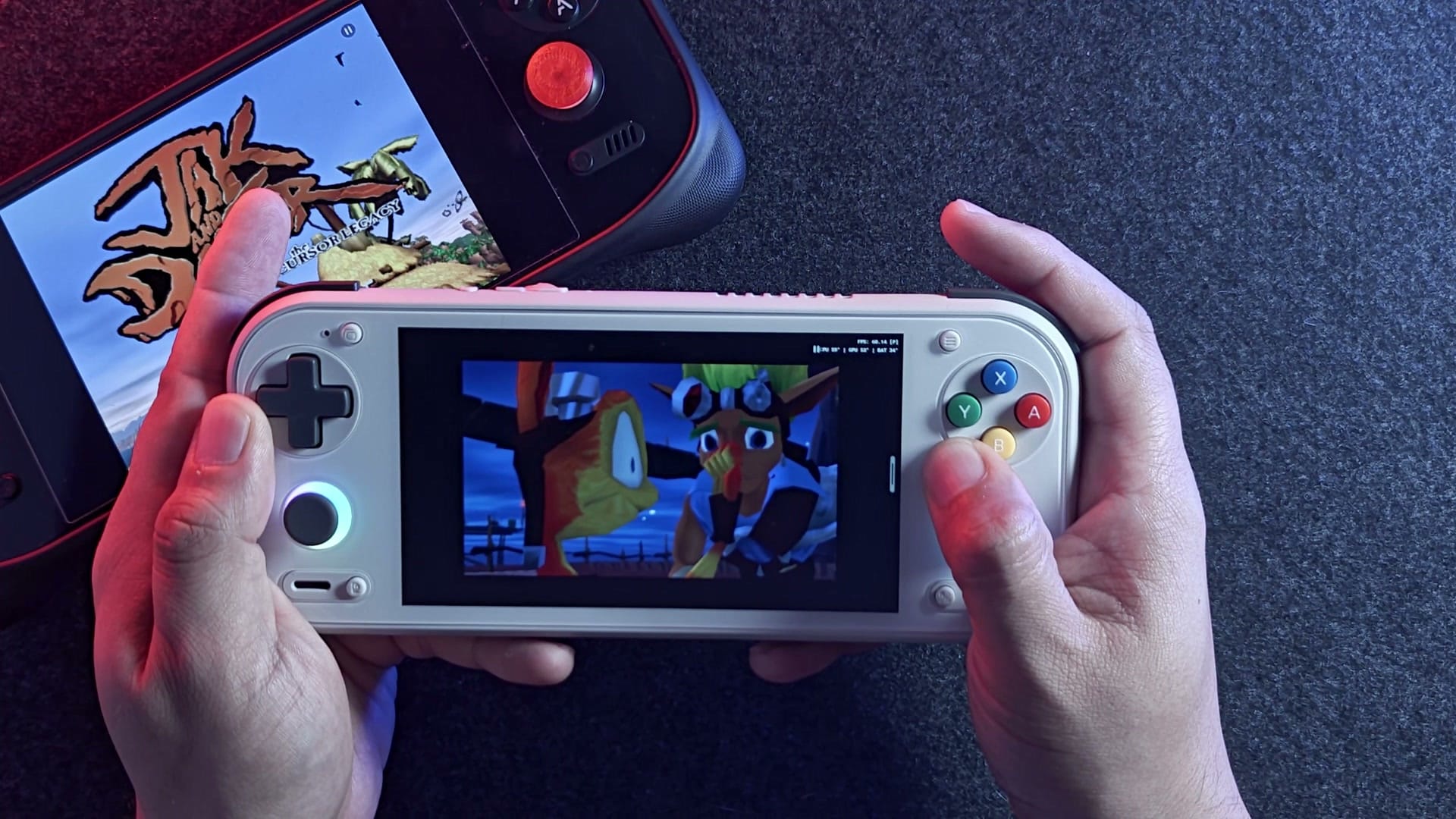
PS2 takes some managing. Jak and Daxter ran fine at 2x, though its opening is all cutscenes, so I never reached real gameplay on camera. For heavier games, native resolution is the setting to use. Shadow of the Colossus is my go-to example: even at native it dips into the 40s, sometimes the 30s, in the heavy action. The God of War games on PS2 behave the same way and drop into the 30s. RPGs are my genre, and the ones I’ve tried run fine at native or even 2x.
So my map of the 55G1 goes like this. Dreamcast and PS1 are no problem at all, most of the PS2 library plays if you’re happy around 30 frames per second in the heavy scenes, and everything above that is off the list.
| System | Game | RG 55G1 | Odin 2 Portal Max |
|---|---|---|---|
| PSP | God of War: Chains of Olympus | 2x, smooth, with room for 3x or more | No trouble |
| GameCube | Sonic Adventure 2: Battle | 2x, about 60 fps, dips into the 40s in action; 3x couldn’t hold 60 | 3x, no trouble |
| PS2 | Jak and Daxter | 2x, fine in the cutscenes I reached | 3x, no trouble |
| Switch | Burnout Paradise Remastered | 9 to 11 fps on the menu: unplayable | Plays it |
Can the RG 55G1 play Switch games?
Not really, and this is where you find the real limit of the chip. I loaded Burnout Paradise Remastered, and sitting on the menu the frame counter hovered between 9 and 11 frames per second. That’s unplayable. I hadn’t even started a race. The Odin plays the same game without a problem. It’s the reason the Odin is my favorite handheld: it handles most of the Switch library, though some of the heaviest games still struggle.
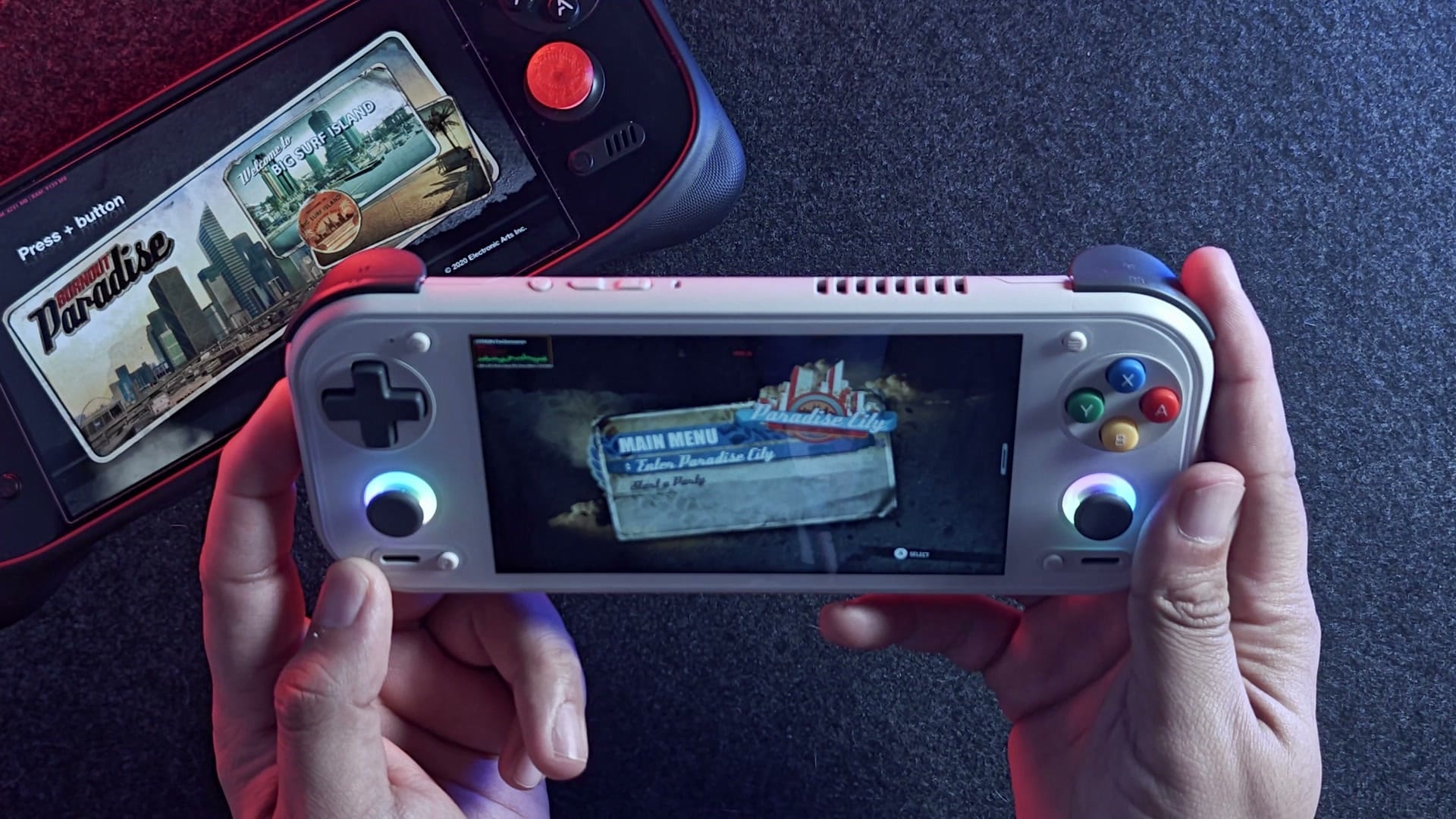
The emulator is part of the story. Eden, the one I use on the Odin, won’t run on the 55G1 in its main build. Its Legacy build does run, just too slowly to play. So on the Anbernic I used Citron Neo, a 2026 build of the Citron emulator, which works but is finicky about what it runs. Switch emulation also depends heavily on the graphics driver, so I ran Mesa Turnip 26.1, an open-source graphics driver for Adreno chips. Even with that, this is what I got. At this point it’s the hardware.
Light games are a different story. Something like Balatro, or another very lightweight Switch game, plays fine enough, and I wouldn’t say much more than that. So even though the 55G1 looks like a Switch Lite, it isn’t a Switch emulation machine. PS3 is a no-go too.
How long does the battery last?
About 8 hours on the Anbernic and about 10 on the Odin, playing PSP games under the same conditions. The Odin carries the bigger battery, and it charges faster too.
Treat those as a guide. Everything moves battery life: the resolution you upscale to, whether the LED rings are on, how hard the fan ramps up, and how well optimized your emulator is. What I can say for sure is about the systems I play most, Dreamcast, PS2 and Switch. On the Odin, all three have always given me at least three hours. I can’t say the same about the 55G1, since it doesn’t really play Switch, and I haven’t put it through that kind of use yet. The Odin has come with me on work trips and seen far more hours in my hands, so my experience with it simply runs deeper.
Should you buy the Odin 2 Portal instead?
If you can find the extra money, yes. It’s about $85 over the 55G1’s list price, closer to $100 against its sale price. At launch, even the cheapest Odin 2 Portal was $349, twice what the Anbernic costs, so they lived in different classes. Today the Base is $259. AYN reportedly stopped making the Odin 2 line, the Base is the only tier left in stock, and my guess is that price is clearance, even though AYN doesn’t call it that. Either way, that extra money buys the same chip as my Max: PS2 at 3x, most of the Switch library, and some PS3 games. At $259, that’s the way to go.
If $175 is the limit, the 55G1 is still a very good value for what it plays. I’d wait for a sale if you can. It’s already a little cheaper on Anbernic’s store, and shipping adds to the price of both.
There’s a newer Odin on the way too. I pre-ordered the Odin 3 Portal, and it hasn’t reached me yet. It has more power than the Odin 2 Portal, and it starts at $399, so it changes the question completely, at a much higher price.
Is the Retroid Pocket 5 a better buy?
If raw power is what you’re after, it’s the one to look at. In the video I said I couldn’t think of another handheld under $200 that performs like this on a different chip. I missed two. The Retroid Pocket 5 is $179 on sale and the Retroid Pocket Flip 2 is $189, and both run the Snapdragon 865, an older flagship chip that’s stronger than the 55G1’s. If you go with the Flip 2, get the version with 12GB of memory and that chip. Both are worth weighing against the Anbernic before you buy.
Who is the RG 55G1 for?
Someone who mostly plays PSP, PS1, PS Vita or PS2 and knows the heavier PS2 games will struggle at points. For that player, the 55G1 delivers, and you may not need what the Odin costs.
If you want PS3, Switch or PC games on Android, you’d be better served by a handheld with a higher-end chip. And if you want one Android handheld that plays it all, expect to pay upwards of $400 once shipping and tax are in. It’s the same point I made in my $400 vs $2,400 handhelds piece: what you need and what you want are different things. Wanting a higher-end device while your budget only covers a lower-end one is very real, and I respect that.
The good news is that the handheld scene has matured to the point where there’s an option for nearly every kind of player. Start with the consoles you love and the games you actually want to replay, and pick the handheld that fits those.
On the shelf
Retro handheldsSee the whole story →Nerd Alert
Your Turn
What are YOUR thoughts
What have your experiences been? Let us know.