News / News · News · PC Hardware · Benchmarks
ASUS ROG NUC 16 Puts an RTX 5080 in a 3-Liter Mini PC for $3,699
ASUS’s ROG NUC 16 pairs Intel HX chips with up to an RTX 5080 laptop GPU in a 3-liter case, or an RTX 5090 in the limited Edition 20. Prices, what reviewers found, and how it compares with Strix Halo for gaming.
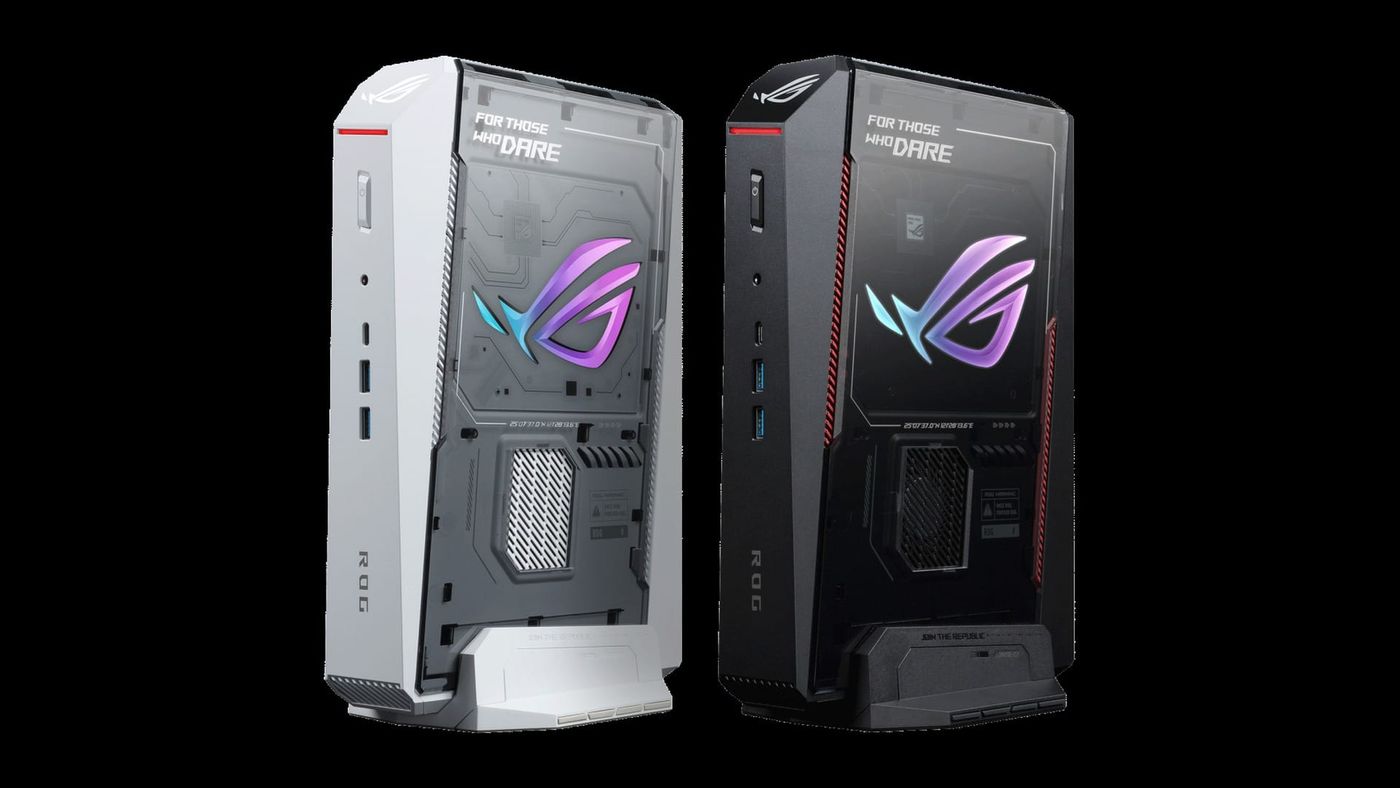
A gaming PC with an RTX 5080 laptop GPU that fits beside a monitor is the pitch of ASUS’s ROG NUC 16, and Techgoondu’s review published today adds another set of test results to the ones already out. The machine has been on sale in the US since the summer, from $2,499 to $4,999 on ASUS’s store. Readers following the Ryzen AI Max+ PRO 495 mini PCs covered on this site will find it answers a different question: what a separate graphics chip buys in a similarly small box.
UPDATE What’s new since publishing
ASUS dressed the ROG NUC 16 up for S-GAME’s Phantom Blade Zero, which launches October 29, as part of a six-piece ROG collection announced October 19. Underneath the new paint and front panel it’s the same machine covered here: the same Core Ultra 9 290HX Plus, ports, chassis and cooling. The one new option is an RTX 5070 configuration that ASUS’s US line doesn’t offer. ASUS China sells it from ¥24,499 with the RTX 5070, 32GB and 1TB, and the RTX 5080 version with 2TB is reported at ¥31,499. There’s no game in the box, and ASUS hasn’t given a US price or date; the NUC isn’t on the collection’s US pre-order list.
How much is the ROG NUC 16?
$2,499 to $4,999 for the four standard models on ASUS’s US store, all with Windows 11 Home, plus a limited edition. The RTX 5080 model at $3,699 pairs the Core Ultra 9 290HX Plus with the RTX 5080 laptop GPU, its 16GB of graphics memory and a 1TB SSD. The $2,499 entry model steps down to an RTX 5060 and the Core Ultra 7 270HX Plus, and gets a smaller 280W power adapter where the others get 380W. The RTX 5080 price has slipped since launch: Notebookcheck reported it at $3,799 on Amazon in August. The limited ROG NUC 16 Edition 20 tops the line with a see-through case, gold accents and an RTX 5090 laptop GPU with 24GB, which Notebookcheck reported at $5,999 in June.
| ASUS US model | Processor | Graphics | Memory and storage | Price |
|---|---|---|---|---|
| RNUC16JNK7X589AU | Core Ultra 7 270HX Plus | RTX 5060, 8GB | 2x 16GB, 1TB | $2,499 |
| RNUC16JNK9X389AU | Core Ultra 9 290HX Plus | RTX 5070 Ti, 12GB | 2x 16GB, 1TB | $3,199 |
| RNUC16JNK9X289AU | Core Ultra 9 290HX Plus | RTX 5080, 16GB | 2x 16GB, 1TB | $3,699 |
| RNUC16JNK9X2AAAU (white) | Core Ultra 9 290HX Plus | RTX 5080, 16GB | 2x 32GB, 2TB | $4,999 |
What are its specs, and what can you upgrade?
Laptop chips: Intel’s Core Ultra 9 290HX Plus or Core Ultra 7 270HX Plus with an RTX 5060, 5070 Ti or 5080 laptop GPU, and you can upgrade the memory and storage. The Core Ultra 9 290HX Plus has 24 cores, eight performance and 16 efficiency, and a configurable power range of 45 to 160 watts on ASUS’s spec sheet. The top graphics chip is the mobile RTX 5080, which Notebookcheck places close to a desktop RTX 5070 in Time Spy. Both are soldered to the board. The memory and SSDs swap without tools, according to ASUS’s FAQ. The two memory slots take standard DDR5-5600 SO-DIMMs or faster DDR5-6400 CSO-DIMMs of up to 64GB each, for 128GB in all, and every model ships with both slots filled, so going bigger means replacing both sticks. Each of the two M.2 slots, one PCIe 4.0 and one PCIe 5.0, takes a drive of up to 4TB. ALKtech found the included PCIe 4.0 drive in the faster slot under ASUS’s SSD heatsink, so a Gen 5 drive can replace it.
What changed from the 2025 ROG NUC?
Very little. ASUS’s press release promises up to 2.3% better 3DMark performance than the 2025 model, and the Core Ultra 9 290HX Plus takes over from the 275HX, which ALKtech calls essentially a higher-clocked version of the same chip. ASUS also says the cooling covers 12% more of the CPU, and Liliputing notes the stand now detaches instead of screwing on.
How big is it, and what plugs in?
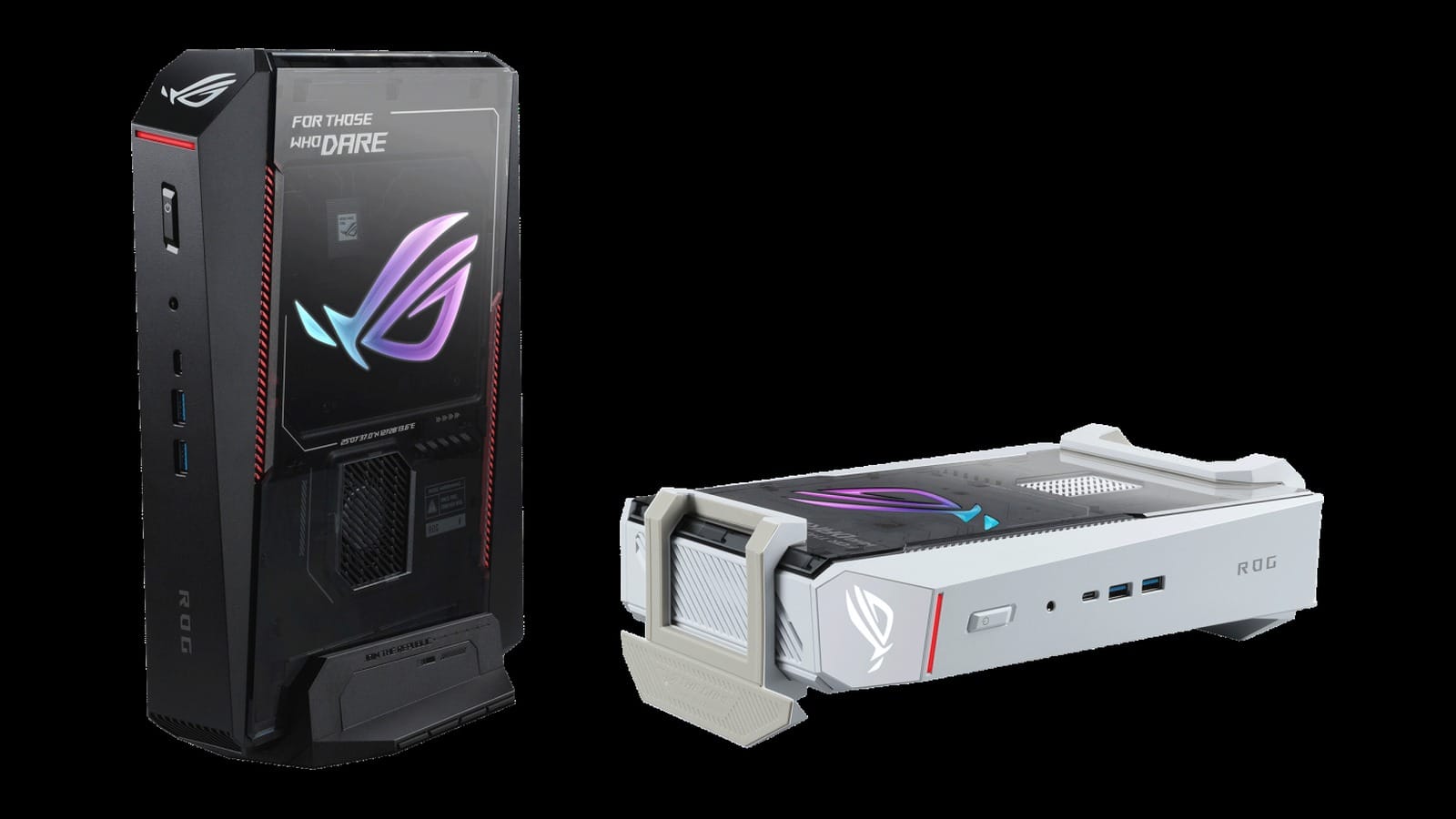
It measures 282.4 x 189.5 x 56.5 mm and weighs 3.12 kg, according to ASUS, and that 3-liter size leaves out the external power brick. You can’t skip the brick either: Techgoondu notes the USB-C port can’t power the unit. A removable stand holds it upright or flat, and ASUS lists no VESA mount among the accessories.
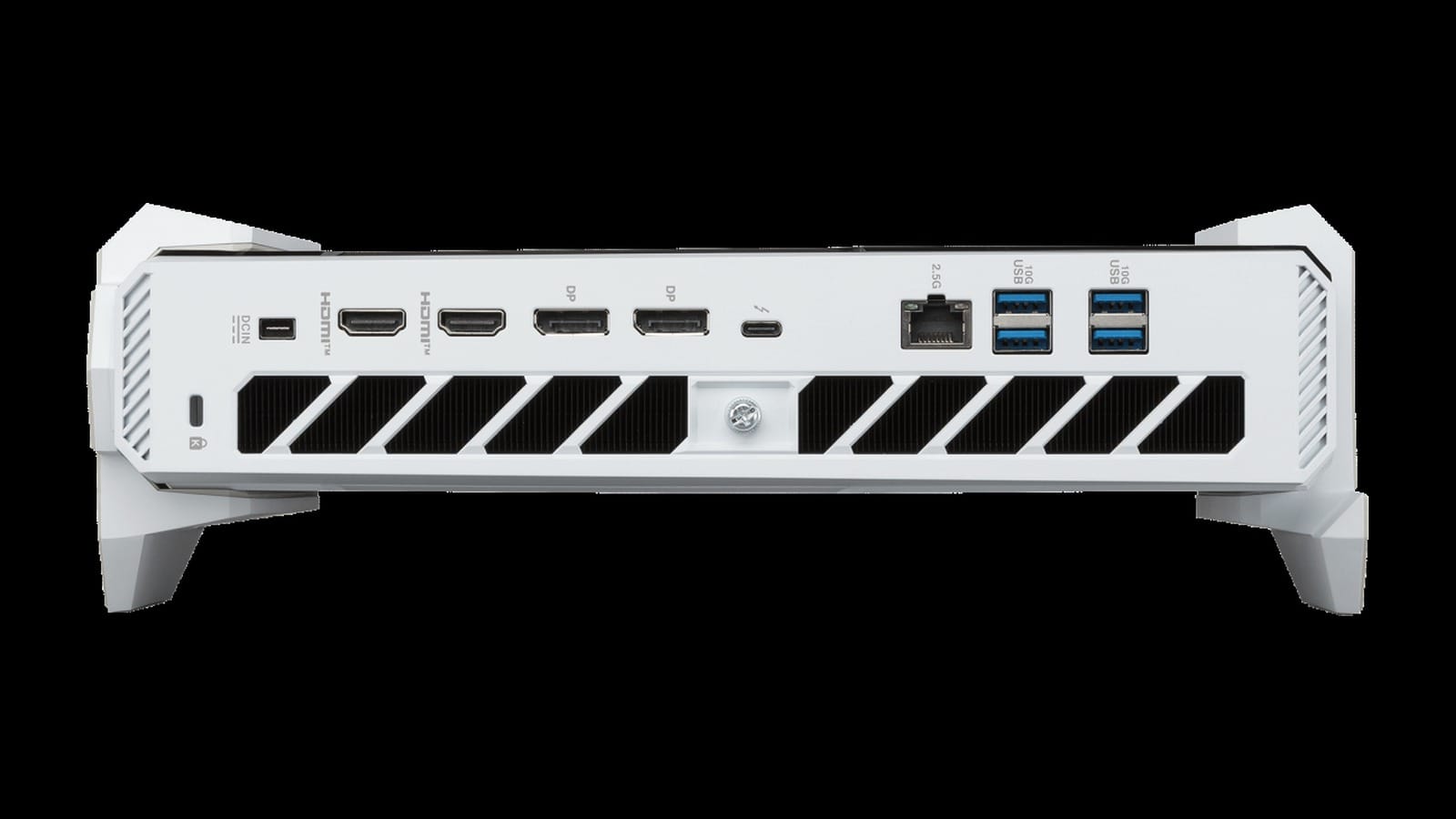
Around the back you get Thunderbolt 4 at 40Gbps, two HDMI 2.1 ports, two DisplayPort 2.1 ports, four 10Gbps USB-A ports and 2.5G Ethernet, plus Wi-Fi 7 and Bluetooth 5.4 for wireless. The front adds two more USB-A ports, a 20Gbps USB-C port and a headset jack, and ASUS says it can drive up to five 4K displays, and that its HDMI 2.1 ports run a TV at 4K 120Hz or 8K 60Hz.
How fast is it in games?
Quick enough that ALKtech rates it best at 1080p and 1440p, with 4K needing DLSS or lower settings. ALKtech’s Aaron Wong tested an RTX 5080 unit with 32GB and a 2TB drive in July, in a room at about 30°C with no air conditioning. Cyberpunk 2077 at 1440p with low ray tracing averaged 92 fps, or 132 fps with DLSS, Nvidia’s upscaling, while Black Myth: Wukong at 4K on High managed 38 fps natively and 78 with DLSS. F1 23 at Ultra High settings averaged 80 fps at 1440p, and Shadow of the Tomb Raider maxed out averaged 96.
Techgoondu’s Wilson Wong benchmarked the RTX 5080 model with 32GB: 21,986 in the graphics test of 3DMark Time Spy, a standard gaming benchmark, and 9,903 in PCMark 10. He sees a gaming machine that also suits photo and video work, though he finds the 1TB drive too small for large video projects and calls the machine solid but expensive at S$5,999 in Singapore. His verdict: it suits buyers who want the performance without the size, while a tower remains the choice for upgrades.
| Reviewer | Configuration | Key findings |
|---|---|---|
| Techgoondu (Wilson Wong) | 290HX Plus, RTX 5080, 32GB, 1TB | 3DMark Time Spy 21,005 overall, 21,986 graphics; PCMark 10 9,903; Geekbench 7 2,689 single-core, 23,602 multi-core |
| ALKtech (Aaron Wong) | 290HX Plus, RTX 5080, 32GB, 2TB | Cyberpunk 2077 at 1440p, ray tracing Low: 92 fps native, 132 fps with DLSS; Black Myth: Wukong at 4K High: 38 fps native, 78 fps with DLSS; CPU up to 104°C, GPU about 173W in F1 23 |
| Tom’s Guide (Anthony Spadafora) | Show-floor demo | Pragmata ran smoothly; no audible fan noise during play |
Does it stay cool and quiet?
It depends on who you ask. ASUS claims it stays below 38 dB(A) under sustained load, using three 102 mm fans and a vapor chamber it says covers 72% of the board, with full contact on the CPU and GPU. A built-in orientation sensor also changes the cooling profile depending on which way the box sits, according to ASUS. ALKtech tested it lying flat, which it understood to cool better than upright.
Tom’s Guide’s Anthony Spadafora heard nothing from the fans while playing Pragmata at ASUS’s Computex event, though a full test was still to come. ALKtech, in that warm room, measured CPU temperatures averaging 82.5°C and peaking at 104°C in F1 23, though it didn’t report whether the processor slowed down. In the same test the GPU held about 173 watts and the CPU averaged 47, about 220 watts between them, under the 380W adapter’s rating. The machine measured 51.9 dB against a 48.7 dB room, and Aaron Wong found it audible while gaming, though he wouldn’t call it noisy. He called the thermals its weak point.
How does it compare with a Strix Halo mini PC?
The RTX 5080 is roughly twice as fast in games, going by Notebookcheck’s averages. Strix Halo is AMD’s Ryzen AI Max chip family, which puts the graphics on the processor itself; it powers mini PCs such as the Framework Desktop and iBuyPower’s Pro AI Halo. The ROG NUC 16 uses a separate Nvidia graphics chip instead. Notebookcheck’s benchmark database runs the same game tests on every machine it reviews, which makes it a consistent yardstick. Here are its averages for the RTX 5080 laptop GPU and the Radeon 8060S, the graphics in the Ryzen AI Max+ 395.
| Notebookcheck average | RTX 5080 laptop GPU | Radeon 8060S (Strix Halo) |
|---|---|---|
| 3DMark Time Spy, graphics | 20,727 | 10,860 |
| Battlefield 6, 1440p | 87.9 fps | 42.7 fps |
| Pragmata, 1440p | about 100 fps | 49.9 fps |
| Crimson Desert, 1440p | about 71 fps | 38.4 fps |
The 8060S results come mostly from laptops and tablets, which run lower power limits than a mini PC, and the RTX 5080 results come from many different laptops. The newer Ryzen AI Max+ PRO 495 doesn’t close the gap: its Radeon 8065S runs about 3.4% faster than the 8060S, and the first 495 tests gathered by VideoCardz showed Time Spy gains of 3.4% to 11.8% over 395 machines. Apply even the larger gain to Notebookcheck’s 8060S average and the RTX 5080 still leads by about 1.7 times in Time Spy. Techgoondu’s 21,986 for the ROG NUC 16 sits close to Notebookcheck’s RTX 5080 laptop average.
What about the $2,499 RTX 5060 model?
It’s roughly level with Strix Halo. Notebookcheck places the laptop RTX 5060 just ahead of a laptop RTX 4070 in synthetic tests and the Radeon 8060S between a laptop RTX 4060 and 4070, and in its game comparisons the two trade wins. The RTX 5060 also has only 8GB of video memory of its own.
Where does Strix Halo win?
Memory. The RTX 5080’s 16GB caps the size of a local AI model it can hold entirely on the graphics chip. Even the Edition 20’s RTX 5090 stops at 24GB. A 495 machine shares 128GB or 192GB between the processor and graphics, which is why those boxes are pitched at large AI models. On price they’re close: the RTX 5080 ROG NUC 16 at $3,699 sits just under iBuyPower’s announced 128GB 495 model at $3,999.
What’s still unknown?
How it handles heat over long sessions. The two noise and heat reports so far came from a show-floor demo and a 30°C room, so more full reviews in normal conditions will settle it. None of the written reviews include frame generation results yet, so how close it gets to a 4K TV’s 120Hz is open too. The RTX 5080 price has already dropped once since launch and may move again. And a head-to-head test against a 495 mini PC, on the same games and settings, would put a firmer number on the gap than database averages can.
Beautiful, but the value is a wash at $2,500
This is a beautiful piece. It’s aesthetically pleasing, it looks nice, and it has the power to deliver. But the value proposition continues to be stripped away by how high prices are. I mean, the $2,499 RTX 5060 model trades wins with Strix Halo in games, and that’s what my X2 Mini Pro runs, for about the same money. So at $2,500 each, the value proposition is about the same, except one is portable and one is not. The RTX 5080 model is a class above, but that one starts at $3,699.
Nerd Alert
Your Turn
What are YOUR thoughts
What have your experiences been? Let us know.